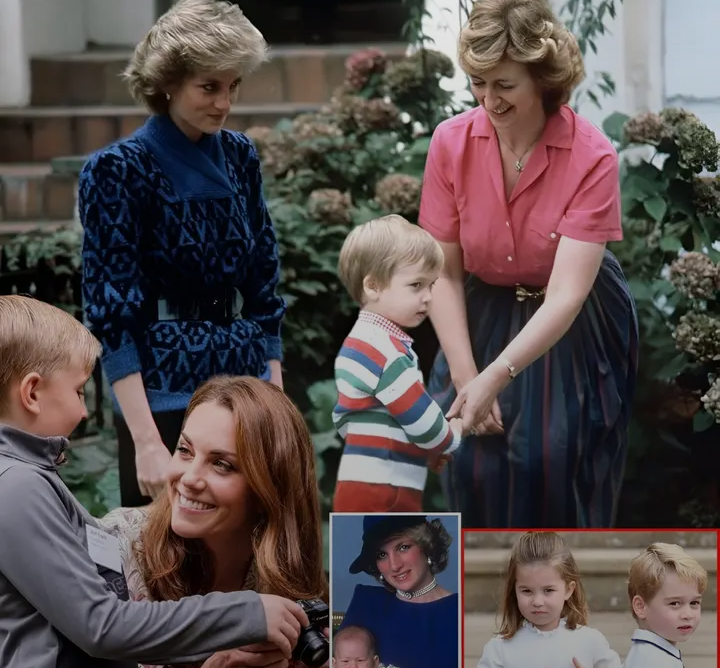
At first, it looks simple. Almost ordinary.
A mother’s hand reaching for her child’s.
A subtle lean inward.
A quiet instinct to shield, to guide, to reassure.
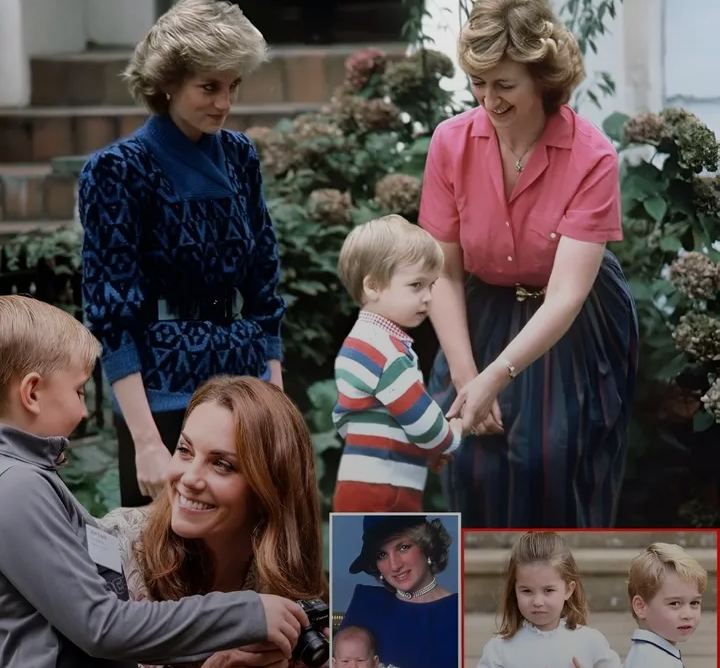
But for millions of people — especially across the United States — this royal moment felt anything
but ordinary.
Because we’ve seen it before.
Decades apart, in photographs that now seem to speak to each other across time, Princess Diana and Princess Catherine appear locked in the same unspoken language of motherhood. Different clothes. Different decades. Different worlds. Yet the gesture is unmistakably the same.
And once you notice it, you can’t unsee it.
Why This Moment Stopped Americans Mid-Scroll
The British monarchy often feels distant to American audiences — wrapped in ritual, titles, and history that can seem foreign. But this moment cut through all of that.
It wasn’t about crowns.
It wasn’t about power.
It wasn’t even about royalty.
It was about motherhood.
And motherhood, in its quiet, protective form, is universal.
For American readers — particularly those who raised children long before social media documented every second — this image unlocked something deeply personal. It reminded them of school drop-offs, crowded public places, and that instinctive hand-reach when the world feels too big for a child.
This wasn’t nostalgia for royalty.
It was nostalgia for life.
Diana’s Silent Rebellion, Revisited
To understand why this comparison matters, we have to return to Diana — not the icon, not the legend, but the mother.
Diana’s gestures were never accidental. Holding her sons’ hands in public, crouching to their level, leaning inward during official events — these were quiet acts of defiance. She was telling the world that her children were
human first, royal second.
In an institution defined by distance, Diana chose closeness.
And America noticed.
For a generation of Americans who watched Diana in real time, her parenting felt revolutionary. She showed affection openly. She rejected emotional stiffness. She insisted that her sons experience real life, not just royal life.
Her message was simple but radical:
Love does not weaken authority. It humanizes it.
Kate’s Gesture — Familiar, Yet Different
Now, decades later, Catherine makes the same movement.
Not loudly.
Not dramatically.
But deliberately.
When she reaches for her child’s hand — especially Princess Charlotte — it feels less like performance and more like inheritance. Not of power, but of wisdom.
Kate does not need to rebel the way Diana did. The world has changed. The monarchy has learned. But the instinct remains.
Protect first.
Explain later.
For American audiences, this distinction matters. It suggests growth — not replacement. Continuity rather than competition.
Charlotte at the Center of the Echo
There is something especially poignant about Charlotte in these moments.
She stands at an age where childhood begins to loosen its grip — where awareness creeps in, and expectations begin to whisper. She is old enough to notice the cameras, but still young enough to need reassurance.
That is why the gesture feels heavier now.
This isn’t about guiding a toddler through a crowd.
It’s about grounding a child who is slowly realizing the world is watching.
And Catherine’s response is instinctive: I’m here.
The Power of What Is Not Said
Neither woman explains herself.
There are no speeches.
No captions spelling out intent.
No press briefings decoding meaning.
Yet the message travels faster than words ever could.
In the U.S., readers didn’t need royal context to understand it. They recognized the body language instantly. Because it’s the same gesture seen in grocery store parking lots, crowded airports, and school assemblies across America.
It says:
Stay close.
I’ve got you.
You’re safe.
And in a world that feels increasingly uncertain, that reassurance carries weight.
Why Americans Still See Diana in These Moments
Diana occupies a unique place in American cultural memory. She wasn’t just admired — she was
felt.
She cried openly.
She broke rules quietly.
She loved visibly.
So when Catherine mirrors her gesture — even unintentionally — it triggers that collective memory. It’s not about comparison. It’s about continuity of compassion.
For Americans who watched Diana raise her sons under scrutiny, seeing that same tenderness echoed today feels like a promise kept.
Kate’s Quiet Mastery of Public and Private
Catherine’s genius lies in restraint.
She understands the power of symbolism — and the danger of overusing it. That is why her gestures are subtle, not theatrical. Why her images feel intimate, not staged.
In the American imagination, this reads as authenticity.
She isn’t asking to be seen as Diana.
She isn’t rewriting history.
She’s simply honoring a truth Diana lived by.
Children are not props.
They are people.
Motherhood as a Form of Leadership
What many American readers responded to most was th