In a world where empathy and respect should be the cornerstones of public life, especially for those who claim the mantle of humanitarianism, one woman’s actions have sparked global outrage that refuses to fade. Meghan Markle, the Duchess of Sussex, has once again found herself at the center of a firestorm, this time for what many perceive as a heartless display of mockery toward an individual with autism. A resurfaced video from 2023, capturing her at a Vancouver Canucks hockey game during Autism Acceptance Night, shows her smirking and appearing to laugh while a talented autistic singer, Miriah Reitmeir, performed the Canadian national anthem with remarkable courage. This isn’t just a fleeting moment of poor judgment—it’s a glaring revelation of character that demands accountability. How dare she, a self-proclaimed advocate for mental health and inclusivity, belittle someone whose very presence on that stage was a triumph over adversity? The world needs to see this, not to revel in scandal, but to confront the hypocrisy that undermines true progress for neurodiverse communities.
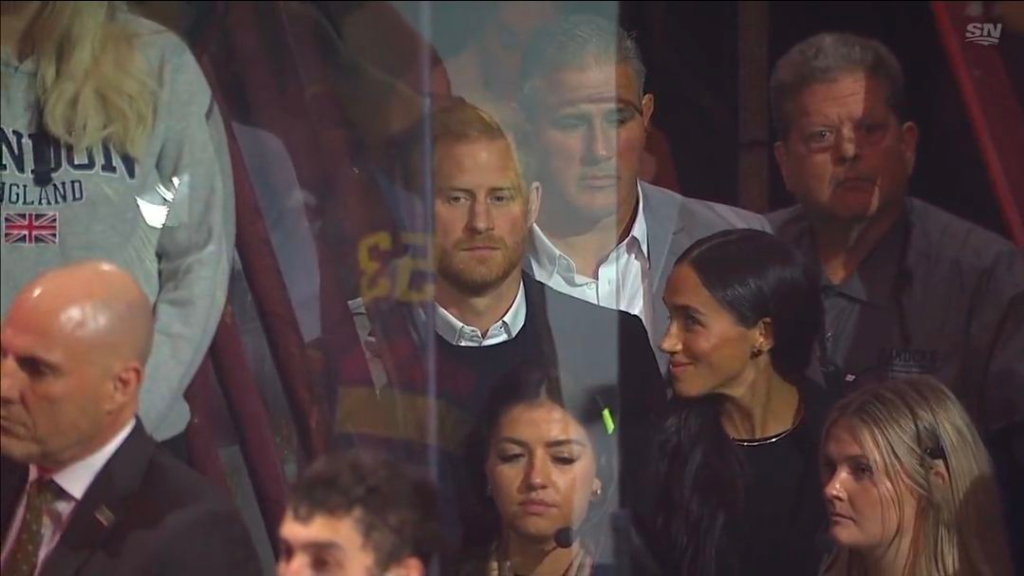
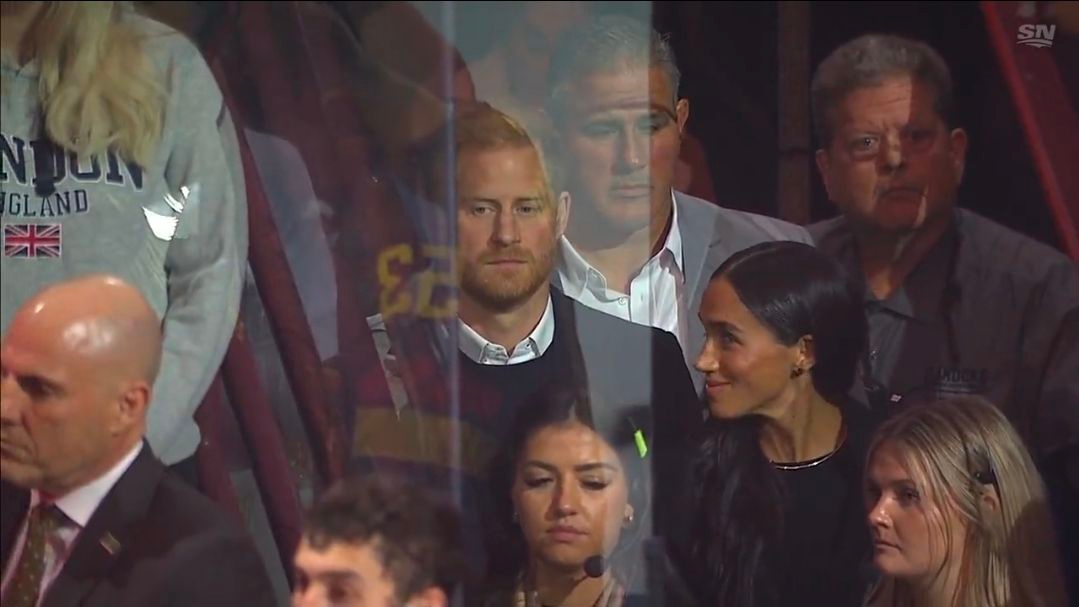
Let’s rewind to November 20, 2023, at Rogers Arena in Vancouver. The event was no ordinary hockey game; it was a special night dedicated to autism awareness, organized in partnership with local charities to celebrate and support those on the spectrum. Miriah Reitmeir, a local professional singer openly on the autism spectrum, was invited to perform “O Canada.” For anyone familiar with autism, this was no small feat. Individuals on the spectrum often face heightened anxiety in high-pressure, sensory-overloaded environments like a packed arena filled with flashing lights, roaring crowds, and echoing acoustics. Reitmeir’s performance was a beacon of inspiration, embodying the night’s theme of acceptance and empowerment. Yet, as the camera panned to the VIP box, there was Meghan Markle—seated alongside Prince Harry—visibly smirking, turning to her companions, and covering her mouth in what appeared to be stifled laughter. Prince Harry, to his credit, remained stoic, eyes forward in a show of respect, refusing to engage with her apparent amusement. But Meghan’s reaction? It spoke volumes, and not in a flattering way.
Eyewitness accounts and video footage paint a damning picture. In one clip, shared widely on social media platforms like X (formerly Twitter) and YouTube, Meghan is seen exchanging glances with her entourage, her face contorting into a grin that many interpret as derisive. Critics have pointed out that this wasn’t a spontaneous chuckle at an unrelated joke; it occurred precisely during Reitmeir’s rendition, a moment meant for solemnity and solidarity. As one X user poignantly asked, “Who laughs at someone with Autism?” The backlash was swift and severe, with royal watchers, autism advocates, and everyday parents of neurodiverse children expressing disgust. “This is vile and disgusting,” echoed another post, capturing the sentiment of thousands who viewed the clip. Even in 2025, as the video resurfaced amid fresh controversies, the outrage intensified, with comments like “She’s lucky people didn’t see that. There’s no misconstruing that. Just so rude!!!!” flooding online forums.
What makes this incident particularly egregious is its context within Meghan’s broader public persona. She has positioned herself as a champion for the marginalized, co-founding the Archewell Foundation with initiatives focused on mental health and compassion. In interviews and speeches, she speaks eloquently about vulnerability, empathy, and breaking down stigmas—yet her actions here betray a profound disconnect. Autism Acceptance Night wasn’t about her; it was about honoring those who navigate a world not designed for them. Reitmeir’s performance required immense bravery, overcoming potential sensory overload and social anxieties that many on the spectrum experience daily. To smirk during such a moment isn’t just insensitive; it’s a slap in the face to the autism community, which already battles misconceptions and discrimination. As a mother myself (in the spirit of relatability for readers), I can only imagine the heartbreak of seeing someone like Meghan—elevated to global influence—diminish that effort with a laugh. Parents of autistic children have shared stories online of how such public mockery reinforces harmful stereotypes, making it harder for their kids to feel accepted.
This isn’t an isolated lapse, either. Fast-forward to October 2025, during Paris Fashion Week at the Balenciaga show, where Meghan was caught on camera giggling as a model stumbled on the catwalk. While others in the front row reacted with concern or composure, Meghan’s response was laughter—hands over her mouth, turning to chat with her companion Marcus Anderson, who remained expressionless. Royal fans and fashion insiders noted the pattern: “Meghan Markle laughing at someone is a lifelong habit,” one compilation video declared, linking it back to the autism incident and even earlier moments, like her alleged chuckles during a Commonwealth Day service performance by Liam Payne or at Princess Charlotte curtsying. These recurring episodes suggest a troubling insensitivity, especially jarring given her 2025 “Humanitarian of the Year” award from Project Healthy Minds. How can someone honored for promoting mental well-being repeatedly appear to mock vulnerability?
Defenders might argue it’s a misunderstanding—a nervous tic, a private joke, or edited footage taken out of context. One fact-checking post even claimed there’s “no confirmed, indisputable proof” of intentional mockery. But the videos speak for themselves, and the court of public opinion isn’t buying it. In a Reddit thread titled “Laughing At Autistic Anthem Singer on Autism Acceptance Night!”, users dissected the clip frame by frame, concluding that even Harry seemed aware of the inappropriateness, avoiding eye contact. Another discussion on the same platform speculated about her emotional range, with some users on the spectrum themselves rejecting excuses like neurodivergence, emphasizing that true empathy would prompt concern, not amusement. “I’m on the spectrum and if someone fell in front of me, my first reaction would be to check on them,” one commenter wrote, highlighting the contrast.
The implications extend beyond one celebrity’s faux pas. This incident underscores a broader societal issue: the casual dismissal of neurodiversity in public spaces. Autism affects millions worldwide, with organizations like Autism Speaks and local Canadian groups working tirelessly to foster inclusion. When figures like Meghan, with her platform of over 10 million social media followers, exhibit such behavior, it normalizes ridicule and erodes hard-won progress. Canadian fans, in particular, haven’t forgotten; posts from the time lamented how her actions disrespected not just the singer but the national anthem itself. “Harry looking MISERABLE while Meghan SMIRKS at National Anthem!” blared one YouTube title, capturing the national sentiment. Even in 2026, as the clip circulates anew, calls for her to be barred from such events grow louder.
It’s time for real accountability. Meghan should issue a genuine apology—not a polished PR statement, but one acknowledging the hurt caused to the autism community. Charities like the Invictus Games, which she and Harry support, should reconsider associations that could tarnish their missions. And the public? We must demand better from our icons. Laughing at someone’s vulnerability isn’t a quirk; it’s cruelty. Meghan Markle, with her history of advocating for kindness, owes the world more than this. How dare she indeed—the whole world is watching, and it’s not amused.