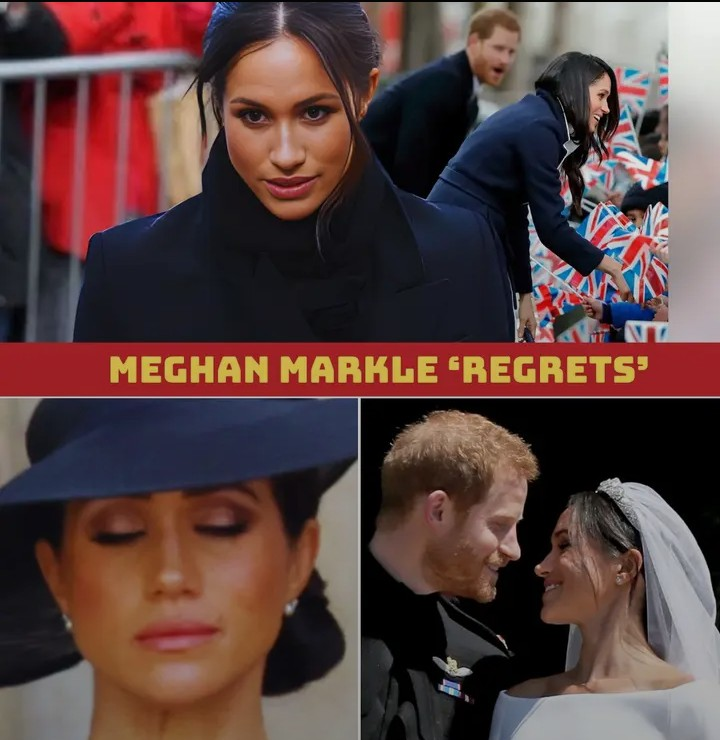
Four years after stepping away from the British Royal Family in a highly public and controversial departure, Meghan Markle is now said to be quietly rethinking how everything unfolded — and, more importantly, how some of her own words may have worked against her.
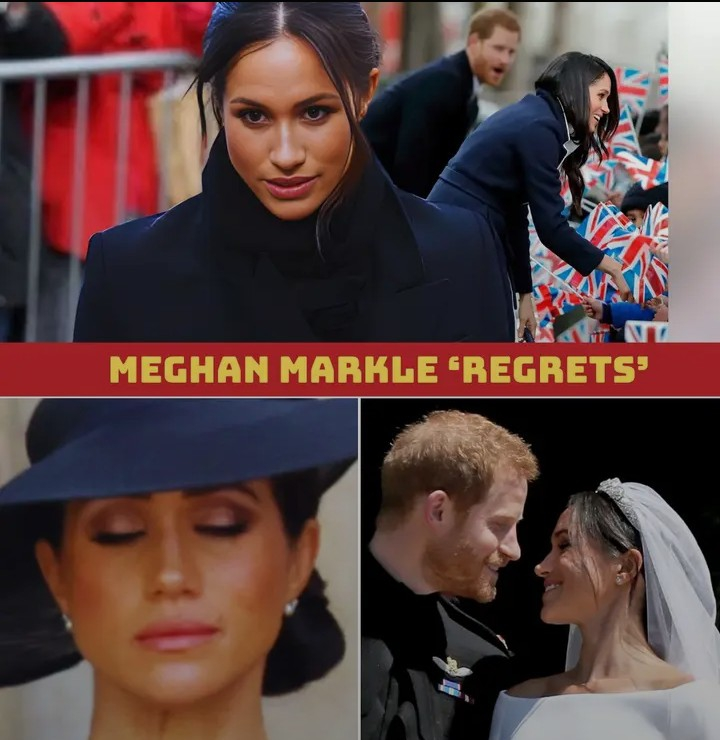
According to royal commentators familiar with the Sussexes’ inner circle, Meghan has begun to reflect on the decision she and Prince Harry made in 2020 to abandon royal life in such a dramatic fashion. While she does not regret leaving Britain itself, she is believed to regret how the departure was handled — and how certain public statements were received.

In particular, several of Meghan’s remarks did not land in the way she had expected. Instead of shaping a lasting conversation around mental health — something she hoped would be the central message — the narrative quickly shifted toward accusations, division and institutional blame. Some of those comments, royal observers say, ultimately backfired.
The fallout from the high-profile interview with Oprah Winfrey proved especially damaging in the UK. What was intended as an emotional testimony instead hardened public opinion and deepened the rift with the Royal Family. For many Britons, the issue was not that Meghan spoke openly, but that deeply personal grievances were aired publicly — leaving the monarchy unable to respond under its long-standing principle of restraint.
Despite speculation, this reassessment does not signal a genuine path toward reconciliation. While Meghan may privately regret the scale and tone of the public fallout, she is not believed to be actively seeking to repair relationships with senior royals. Attempts to re-establish trust have largely failed, and the emotional distance between both sides remains firmly in place.

Those close to the situation describe Meghan’s current life as carefully controlled and selective. Her social circle is small, built around trust and usefulness rather than broad connection. Friends are chosen cautiously, often based on how they align with her personal ambitions and future plans. Privacy and control, rather than reconciliation, appear to be the priority.
This, critics argue, highlights a deeper irony. The Royal Family has long been accused by the Sussexes of prioritising appearances over feelings — yet Meghan’s post-royal life has been meticulously curated, shaped by strategic interviews, brand-building and tightly managed visibility.
For many in Britain, Meghan’s regret comes too late. The royal exit was not merely a personal decision; it was a public rupture. Once private family conflict was transformed into global entertainment — through documentaries, interviews and memoirs — the damage became irreversible.

Royal insiders have long maintained that royal status cannot be separated from royal duty. Prestige, once detached from responsibility, inevitably loses its weight. Meghan’s apparent regret may reflect a growing awareness of that reality.
In the end, leaving the Royal Family was not just loud — it was final. And while regret may now exist behind closed doors, the consequences of that decision remain firmly in the public domain.
For a family built on continuity and discretion, the door does not reopen simply because the noise has faded.