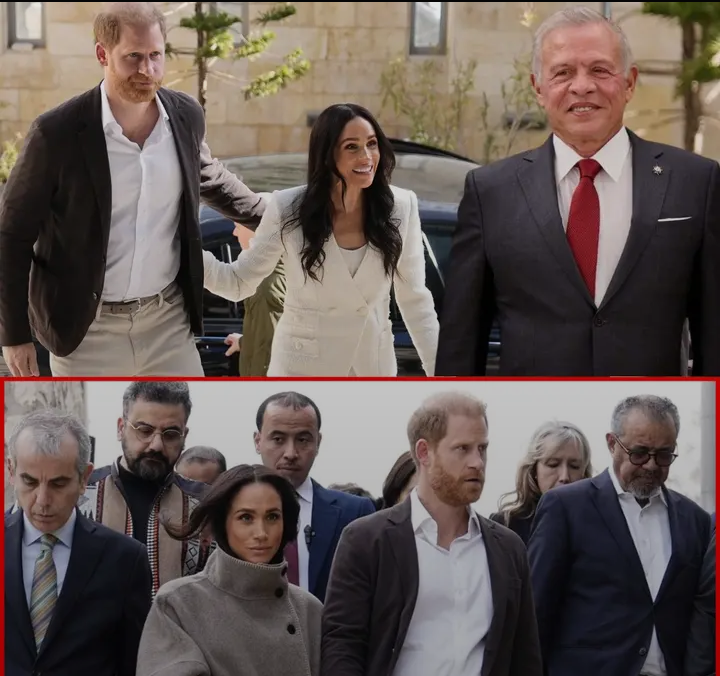
The latest controversy surrounding Meghan Markle and Prince Harry erupted during their recent visit to Jordan, where expectations of high-level royal engagement quickly dissolved into awkward silence. According to reports, there was no scheduled meeting between the Sussexes and King Abdullah II, nor with his heir, Crown Prince Hussein. Instead, official palace communications highlighted the King’s meetings with international leaders and global health officials, leaving Harry and Meghan conspicuously absent from the diplomatic spotlight.Meghan Markle and Prince Harry Make a Semi-Official Trip to Jordan to Visit José Andrés | Vanity Fair
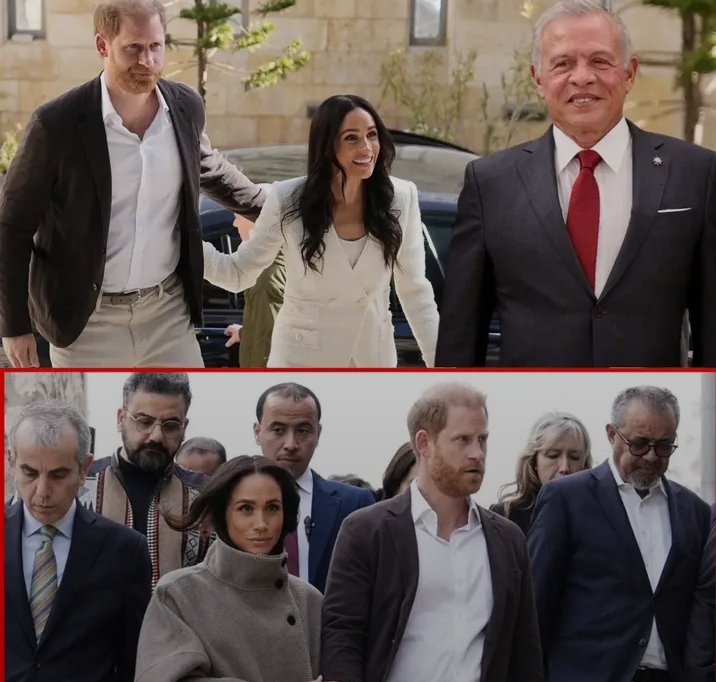
Photographs released by the Jordanian court showed King Abdullah II engaged in discussions with visiting dignitaries, including the head of the World Health Organization. Observers were quick to note that despite Archewell’s previously publicized partnerships in humanitarian spaces, the Sussexes did not appear in any official imagery. The contrast was striking: formal receptions, handshakes, press coverage—yet no trace of the couple whose visit had drawn tabloid anticipation.Meghan Markle and Prince Harry Step Out Together at World Central Kitchen in Jordan
Only a brief interaction with Princess Basma bint Talal, an aunt of the King, was acknowledged during a visit tied to a development initiative. For critics, this detail reinforced the perception that the Sussexes were granted courtesy but not prominence. “In diplomatic language, absence speaks volumes,” one London-based royal commentator remarked during a radio segment, suggesting that modern royal optics are as deliberate as written statements.Harry and Meghan in Jordan is a Humiliation for King Charles
The reaction online was swift and polarizing. Supporters of the couple argued that not every visit requires ceremonial fanfare, and that humanitarian work often happens outside the glare of state protocol. However, detractors framed the situation as symbolic—a sign that the Sussexes’ global leverage has diminished since stepping back from official royal duties in 2020. “Once you leave the institution, you also leave the automatic prestige that comes with it,” noted a media analyst. “International courts tend to prioritize state relationships over celebrity adjacency.”
The backdrop to this episode adds further complexity. The Jordanian royal family maintains longstanding ties with senior members of the British monarchy. Prince William and Catherine, Princess of Wales notably attended the 2023 wedding of Crown Prince Hussein and Princess Rajwa, underscoring a visible bond between the two royal households. Catherine also has a personal connection to Jordan, having spent part of her childhood in Amman when her father worked there. For many observers, these historical and personal links deepen the perception that diplomatic warmth may naturally gravitate toward the working royals who represent the British state.
That context has fueled speculation about whether the Sussexes’ Jordan visit was misinterpreted from the start. Without official royal status, their engagements fall into a gray zone between philanthropy and personal branding. A communications strategist interviewed by a British broadsheet described it as “a structural mismatch of expectations.” In other words, when public narratives anticipate red carpets but receive routine courtesy, the gap becomes headline material.
The phrase “no one cares” has circulated widely in online commentary, though such declarations are often more emotional than factual. The Sussexes continue to command global attention, but attention does not always translate into institutional endorsement. What this episode appears to reveal is not indifference so much as recalibration. International royal houses, particularly in politically sensitive regions, may choose to maintain visible alignment with official state representatives rather than figures who now operate independently.
Still, perception drives modern royal storytelling. The absence of a formal meeting created a vacuum quickly filled by interpretation. Some readers see it as a diplomatic snub; others view it as a routine scheduling matter inflated by adversarial media ecosystems. What cannot be denied is the optics: while global leaders stood beside the King in official photographs, Harry and Meghan did not.
Whether this moment represents a genuine shift in their international standing or simply a misread itinerary remains open to debate. Yet in the highly choreographed world of royalty, visibility is currency. When it disappears, questions inevitably follow. And in that silence between expectation and reality, a narrative of embarrassment was born—one that continues to ripple across headlines long after the visit itself concluded.