In the glittering world of royalty, where every glance, smile, and touch is scrutinized under the microscope of public opinion, two strikingly similar photographs have ignited a firestorm of debate among body language experts, royal watchers, and fans alike. Captured in moments of public duty, these images show Princess Catherine (widely known as Kate Middleton) and Meghan Markle each placing a hand on their husbands’ backs—gestures that, at first blush, appear affectionate. But dig a little deeper, and the differences couldn’t be starker: one radiates partnership and mutual support, the other whispers of dominance and direction. As a royal insider, I’ve seen my share of palace intrigue, and these snaps? They’re telling a tale as old as time—support versus control in the high-stakes game of royal relationships.
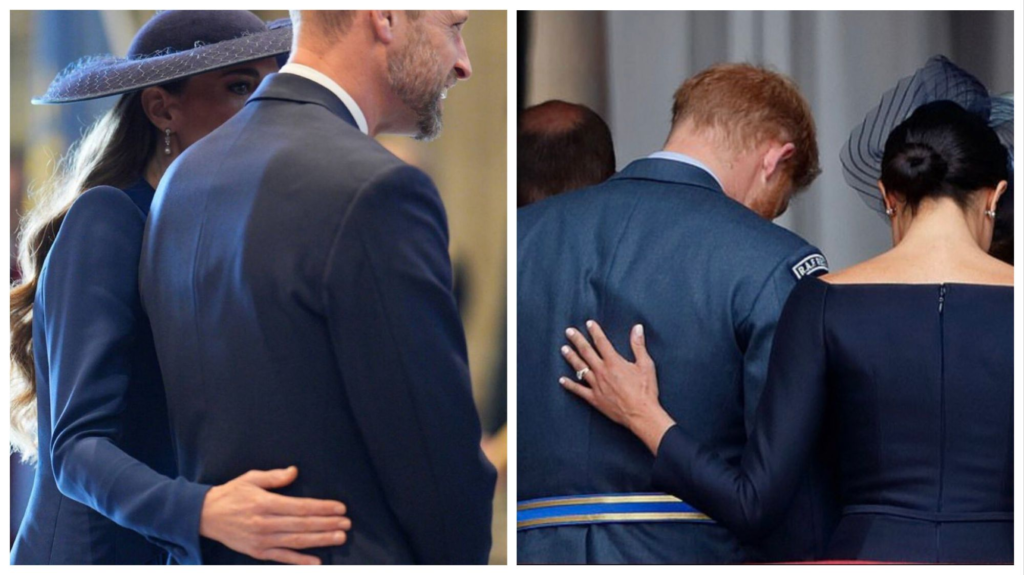
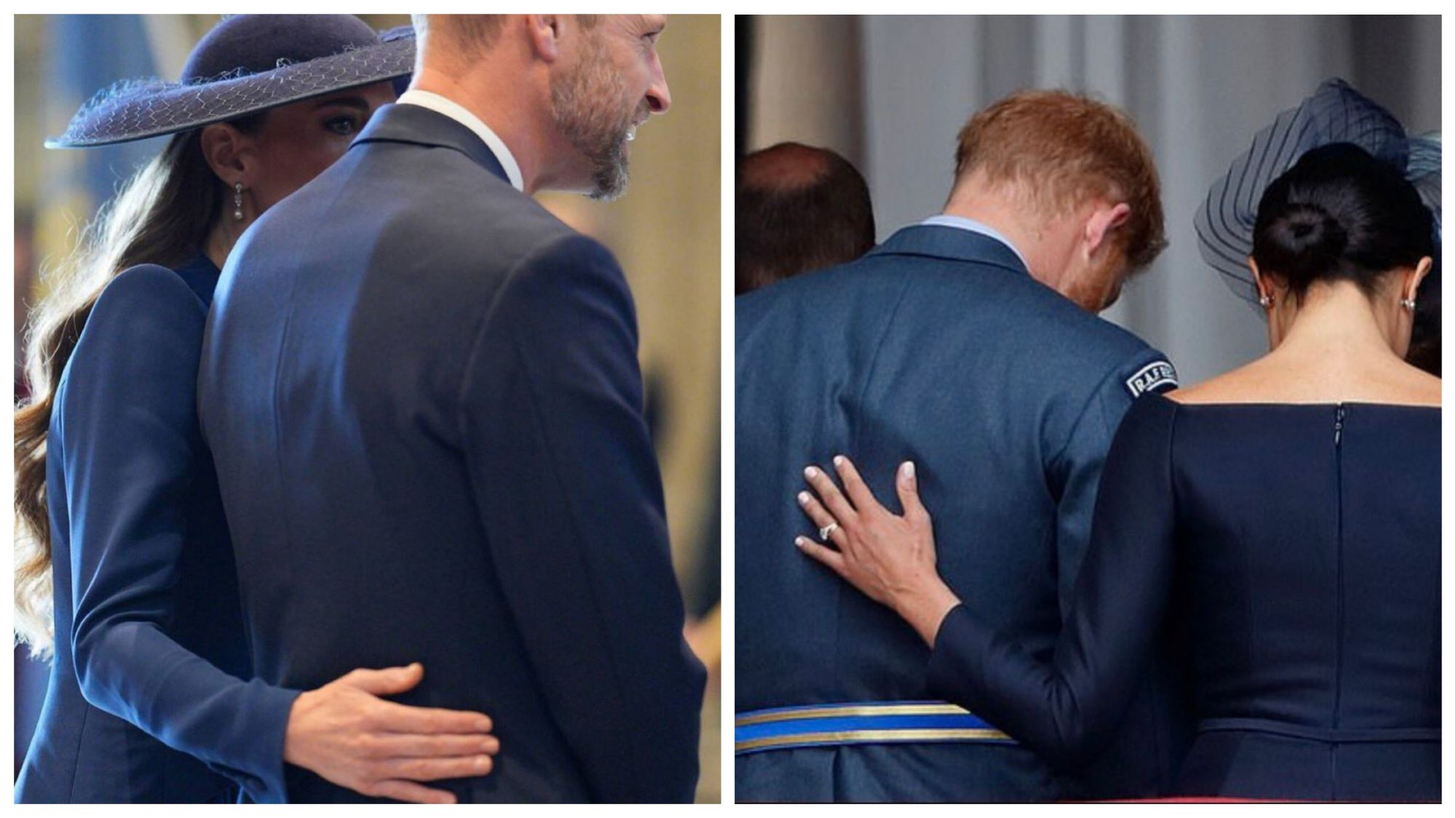
Let’s set the scene. Both couples are dressed in eerily similar navy blue ensembles, with coordinated wardrobe choices that scream “power duo” from afar. The body positioning is almost identical: the wives standing slightly behind their princes, hands gently (or not so gently) placed on the lower back. Yet, according to leading body language analysts, these “twin” moments expose profound contrasts in the dynamics of the Waleses and the Sussexes. Princess Catherine’s arm wraps around Prince William’s waist in a way that’s been hailed as a “gesture of love and support,” while Meghan’s hand on Harry’s back feels more like she’s “pushing him forward and controlling the pace.” Don’t just take my word for it—the experts are weighing in, and the verdict is unanimous: one couple embodies confident equality, the other hints at underlying tension.
Take a close look at the image of Princess Catherine and Prince William. Captured during a solemn event, Kate’s hand rests softly yet firmly on William’s lower back, her arm encircling his waist in a protective, loving arc. Body language expert Judi James, in a detailed analysis, describes such touches as “subtle signals of unity and encouragement,” where the partner is saying, ‘I’ve got your back—literally.'” Here, Kate appears relaxed, her posture open and her expression one of quiet assurance. William, in turn, leans into the moment without resistance, his body language mirroring hers in a natural synchrony that experts say comes from years of shared confidence. As one commentator noted in a viral discussion, “William and Kate walk with confidence as individuals and don’t need to lean on each other, even in difficult situations.” This isn’t about clinging; it’s about standing strong together, a hallmark of their rock-solid marriage that’s weathered storms from media scrutiny to personal health challenges.
Now, contrast that with the parallel shot of Meghan Markle and Prince Harry. Again, navy blues dominate the frame, and the positioning is uncannily alike—Meghan’s hand flat on Harry’s back, fingers splayed in what some interpret as a guiding push. But here’s where the narrative shifts dramatically. Body language specialist Katia Loisel points out that such a placement can indicate “a need to direct or control the situation,” especially when paired with Harry’s forward-leaning stance, which suggests he’s being propelled rather than partnered. In expert analyses, Meghan’s grip has been called a “claw-like hold,” implying dominance over a more passive Harry. Observers on social media echo this, with one popular X post declaring, “Meghan has her hand on Harry’s back in a manner that feels like she is pushing him and controlling him.” Harry’s expression? Often described as “strained” or “unhappy,” a far cry from William’s composed demeanor. This isn’t mere speculation; it’s rooted in patterns seen across their public appearances, where Harry and Meghan’s affection sometimes borders on the needy, reducing stress for Harry but highlighting a dependency that William and Kate seem to avoid.
Why do these images matter so much? In the royal family, where protocol reigns supreme, physical touch is a rare window into private emotions. Historically, royals like Queen Elizabeth II and Prince Philip maintained a stoic distance in public, but modern couples are rewriting the rules—with varying success. Body language guru Darren Stanton notes that while Harry and Meghan often engage in “prolonged eye contact and tactile gestures” signaling deep connection, it can come across as overcompensation. In contrast, William and Kate’s interactions are “more proper and royal,” with subtle cues like mirroring each other’s movements that feel authentic and unforced. Stanton even suggests the Waleses are adopting some Sussex-style PDA, but in a measured way that enhances their image rather than overshadowing it.
Delving deeper into the psychology, these gestures reveal core relationship dynamics. For Kate and William, the waist embrace is a “power equalizer,” says expert Nicole Moore, allowing Kate to show ownership and support without diminishing William’s lead role. It’s a move that’s evolved over their 13-year marriage, from early reserved outings to today’s confident displays. Remember their polo match appearances, where Kate’s arm around William’s arm (a variation on the theme) was dubbed a “romantic gesture of ownership”? It’s all about balance—love without the leash.
On the flip side, Meghan’s back-hand placement has sparked controversy for its perceived intensity. In one expert breakdown, it’s likened to “handling Harry with the claw,” an obsession with control that’s visible in multiple outings. Critics argue this stems from the Sussexes’ more Hollywood-influenced style, where PDA is performative rather than private. As Fox News reported, the “gigantic difference” in body language highlights how William and Kate prioritize duty over drama, while Harry and Meghan’s affection can seem “affectionate but needy.” Even at solemn events like Queen Elizabeth’s lying in state, Harry and Meghan held hands—a break from formality that experts say showed tactile dependence, whereas William and Kate maintained a “poker face to mask their pain,” exuding strength independently.
Of course, not everyone agrees. Some defenders of the Sussexes point to their “united front” as a sign of genuine love, with one X user claiming Harry and Meghan are “always supportive and connected.” But even balanced analyses reveal surprises: Stanton highlights “surprising similarities” like shared eye contact, yet emphasizes William and Kate’s synchronization feels more natural. And let’s not forget the icy undercurrents—clips of Meghan’s body language toward Kate have gone viral, with “icy stares” and “ill at ease” vibes adding fuel to the feud narrative.
As we approach 2026, with the royals navigating post-Megxit realities and Kate’s triumphant return to public life after her health battles, these images serve as a reminder: in the monarchy, actions speak louder than words. Kate’s supportive embrace? It’s the epitome of a modern royal partnership—loving, equal, and enduring. Meghan’s controlling touch? It raises questions about who’s really steering the ship in Montecito. Whether you’re Team Wales or Team Sussex, one thing’s clear: these photos aren’t just snapshots; they’re windows into the soul of the Firm. And right now, the support vs. control debate is hotter than ever. Stay tuned, royal fans—the body language saga is far from over.