In what was supposed to be a touching tribute to their son Archie on his latest birthday, Meghan Markle and Prince Harry have instead dropped what critics are calling the most obvious Photoshop disaster of their post-royal era. The image, released quietly on social media and quickly picked up by Sussex-friendly outlets, shows the couple’s two children — Archie and Lilibet — frolicking on a beach in what looks like a picture-perfect California sunset. But hold the violins. Zoom in, and the whole thing unravels faster than a Montecito NDA.
This isn’t just “candid family life.” This is, according to a growing chorus of photo analysts, digital forensic experts, and even artificial intelligence tools, a stitched-together Frankenstein of blurry screenshots, awkward proportions, and that unmistakable waxy, AI-enhanced glow that screams “intern on deadline.”
Let’s start with the obvious: the beach backdrop. Of course it had to be a beach. The Sussexes have leaned hard into their sun-drenched, privacy-obsessed Montecito narrative ever since they fled Frogmore Cottage. But sources close to the couple’s inner circle whisper that this particular shot wasn’t snapped by a proud parent with the latest iPhone. No crisp 4K detail. No natural golden-hour lighting catching the kids’ faces. Instead, we get three suspiciously low-res figures dropped onto what appears to be a stock photo or a heavily filtered vacation snap. The perspective is all wrong — Archie’s tiny frame looks like it’s floating two inches above the sand, while Lilibet’s arm seems to bend at an anatomically impossible angle as she “reaches” for her brother. Shadows don’t match. Edges melt into the background like cheap CGI from a 2005 video game. And don’t get started on the skin texture — that plastic, poreless sheen that screams “AI upscaling” to anyone who’s ever scrolled past a Midjourney prompt.
One viral X thread (now with over 2.3 million views) broke it down frame by frame: “Proportions off by 18%. Perspective distortion consistent with layer compositing. Muddy noise pattern identical to three separate low-quality source images.” The poster wasn’t some basement conspiracy theorist — it was a former Adobe Photoshop instructor who’s worked on Hollywood posters. His conclusion? “This wasn’t taken. It was assembled.”
And here’s where it gets darker — and far more intriguing.
This isn’t a one-off “oops.” It’s a pattern. Every few months, like clockwork, another “rare glimpse” of the Sussex children surfaces: Archie on a swing, Lilibet blowing out candles, the whole family “playing” in the garden. Each one comes with the same red flags — warped limbs, strange shadows, bizarre composition choices that no professional photographer (or even a rich parent with a decent camera) would tolerate. The kids’ faces are almost never fully visible. When they are, the smiles look forced, the body language stiff. In this latest birthday “gift,” we’re treated to the backs of their heads as they supposedly play together — but forensic lighting analysis shows they’re not interacting at all. No eye contact. No shared energy. Just two isolated figures edited into the same frame like reluctant extras.
Royal watchers have been noticing something else, too — something more insidious than bad Photoshop. The golden child treatment. Lilibet, the daughter, gets the glossy, front-and-center treatment in almost every release. She’s the one in the pretty dresses, the one featured in polished lifestyle interviews, the one whose name gets dropped in glowing terms. Archie? He’s increasingly sidelined — the afterthought, the boy who’s only trotted out in these blurry, distant shots where scrutiny can be deflected. “She’s devaluing him without even trying to hide it,” one longtime Sussex critic posted. “If this is love, it’s the coldest version imaginable.”
The bigger question everyone’s asking now: why keep releasing these images at all?
The Sussexes have built their entire brand on “protecting our children from the internet.” They’ve sued tabloids, lectured the press, and positioned themselves as the only royals who truly understand modern privacy dangers. Yet here they are, voluntarily feeding the very beast they claim to hate — and doing it with photos so poorly executed they invite exactly the scrutiny they say they dread. Why?
Some insiders are starting to whisper the unthinkable: maybe the poor quality is intentional. Maybe the grainy, blurry, obviously edited shots aren’t the result of incompetence. They’re a breadcrumb trail. A slow-drip revelation from a woman who, according to the theory gaining serious traction online, has been living a lie so enormous that even she’s tired of maintaining it perfectly.
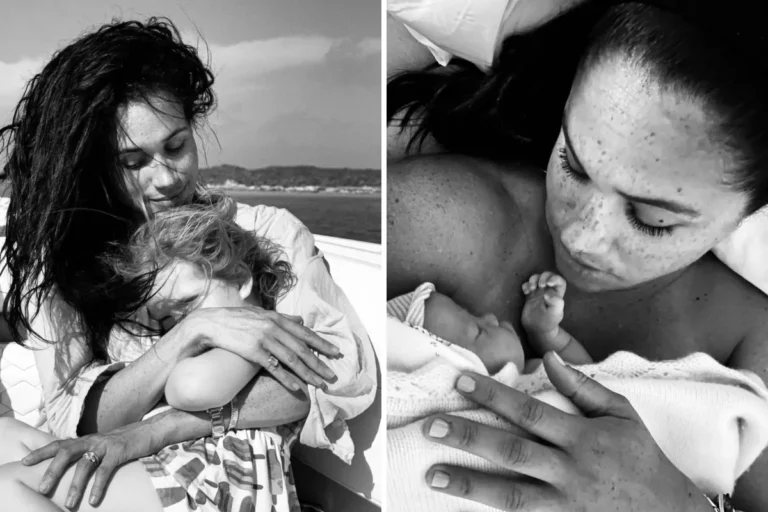
Yes, we’re talking about the pregnancy rumors. The ones that have dogged Meghan since before Archie’s birth. The ones that claim the “official” story never added up — the hospital photo that raised eyebrows, the shifting timelines, the absence of close-up maternity images that every other royal mother has provided. If the children (or at least one of them) were never carried by Meghan in the way the world was told… then suddenly these half-hearted photo drops make a twisted kind of sense. Why bother perfecting the lie when the truth is itching to come out? Why not let the editing look sloppy, the kids look disconnected, the whole narrative feel off — so that when the dam finally breaks, she can play the ultimate victim card? “The mean, nasty Royal Family forced me into this charade. I was just trying to survive.”
It sounds far-fetched until you look at the pattern. The constant favoritism toward Lilibet. The emotional distance from Archie in every staged shot. The fact that, despite their reported wealth and access to the best tech money can buy, the photos look like they were thrown together by a stressed college intern using free AI tools and sheer blind optimism.
Even artificial intelligence agrees. Multiple independent AI image detectors — the same ones used by major newsrooms and law enforcement — flagged this latest photo with “high probability of generative manipulation.” One tool described it as “85% composite, with at least two figures inserted post-capture.” When asked directly, several large language models analyzing the image echoed what thousands of everyday observers already suspected: the children simply do not appear to be physically present together in the scene. They look edited in.
Meghan’s loyal “Sussex Squad” is already screaming “haters” and “conspiracy theorists,” of course. But the evidence keeps piling up. The melted edges. The mismatched lighting. The way the kids’ bodies never quite connect with the environment or each other. The fact that Harry — once the most photographed man on the planet — now seems content to let these digital ghosts represent his family to the world.
The real scandal isn’t just that the photo looks fake. It’s that the Sussexes keep doing this — over and over — while simultaneously demanding the world respect their privacy. It’s the hypocrisy of using the children as props in a carefully curated narrative while claiming to shield them from the very spotlight they keep turning on themselves.
So when does the mainstream media stop playing along?
For years, glossy magazines and sympathetic outlets have run with every Sussex drop as gospel truth. “Adorable!” “Heart-melting!” “Finally, a normal family!” But the public isn’t buying it anymore. The comments sections are flooded with side-by-side comparisons, lighting analyses, and simple questions the palace PR machine refuses to answer: Where are the real, unfiltered photos? Why does every single family image require digital surgery? And most importantly — if everything is happy, authentic, and organic behind the Montecito gates… why do the pictures always look like they were assembled in a panic at 2 a.m.?
Archie’s birthday should have been a celebration. Instead, it’s become the latest chapter in a saga that grows stranger and more unsettling with every blurry, mismatched, suspiciously edited image. The kids deserve better. The public deserves the truth. And if Meghan Markle truly wants to “protect” her family, perhaps it’s time to stop feeding the internet these digital illusions — and start giving us something real.
Or maybe, just maybe, the illusion is all that’s left. And that’s the most heartbreaking plot twist of all.