The Duchess of Sussex has done it again. In a move that has sent royal watchers into a frenzy of disbelief and disgust, Meghan Markle posted photos of herself cradling and kissing the young son of her close friend Kelly McKee Zajfen — and the internet is not having it.
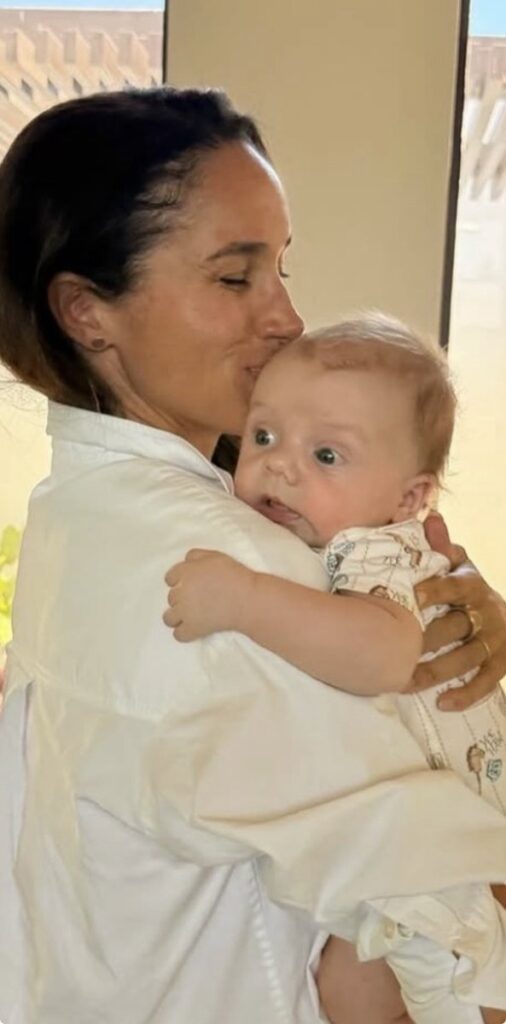
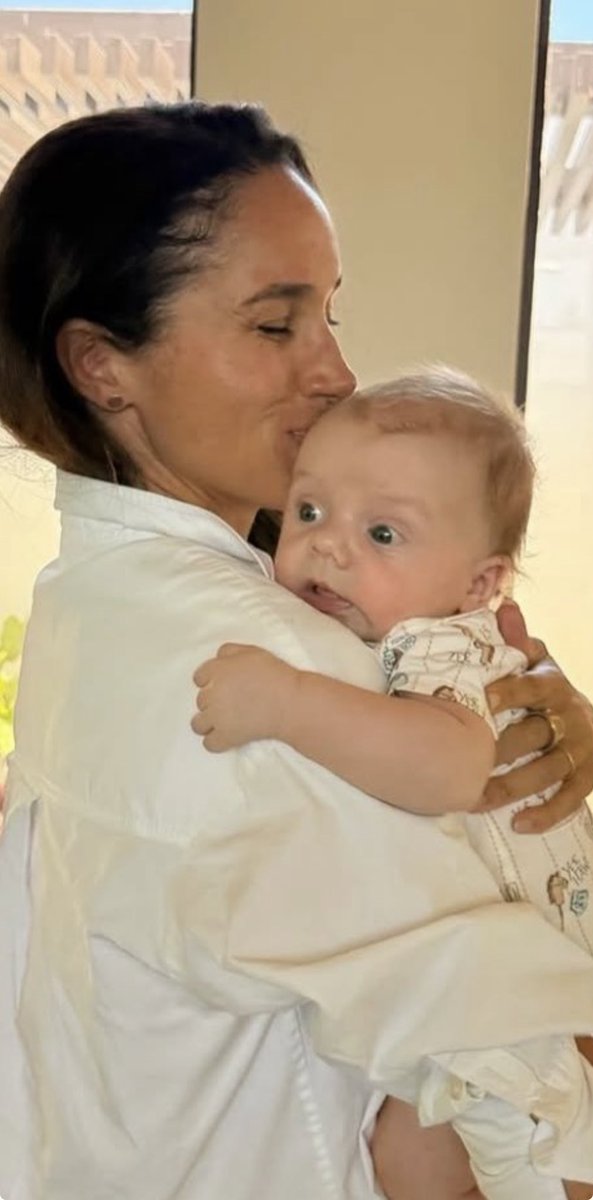
The images, shared across her social platforms, show the 44-year-old former actress in a crisp white shirt, tightly gripping the redheaded baby boy named Jack Oliver. In one shot, she leans in to plant a kiss on the child’s head or cheek. But instead of the warm, maternal glow one might expect, viewers are zeroing in on what critics are brutally calling her “sour lemon face” — a tight, almost reluctant expression that looks more like she’s forcing herself through something unpleasant than enjoying a sweet moment with a friend’s child.
The baby, for his part, appears startled. Wide eyes stare straight at the camera, mouth slightly agape, as if caught off guard by the sudden close encounter. The onesie-clad infant looks anything but relaxed in the duchess’s arms.
Meghan reportedly added a playful caption joking about the baby’s red hair and preemptively shutting down rumors — something along the lines of “We know I love a redhead… no, it’s not his baby.” What was clearly intended as lighthearted banter has instead detonated into a firestorm of accusations about staggering double standards, privacy hypocrisy, and questionable judgment when it comes to other people’s children.
“Still no engagement ring and she’s got a sour lemon face like kissing a baby is icky. Apparently it’s perfectly fine, safe and appropriate to blast someone else’s infant all over a global social media platform, right internet safety for children advocate?”
That brutally direct assessment, now circulating widely, captures the core of the outrage. How can Meghan Markle — who has repeatedly weaponized the narrative of protecting her own children’s privacy at all costs — turn around and plaster another family’s baby across the internet without a second thought?
For years, the Sussexes have hammered home the message that their children, Archie and Lilibet, must be shielded from public view for safety and “normalcy” reasons. They’ve complained loudly about media intrusion, paparazzi dangers, and the need for strict boundaries. Yet here is Meghan, enthusiastically sharing close-up images of a friend’s infant — face fully visible, no blurring, no anonymity — while the baby’s parents apparently had no issue with the global exposure.
Critics are asking the obvious question: If children’s online safety and privacy are so paramount, why does that rule only apply to her kids?
The contrast with the Prince and Princess of Wales couldn’t be starker.
Prince William and Princess Catherine have always been extremely measured with images of Prince George, Princess Charlotte, and Prince Louis. They release a handful of carefully curated photos a year, fully aware that the children are high in the line of succession and that public interest comes with real responsibilities. The Wales family understands the balance — they don’t flood social media with constant snapshots, nor do they treat other people’s children as content props while demanding total privacy for their own.
Meghan’s post has ignited a wave of commentary pointing out this exact inconsistency. Observers noted the baby’s startled expression, questioned the heavy bronzer and tightly pulled-back hairstyle in the photo, and wondered aloud why anyone would think it was appropriate to turn someone else’s child into viral fodder — especially someone who positions herself as thoughtful about children’s welfare.
One viral reaction summed it up bluntly: the only safe way to protect children online is to keep them off social media entirely. Posting other people’s infants while fiercely guarding your own is the definition of “rules for thee but not for me.”
This isn’t an isolated incident — it fits a pattern.
Time and again, the Duchess has shown a selective approach to privacy and boundaries. Whether it’s high-profile interviews, documentaries, or social media moments, there’s a recurring theme of controlling the narrative around her family while showing far less restraint when it comes to others. The latest baby photo has simply poured gasoline on long-simmering frustrations about hypocrisy.
Social media erupted within hours. Thousands of comments flooded in, with users calling the post tone-deaf, inappropriate, and further proof that Meghan operates by a completely different set of rules than the ones she demands everyone else follow. Some pointed out the irony of someone who has spoken about online safety and children’s issues now being accused of casually exposing a baby to global scrutiny for likes and engagement.
The baby’s wide-eyed, slightly alarmed expression in the photos has become meme fodder. “That child looks horrified,” one person wrote. Others joked that the infant seemed to be thinking “What the hell is happening?” as the duchess leaned in with her signature poised-but-uncomfortable smile.
The bigger question now hanging over Montecito:
Is this another self-inflicted PR wound, or does it reveal something deeper about how Meghan views privacy — as a tool to be used when convenient rather than a consistent principle?
Supporters will no doubt argue it was just a sweet moment between friends and that the backlash is overblown. But the sheer volume of criticism, and the speed with which the “hypocrite” label stuck, suggests this one has cut through in a way that’s hard to spin away.
For an audience already skeptical of the Sussex brand, the photo and its fallout serve as yet another reminder of the glaring gap between the carefully crafted image of thoughtful, privacy-conscious parents and the reality of selective standards.
The redheaded baby may have been kissed and posted with the best of intentions. But in the court of public opinion, that “sour lemon face” and the decision to broadcast another family’s child have left a very bitter aftertaste.
Meghan Markle wanted to share a cute moment. Instead, she handed her critics a masterclass in perceived double standards — and they’re not letting it go anytime soon.