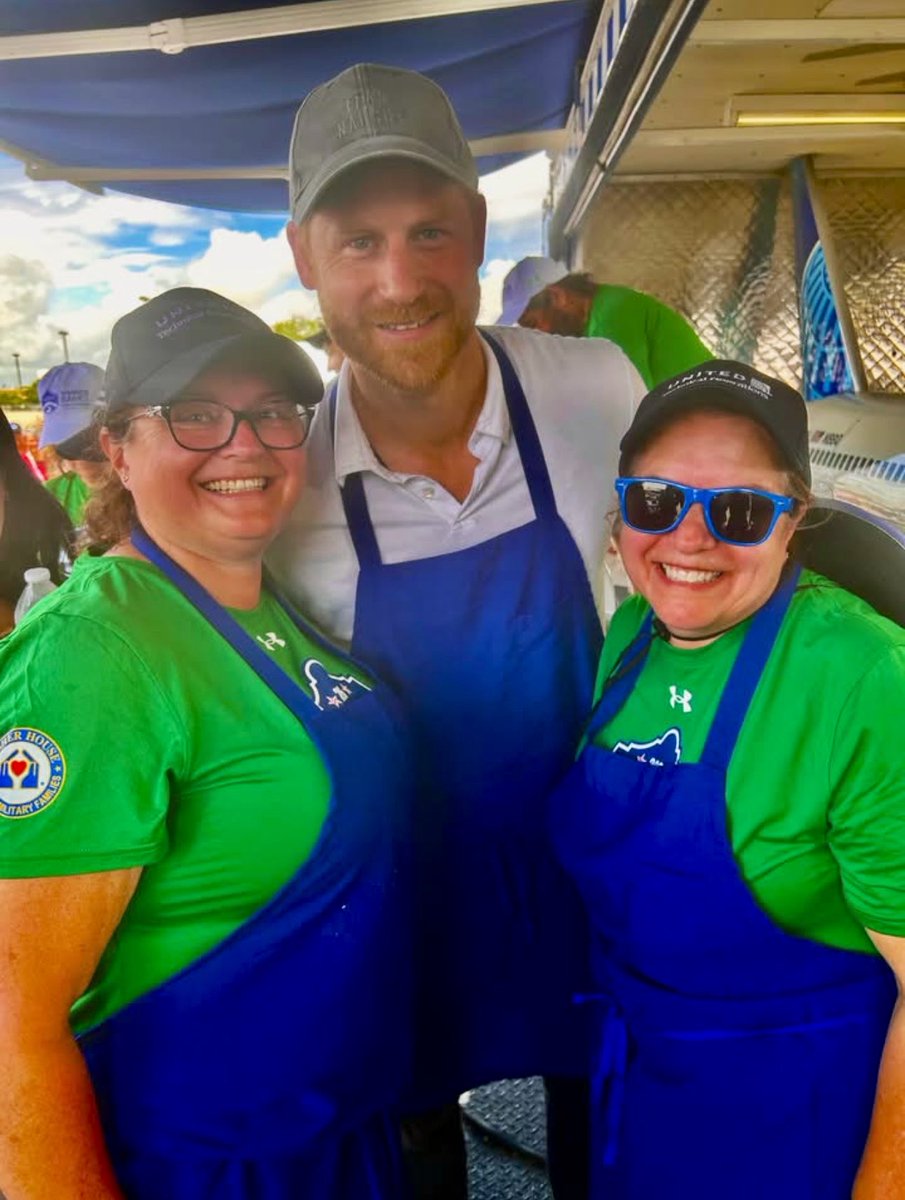
What was meant to be another polished chapter in Prince Harry’s post-royal redemption tour has instead detonated into a social media firestorm. Fresh photos from the U.S. Department of Defense Warrior Games Family Program show the Duke of Sussex grinning broadly while posing with volunteers and attendees — yet the internet is not buying the wholesome narrative. A blistering viral assessment has captured the growing mood: posing for photos with “liar, bully, hypocrite #PrinceHarry is without a doubt nothing to be proud of unless of course those people behave the same way.”
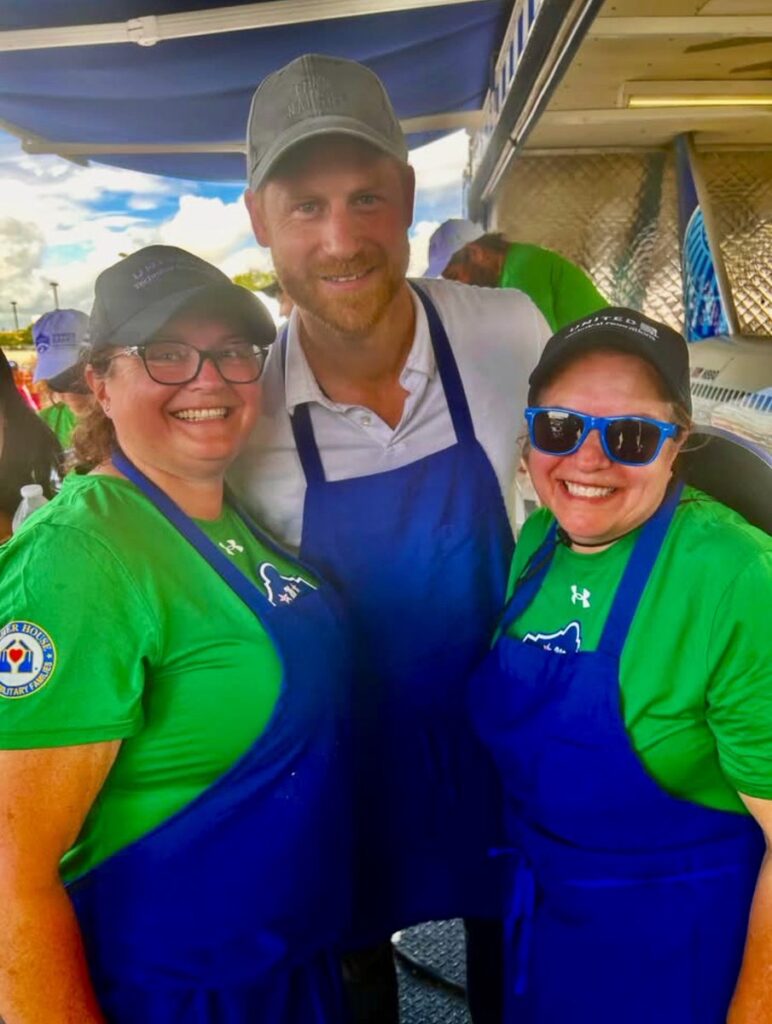
The images, now circulating widely, capture Harry at the 2026 Warrior Games in San Antonio during what officials billed as a low-key, supportive appearance. Instead, they have become Exhibit A in the case against the Duke’s carefully managed public image.
The Photos That Sparked the Outrage
In one striking shot, Harry stands at what appears to be a food service station under a large tent. He wears a gray cap and a blue apron over a white polo shirt, his trademark red beard neatly trimmed. Flanking him are two smiling women in matching green shirts and blue aprons. The woman on his left sports glasses and a black cap; the one on his right wears bright blue sunglasses. Both beam at the camera. Harry leans in with an easy, toothy smile. The backdrop suggests a community or military family support setup, complete with other volunteers in green and the casual chaos of an outdoor event kitchen.
The second image is even more candid. Inside a venue with black curtains and bleachers, Harry poses in a group selfie-style moment. He is again in his gray cap and white shirt, leaning forward with a wide, engaging grin. To his side, a woman in a black polo appears to pull a playful face or gesture animatedly toward the camera, while an older man in a loud Hawaiian shirt flashes a “shaka” hand sign and smiles broadly. Other attendees in caps and lanyards mill about in the background, some smiling, seemingly enjoying the moment.
To supporters, these are the pictures of a compassionate prince still connected to the adaptive sports world he claims inspired the Invictus Games. To a swelling chorus of critics, they are something far less flattering: the latest desperate PR snapshots of a man who fled royal “trappings” only to recreate similar photo-op pageantry on his own terms.
Online Backlash Turns Ruthless
The reaction has been swift and savage. Commenters have zeroed in on everything from the optics of the poses to questions about authenticity and staying power.
“Why are these people smiling like they just won the lottery next to him?” one thread wondered. Others were blunter: “He attracts the fatties,” read one harsh reply, zeroing in on the appearance of the women in the first photo. Another asked pointedly, “How many were plants paid to do this?” and “I wonder how long he actually stayed?” — implying the visit was little more than a quick in-and-out for maximum imagery with minimal genuine engagement.
The sharpest cut came from the original viral post itself, which framed the entire exercise as something fundamentally un-proud. “Isn’t he now doing the exact same thing he said made him feel ‘trapped’ in the RF?” another user added, highlighting the glaring hypocrisy. In his memoir Spare and countless interviews, Harry described royal duties and protocol as suffocating, a system that left him feeling trapped and stripped of freedom. Yet here he is, years later, flying into Texas, donning an apron, posing for endless photos with strangers, and milking the “supportive royal” role for all the positive coverage it can generate.
One commenter summed up the handler question making the rounds: “Question is why is his handler not with him?” — a not-so-subtle reference to Meghan Markle’s frequent absence from these veteran-focused outings, fueling speculation about selective participation in the Sussex brand’s public-facing philanthropy.
A Pattern of Calculated Contradictions
This Warrior Games appearance did not happen in a vacuum. Harry was already in the area after a surprise cameo at Game 5 of the NBA Finals the previous evening, where he was photographed alongside a U.S. Army veteran. Days earlier came the news of his inclusion on TIME’s 100 Most Influential People in Sports list for 2026, largely credited to his founding of the Invictus Games.
Critics see a coordinated charm offensive. The same man who accused the royal family of emotional neglect and institutional racism now positions himself as the compassionate face of veteran recovery — all while jetting between Montecito mansions, high-profile media deals, and selective public appearances. The cognitive dissonance, they argue, is staggering.
Former palace aides have long alleged a toxic environment in the Sussex household, with bullying complaints that made headlines years ago. Harry’s own book painted family members in unflattering terms, leaked details of private conversations, and settled scores in public. The 2021 Oprah interview doubled down on explosive claims that were later walked back or contradicted by evidence. Through it all, the Sussexes have positioned themselves as victims of a cruel system while building a lucrative brand around that very victimhood.
Now, at events like the Warrior Games, the same playbook appears to be in motion: show up for the cameras, collect the warm photos, generate the glowing coverage, then retreat. For many observers, the smiling faces in these latest images represent something sadder than support — they represent people who either don’t know the full record or have chosen to ignore it.
Why the Photos Land So Poorly
The Warrior Games are a legitimate platform honoring wounded, ill, and injured service members through adaptive sports. Harry’s 2013 attendance as a young prince reportedly inspired Invictus. That origin story is well-documented. What has changed, critics insist, is the authenticity of his involvement and the relentless self-promotion layered on top.
When the man who once decried royal photo calls and “performance” now stages his own version — complete with aprons, thumbs-ups, and group selfies — the eye-rolls are audible. When he lectures the world about mental health and compassion while former staffers describe a different reality behind closed doors, the disconnect becomes impossible to unsee for a growing audience.
The viral reaction to these specific photos reveals a deeper fatigue. People are tired of the curated narrative. They are tired of the hypocrisy. And they are increasingly unwilling to let smiling snapshots rewrite a well-documented history of contradictions, family betrayals, and selective outrage.
The Bottom Line
Prince Harry may continue to collect positive headlines and influencer-style photo ops at events like the Warrior Games. He may even earn another glossy magazine list or two. But the court of public opinion — at least the vocal segment now dominating these conversations — has rendered its verdict on these particular images.
Posing next to him, they say, is nothing to be proud of.
As the Warrior Games continue through June 20 in San Antonio, the photos will keep circulating and the debate will rage on. One thing is already clear: the carefully constructed image of the compassionate, post-royal Harry is cracking under the weight of his own contradictions — and these latest snapshots may have just accelerated the process.
For the growing number of people who see through the performance, the message is simple and brutal: some photo ops are best declined.