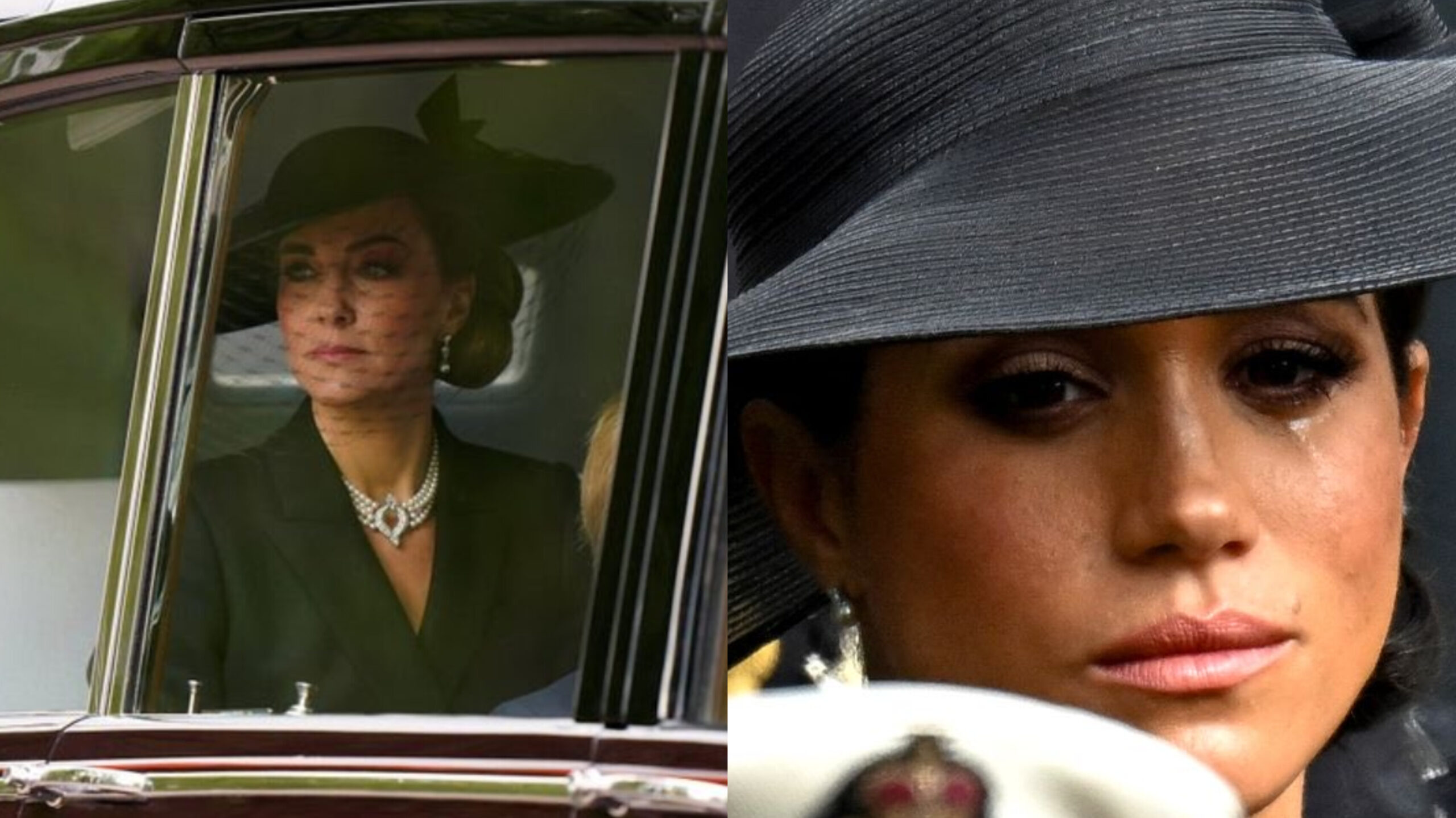
A single image now circulating across royal watchers’ timelines has laid bare what millions have long suspected: the unmistakable gulf between genuine royal mourning and calculated performance. On the left, Princess Catherine, the Princess of Wales, sits in the back of a state car, her face partially veiled, her expression one of profound, inward sorrow as she attends the September 2025 funeral of Katharine, Duchess of Kent. On the right, a close-up of Meghan Markle at Queen Elizabeth II’s 2022 State Funeral shows a single, perfectly placed tear rolling down her cheek beneath a wide-brimmed black hat.
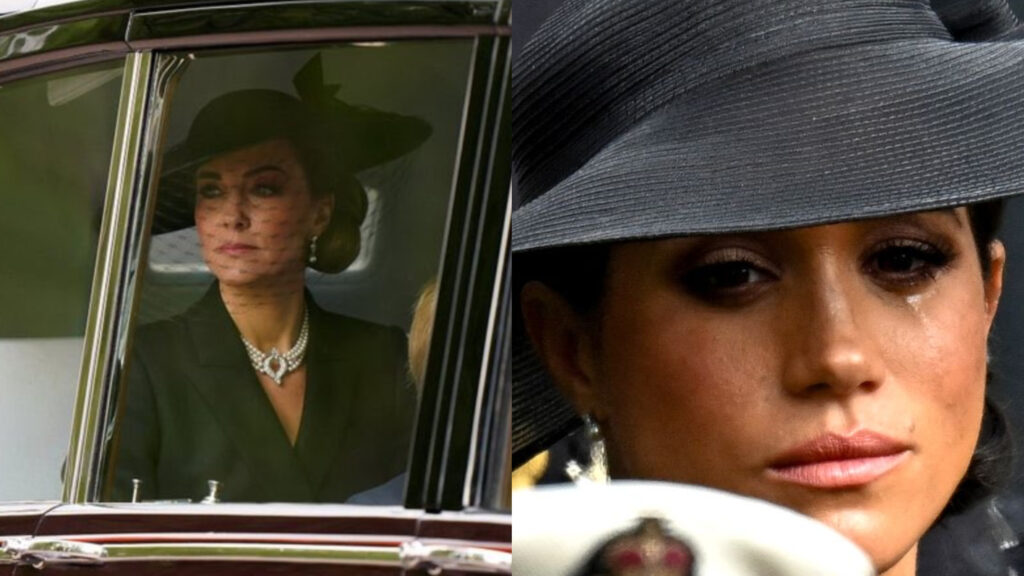
The caption says it all: There’s a difference between real grief and bad acting.
Royal insiders and body-language experts are calling the juxtaposition “devastatingly telling.” One senior palace source, speaking on condition of anonymity, told this publication: “Catherine doesn’t need to perform grief. She feels it. She carries it with the quiet dignity this institution has always demanded. Meghan, on the other hand, has spent years treating emotion like a camera cue.”
The Left Side: Dignity Behind the Veil
The photograph of Princess Catherine was taken as she arrived for the funeral of Katharine, Duchess of Kent at Westminster Cathedral in September 2025. She chose to re-wear the elegant black Roland Mouret dress and Jane Taylor halo pillbox hat with delicate birdcage veil she had first worn at Prince Philip’s funeral in 2021 — a deliberate act of continuity and respect.
Her face is composed yet unmistakably marked by loss. The veil softens her features without hiding the weight of the moment. There are no dramatic gestures, no strategic single tears for photographers, no head tilts engineered for maximum sympathy. This is the face of a woman who has endured private battles — including her own cancer diagnosis and treatment — while maintaining public duty without complaint.
Body-language analysts note her posture is closed and protective, her gaze directed inward. She is not “on.” She is simply present, carrying the grief of a family and a nation the old-fashioned way: with restraint.
The Right Side: The Lone Tear That Launched a Thousand Accusations
The image on the right was captured during the September 2022 State Funeral of Queen Elizabeth II. Meghan Markle, then still styling herself as a working royal despite having stepped back two years earlier, was photographed with a single tear visibly rolling down her left cheek.
Almost immediately, questions erupted. Australian television presenter Karl Stefanovic publicly questioned whether the tears were genuine. Social media exploded with side-by-side comparisons and slow-motion analysis. Critics pointed out that the tear appeared only from one eye — a detail some claimed was consistent with “practiced” emotional displays honed during her years as an actress on Suits.
Multiple royal commentators and former palace staff have since alleged that Meghan “cries on demand” when cameras are present. One former aide told a British newspaper in 2024 that the Duchess had “mastered the single-tear technique” and that it was “always the left eye.” Whether fair or not, the perception stuck: emotion as performance.
Why This Comparison Cuts So Deep
The contrast is not merely about tears versus no tears. It is about authenticity versus artifice in the most scrutinized family on earth.
Princess Catherine has spent over a decade learning — and living — the unspoken rules of royal grief. She has stood through countless memorials, walkabouts after national tragedies, and private vigils. Her red eyes after the Queen’s death were noted, but she never made them the story. She absorbed the pain, supported her husband and children, and carried on.
Meghan Markle arrived in the royal family with a very different playbook. Her tear at the Queen’s funeral came after months of increasingly bitter public statements, a Netflix documentary deal, and the bombshell Oprah interview in which she accused the family of racism and neglect. To many, that single tear felt less like mourning the monarch who had welcomed her and more like another scene in an ongoing narrative of victimhood.
Royal historian and commentator Hilary Mantel once observed that the British monarchy survives on the public’s belief in its members’ sincerity. When that belief frays — when displays of emotion begin to look like scenes from a soap opera — the institution itself is damaged.
Public Reaction: The Internet Has Chosen a Side
Within hours of the side-by-side image appearing online, hashtags #RealGrief and #BadActing trended in the UK and beyond. Supporters of the Wales family praised Catherine’s “quiet strength” and “respect for tradition.” Critics of the Sussexes accused Meghan of turning even a funeral into content.
One viral comment summed up the prevailing sentiment among royal traditionalists: “One woman is preparing to be Queen. The other is still auditioning for the role of tragic heroine.”
Even some who once defended Meghan have privately admitted the optics are poor. “She had every right to feel emotional,” one former Sussex staffer said. “But the way it was captured and the timing… it just fed the narrative she’s been fighting for years.”
The Broader Context: Two Very Different Paths
This is not an isolated moment. It fits a pattern that has defined the post-2020 royal rift.
Catherine and William have doubled down on duty: school runs, hospital visits, military commemorations, and quiet support for the King during his own health challenges. Their family life remains largely private. Their public image is one of service over self.
Harry and Meghan have chosen the opposite route: high-profile deals, tell-all interviews, podcasts, and public complaints about the very institution that gave them their platform. Every emotional display is now filtered through that lens. Is the tear grief — or is it leverage?
Expert Verdict: “You Can’t Fake the Real Thing”
Body-language expert Dr. Elizabeth Kuhnke, who has analyzed royal footage for years, put it bluntly when shown the comparison: “Catherine’s grief is internalized. Meghan’s appears externalized and camera-aware. One feels private even in public. The other feels performed.”
The palace source was even blunter: “Catherine doesn’t need the world to validate her sorrow. Meghan has built a brand on making sure the world never stops talking about hers.”
The Final Frame
The attached photograph needs no further commentary. On one side, a future Queen Consort carrying centuries of tradition and personal loss with grace and silence. On the other, a former actress delivering a single, glistening tear at precisely the right angle.
One is mourning.
The other is acting.
And the British public — and the world — can still tell the difference.
The image speaks louder than any press release ever could.