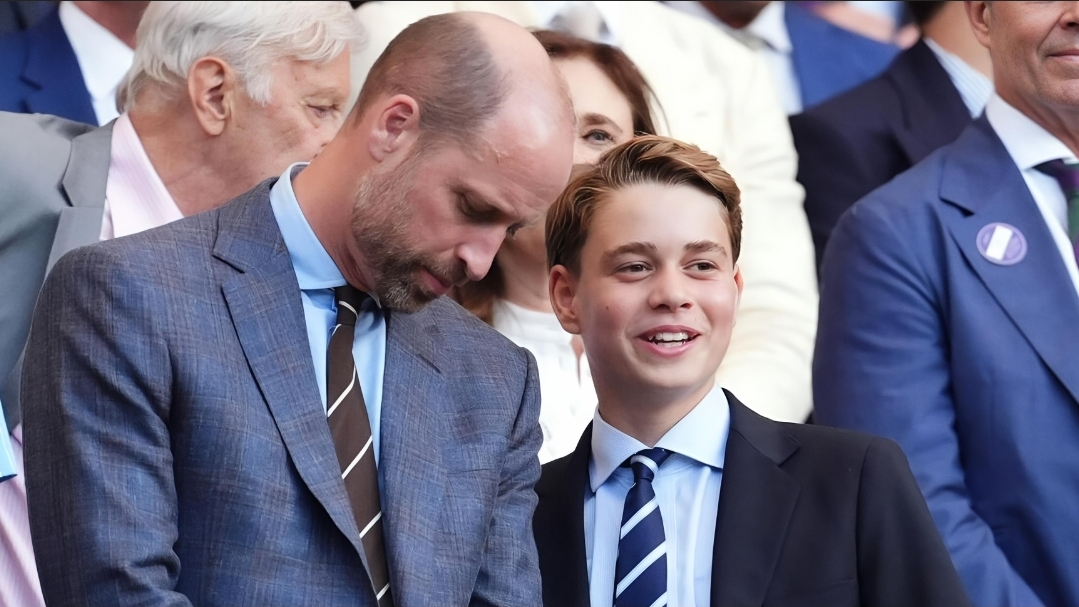
In the sun-drenched Royal Box at the All England Lawn Tennis and Croquet Club, a moment unfolded that royal watchers are still dissecting. As the Wimbledon Gentlemen’s Singles Final reached its crescendo, 12-year-old Prince George of Wales greeted German Chancellor Friedrich Merz with effortless confidence, a warm smile, and the kind of quiet authority that cannot be taught in any finishing school.
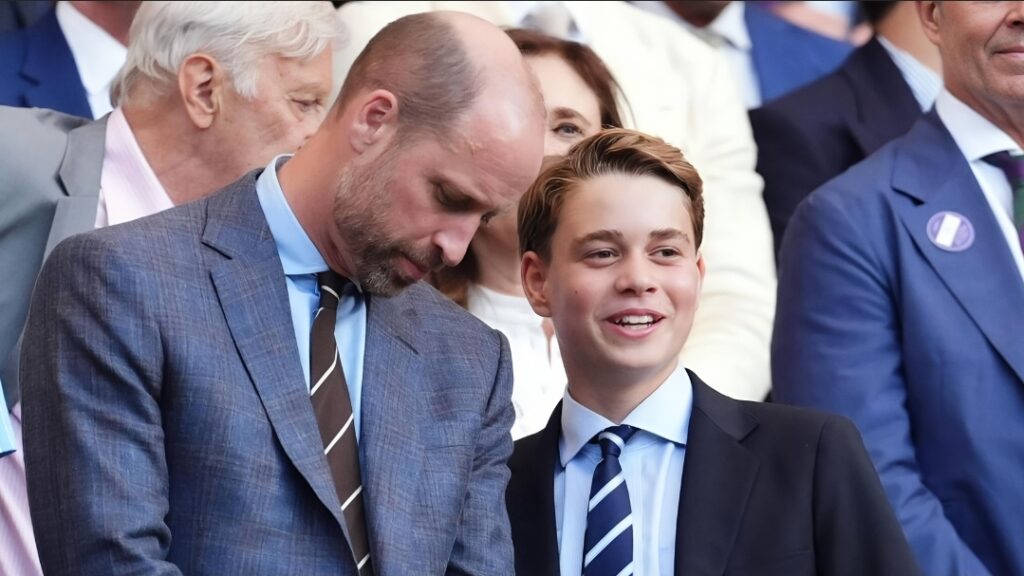
Standing beside his father, Prince William, the future king carried himself with a maturity that belied his young age. The attached photograph captures it perfectly: William, ever the steady presence, appears deep in thought or quietly moved, hands clasped in front of him in his distinctive blue check suit. George, in a sharp dark suit and striped tie, radiates easy charm and self-assurance, his smile bright and genuine as he engages with one of Europe’s most powerful leaders. No fidgeting. No need for grand gestures. Just pure, innate regal bearing.
This is what true royal lineage looks like in 2026.
Prince George is merely 12 years old. Yet he holds himself with more aplomb, sophisticated class, and maturity than his 42-year-old uncle while meeting the German chancellor at Wimbledon over the weekend. George, just like William, does not need to announce himself as “Prince.” You know who they are by the way they hold themselves. Harry will always need to prove he is a “Prince” because his innate vulgarity comes across as soon as you hear him or look at him.
The contrast could not be starker.
On this historic afternoon, the Prince and Princess of Wales brought their two eldest children to Centre Court for the men’s final between defending champion Jannik Sinner and Alexander Zverev. It was a family affair in the Royal Box, with Princess Charlotte also present, and German Chancellor Friedrich Merz as a distinguished guest. Prince George’s interaction with the Chancellor was captured in multiple angles, but the image supplied here speaks volumes. While adults around him navigated the high-pressure environment of international diplomacy mixed with global sport, the young prince projected calm, warmth, and complete comfort in his own skin.
William’s body language in the photo is telling. The Prince of Wales, who has shouldered immense responsibility since his mother’s death and through his father’s reign, often carries the weight of duty visibly. Here, hands clasped and head slightly bowed, he appears reflective — perhaps proud, perhaps simply present in the moment with his son. George, by contrast, stands tall (he is growing rapidly and nearly matches his mother’s height in heels, according to observers), shoulders relaxed, expression open and engaging. There is no performance. No strain. Just the natural ease of someone who knows exactly who he is and what is expected of him.
Royal experts and long-time observers have noted for years how William and Catherine have raised their children with a deliberate blend of normalcy and duty. George and Charlotte attend regular schools, play sports, and experience everyday childhood moments, yet they are being prepared for lives of service. The results are visible. At 12, George already understands protocol without appearing stiff. He smiles when appropriate, maintains eye contact, and carries himself with the quiet confidence that once defined the late Queen Elizabeth II and, before her, Prince Philip in his prime.
Now consider his uncle.
Prince Harry, at 41 turning 42 this September, has spent the better part of the last decade attempting to redefine what it means to be a prince in the modern age — or, more accurately, to remind everyone that he still is one. From the Oprah interview and the Netflix series to the memoir Spare and the Archewell foundation’s uneven output, Harry has consistently chosen platforms and narratives that thrust his royal status into the spotlight while simultaneously distancing himself from the very institution that gave him that status. The effect, for many observers, is the opposite of regal. It often reads as desperate validation-seeking rather than quiet dignity.
Where George lets his presence and upbringing do the talking, Harry has repeatedly felt the need to explain, justify, and monetize his title. The result is a public persona that frequently clashes with traditional expectations of royal decorum. Whether it is the tone of certain interviews, the choice of commercial ventures, or the public airing of family grievances, the impression left is one of someone still wrestling with an identity he was born into rather than one he has gracefully grown into.
The Wimbledon image of father and son crystallizes the generational difference. William, shaped by loss and duty, has become the steady anchor of the modern monarchy. George, watching and learning at his side, is already absorbing those lessons. The boy in the photograph does not need a Netflix deal, a tell-all book, or a PR campaign to affirm his place. He simply is. And in that simplicity lies power.
Public reaction to the Royal Box appearance has been swift and largely glowing. Social media lit up with praise for George’s manners and the visible bond between father and son. Comments ranged from “What a well-mannered boy — well done William and Kate” to observations that William looked “so proud” of his eldest. One viral thread noted how George appeared “grown up” and “a perfect gentleman.” These are not scripted reactions; they are the instinctive response to seeing a child who has been raised with both love and expectation.
Of course, the monarchy’s future does not rest solely on one afternoon at Wimbledon. But symbols matter. In an era when authenticity is prized yet often performed, George’s unforced poise stands out. He did not grandstand. He did not seek the camera. He simply greeted a visiting head of government with the warmth and respect his position demands — and did so while looking entirely comfortable.
William’s influence is unmistakable. The Prince of Wales has long emphasized that his children will understand both the privilege and the responsibility of their birth. The photo shows the lesson taking root. George’s easy smile and straight posture reflect a boy who has been taught that being royal is not about announcing it loudly — it is about living it quietly, consistently, and with class.
Harry’s path has been different. At 42, he remains a prince in name, yet the public perception gap between him and his brother’s family continues to widen. Where the Waleses project unity, service, and quiet strength, the Sussex narrative has often been one of grievance and reinvention. The result is a man who still feels compelled to prove his royal credentials rather than simply embody them.
The attached photograph from Wimbledon tells a story without words. On one side, a father and son representing continuity, duty, and natural grace. On the other side of the family tree, an uncle whose public journey has been marked by the very need to remind the world of a title that George and William wear so lightly it barely needs mentioning.
As the tennis balls flew across Centre Court and the German Chancellor witnessed British royal life up close, a 12-year-old prince gave the world a masterclass in the difference between wearing a crown and living up to one. George did not need to say a word about being royal. His demeanor said it all.
And that, more than any interview or documentary, is the mark of true class.
The future of the British monarchy, it seems, is already in very safe hands.