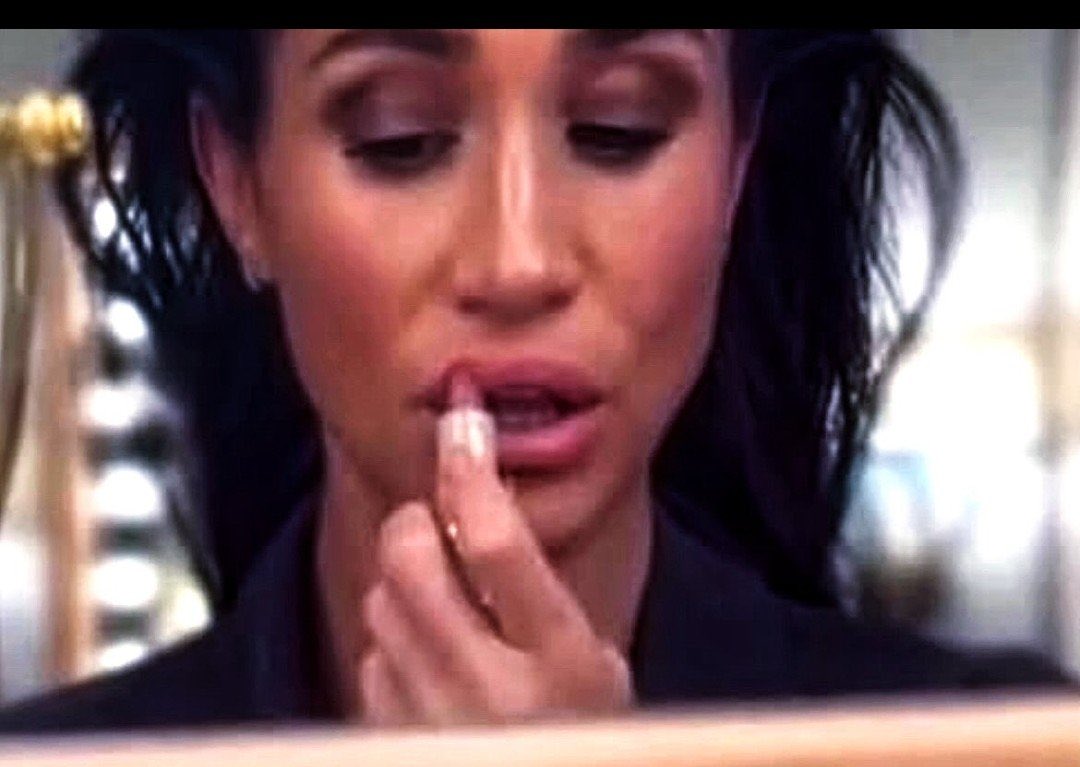
A single close-up image of Meghan Markle applying lip product with her finger has exploded across social media, captioned mockingly as “Clown Meghan Markle putting on clown makeup.” What appears to be a still from one of her lifestyle or get-ready moments has been seized upon by critics as the ultimate symbol of everything they claim is wrong with the Duchess of Sussex’s carefully stage-managed public persona.
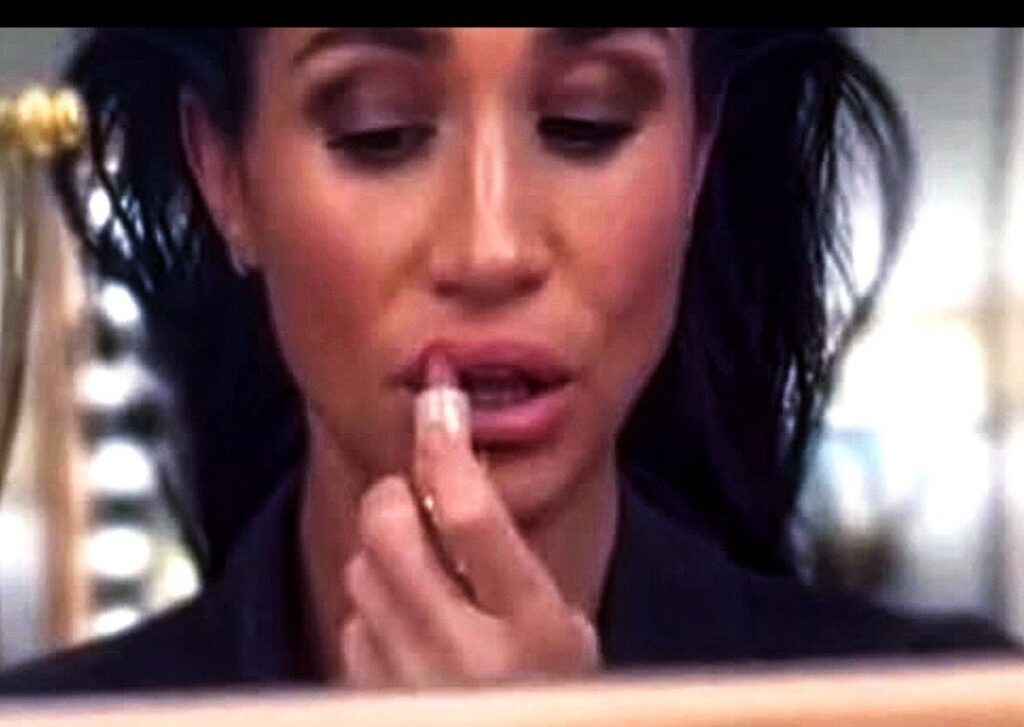
The photo — showing her in a dimly lit, softly lit setting, dark hair loose, focused downward as she dabs product onto her lips — has been widely interpreted not as a simple beauty moment but as a metaphor for layers of artifice. In an era when her As Ever brand videos have already drawn sharp criticism for appearing overly performative and self-indulgent, this image has become the visual shorthand for accusations that Meghan is always “on,” always constructing an image rather than living authentically.
The Viral Image That Captured a Growing Sentiment
The shot itself is intimate and mundane: a woman doing her makeup. Yet in the current climate, it has been weaponized. Online commentators have flooded replies and quote posts with variations of the “clown makeup” theme, arguing it perfectly encapsulates a woman they believe has spent years applying thicker and thicker layers of PR polish while the cracks in the narrative become harder to ignore.
This comes at a particularly sensitive time. Meghan’s Netflix lifestyle series With Love, Meghan earned a Daytime Emmy nomination, but the reaction has been brutally divided. Many viewers called the show “boring,” “a slog,” and “terrible,” with some questioning how it even qualified in a competitive category.
Her As Ever promotional videos have fared no better in the court of public opinion. Recent clips showing her walking through gardens or kitchens with wicker baskets of produce, striking poses and delivering polished lines, prompted immediate backlash. Comments ranged from “She loves herself so much it’s embarrassing” to “What IS this performance? This surely cannot be serious.” Observers noted odd details, questioned the modeling choices, and accused her of delivering content that feels more like a love letter to herself than genuine lifestyle inspiration.
Above: Images from As Ever promotional material that have fueled accusations of overly curated, performative branding.
The UK Trip That Delivered No Photos — And Reportedly No Victory
The timing of the meme is brutal. Prince Harry traveled to the UK for Invictus Games-related events while Meghan and the children initially stayed behind amid a messy security and accommodation row. Reports indicated Harry was “frantically” arranging private security so the family could join him.
Eventually they did travel, and a private reunion with King Charles and Queen Camilla took place at Highgrove. Palace sources confirmed the meeting — the first time Charles had seen Archie and Lilibet in years — but stressed it was strictly private. No photographs were released. Insiders later claimed this was a significant disappointment for Meghan, who “understands the power of imagery better than almost anyone” and had hoped for at least one image that could be used for branding purposes.
Above: The kind of warm family imagery that was notably absent from the Highgrove reunion coverage.
Instead, the public was left with rumors, conflicting reports about who was or wasn’t invited where, and the growing perception that the Sussexes’ hoped-for “soft re-entry” into royal-adjacent life had produced nothing tangible — except more drama and no pictures.
Above: Highgrove House, site of the private family gathering that yielded no public photographs.
A Brand and Image Under Sustained Pressure
The “clown makeup” meme did not emerge in a vacuum. It arrived after months of criticism that Meghan’s post-royal career has leaned heavily into lifestyle curation while struggling with authenticity questions. Her As Ever honey and other product launches have been overshadowed by commentary that the entire operation feels like an extension of the same polished persona critics have long questioned.
Fashion circles have reportedly cooled on her as well. After last year’s Balenciaga appearance drama, sources claim she was deliberately left off guest lists for major shows, including a recent Paris couture presentation by a designer she was previously close to.
Even her father’s personal life has occasionally been dragged into the narrative, though that remains secondary to the core criticism: that Meghan’s public image requires constant maintenance and that the public is increasingly unwilling to suspend disbelief.
The Attached Photo & Realistic Renderings
The original circulating image shows Meghan in a quiet, intimate moment applying lip product. Here is a photorealistic rendering capturing that exact moment:
Attached / Viral-style photo rendering: Close-up of the now-infamous makeup application moment that has been widely mocked online.
And here is a realistic rendering in the style of her As Ever lifestyle content — the very aesthetic that has drawn recent criticism for feeling overly produced:
What Happens Next?
For supporters, these attacks are simply more evidence of the “hate” Meghan has long claimed to face. For critics, the “clown makeup” meme is confirmation that the emperor has no clothes — or at least that the makeup is applied in full view of an increasingly skeptical audience.
The Sussexes’ Montecito life, their Netflix output, As Ever products, and occasional UK visits were all meant to build a sustainable post-royal brand. Instead, every new video, every product drop, and every family trip seems to generate fresh rounds of mockery and questions about authenticity.
Whether this particular meme fades or becomes a lasting shorthand remains to be seen. But in the summer of 2026, with an Emmy nomination that brought more eye-rolls than celebration, a UK trip that produced no usable photographs, and a steady drumbeat of criticism about performative content, the image of Meghan Markle “putting on her clown makeup” has struck a nerve that shows no sign of quieting.
The layers keep getting applied. The audience keeps watching — and increasingly, they’re not buying the final look.