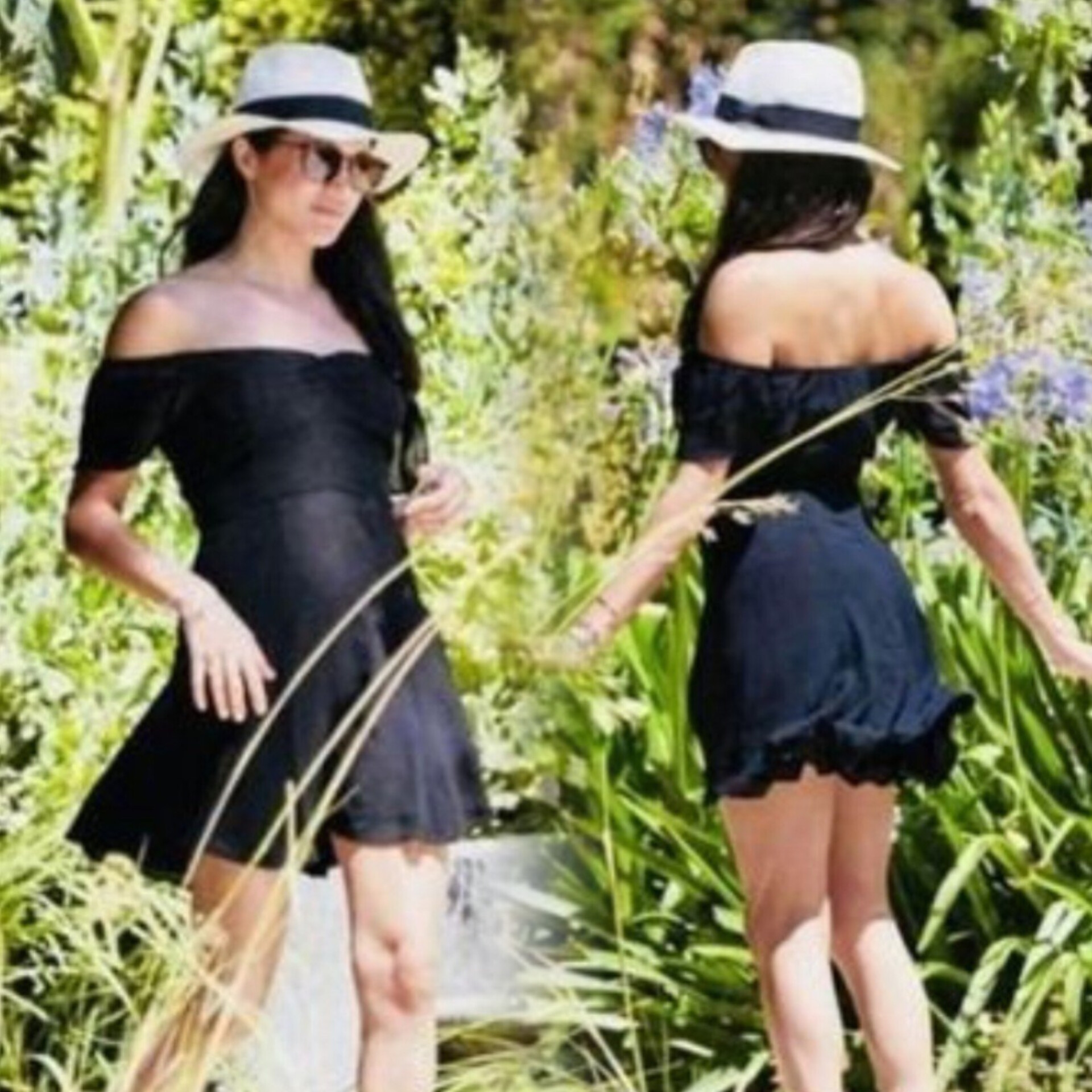
A photo of Meghan Markle in a tiny black off-the-shoulder dress and a white panama hat is ripping through social media this week — and the caption writing itself is brutal. Critics say the Duchess of Sussex once collected roughly $30,000 for a yacht weekend. Their advice now is simple: pick that hustle back up, because the Sussex security bill is enormous, the British public is not in the mood to pay it, and the couple’s own spending habits look nothing like people who are short of cash.
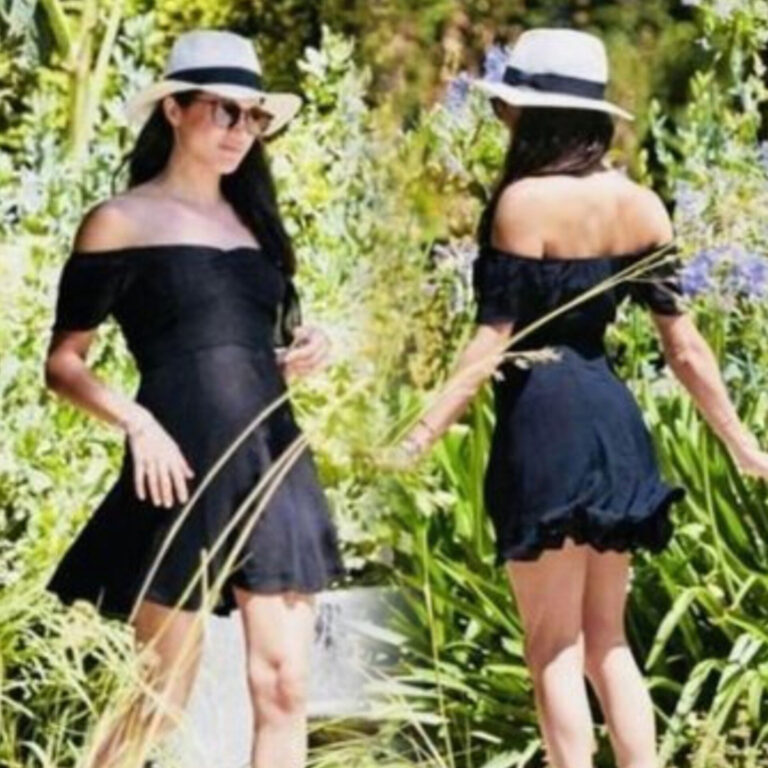
The image making the rounds shows Markle in two poses among tall grasses and purple flowers: sunglasses on, hat tilted, dress riding high on the thigh. One shot is a three-quarter turn. The other is from behind, arms out, as if she is staging the garden like a lookbook. It is the kind of glossy, self-conscious picture that has followed her from Montecito lawns to lifestyle branding. Online, it has been treated less as fashion and more as evidence of a life that has always been about being seen — and being paid to be seen.
The punchline attached to the photo is the one that has stuck: Sharkle was getting paid $30K for a yacht weekend. Perhaps she could try doing that again to pay for security.
That line is ugly. It is also the mood.
The security sermon they never stop preaching
Prince Harry and Meghan Markle have spent years framing themselves as a hunted couple who fled Britain for safety. What they have not framed as clearly is the price tag that followed them.
In the United States, the pair have been reported to spend about $3 million a year on private security. That is not a rounding error. That is a standing army of close protection, vehicles, and logistics for two people who walked away from working royal duties and then spent half a decade telling the world they were the victims of the institution they left.
The bill did not shrink when they looked back toward Britain. Security specialists have put the cost of a serious private detail in the UK at £3 million to £5 million a year, depending on travel and public events. Harry lost his bid for automatic taxpayer-funded armed protection after stepping back as a working royal. The Home Office and RAVEC have treated his case as a special pleading exercise, not an entitlement. The British public’s answer, in poll after poll and comment after comment, has been the same: you left, you monetized the exit, you do not get to invoice the country for the lifestyle you chose.
Harry has still tried. He has still complained. He has still presented the absence of a police convoy as proof that the state is cruel rather than proof that he is no longer a working member of the family firm. That is the part that infuriates people. The Duke of Sussex talks like a man owed a detail. The country talks like a man who cashed out.
If the Sussexes are truly as cash-strapped as their security panic implies, critics argue, then Meghan already has a documented method for raising large sums quickly: show up, smile, leave.
She already knows how to get paid for a weekend
The $30,000 yacht-weekend figure circulating with the garden photos is an online allegation, not a court finding. It sits in the same swamp of pre-royal “yacht girl” rumors that have followed Markle for years — some of them built on misidentified pictures, some of them pushed by hostile biographers and video channels that make claims far beyond what mainstream news has verified.
What is not rumor is how she charges when the cameras are rolling now.
In April 2026, guests at a Sydney “Her Best Life” retreat paid as much as $3,199 a ticket for a weekend sold around Meghan’s presence. She stayed about two hours. Reports put her own fee in the region of $150,000. Then she left in a Range Rover. Attendees who had paid thousands for the “immersive” experience were left with a Q&A, a photo, and the realization that the headline act had a car waiting.
That is the Sussex business model in miniature. Sell intimacy. Deliver a cameo. Collect the fee. Complain about the coverage.
The same pattern shows up in the travel ledger. After the Invictus Games in Canada, Meghan’s private-jet hop home was estimated at $21,000 to $30,000, with a reported stop in Seattle and a carbon footprint that sat awkwardly next to the couple’s old “eco role model” branding. A family crossing from California back toward Britain has been costed in the six figures for a single charter.
So the internet’s $30,000 joke is not really about boats. It is about arithmetic. If a weekend of being decorative once paid five figures, and a two-hour retreat now pays six, why is the country being lectured about who should fund their bodyguards?
Harry’s contribution: the grievance, the lawsuit, the bill
Harry’s public role in this saga is not glamorous. It is the long campaign to recast a voluntary departure as an exile, and a security downgrade as a plot.
He stepped back from senior royal duties in 2020. He moved to California. He signed the streaming deals, did the memoir, sat for the interviews, and built a brand on the claim that the Palace and the press had made Britain unlivable. When the protection package that comes with being a working royal went away, he sued. He lost. He kept talking as if the verdict were a personal insult rather than the predictable result of leaving the job that justified the guns.
Canada, meanwhile, has had to publish its own receipts. Records obtained after a years-long fight showed the RCMP spent hundreds of thousands of dollars protecting Harry during the years he was flying in to see Meghan and promote Invictus — a larger bill than other visiting dignitaries in the same window. Canadian taxpayers were not consulted about becoming extras in a royal courtship. They paid anyway.
That is the through-line. Other people pay. The Sussexes narrate.
Harry’s defenders say threat levels are real and children should not be bargaining chips. Fair enough, as a principle. It does not explain why the couple’s answer is always the same: more public money, more special treatment, more moral lecture — and never a quieter life that would make the detail cheaper. They want the status of royalty, the income of celebrities, and the security of heads of state. They want it while attacking the institution that used to provide the last of those things for free.
That is not tragedy. That is a business plan with a press team.
The photo is the point
Look again at the picture that started this latest round. It is not a woman in hiding. It is a woman posing. Off-the-shoulder black dress. Designer-hat leisure. Garden as backdrop. The internet did not invent the contrast. She did, by building a public identity on vulnerability while living in a register of staged luxury.
Critics have given her the nickname “Sharkle” because they see the brand as predatory: take the title, take the deals, take the victim story, take the appearance fee, then circle back for protection money when the math gets uncomfortable. Whether that nickname is cruel is beside the point they are making. The couple have spent six years teaching the public to read them as a revenue operation. The public learned.
Meghan Markle does not need a yacht to raise $30,000. She has already shown she can raise five times that by walking into a hotel ballroom for two hours and walking out. Prince Harry does not need a speech about trauma to explain a security invoice. He needs to accept that leaving the firm means paying the firm’s rates — or living like someone who cannot.
If the Sussexes cannot cover the men at the door, the men at the door are not the country’s problem. They are the couple’s. And the photo in the black dress is a reminder of how often Meghan Markle has been willing to be paid to stand in the sun and look available.
The public is done subsidizing the performance.