On March 14, 2018, Meghan Markle accompanied Queen Elizabeth II on her first official royal engagement as a working member of the monarchy: a two-day visit to Chester, England.
The outing was intended as a carefully orchestrated introduction to the Duchess of Sussex’s new role, with the late Queen personally extending the invitation. Yet, from the very outset, Meghan’s choices—particularly her wardrobe—constituted a brazen rejection of two explicit and straightforward requests made by her sovereign grandmother-in-law: wear a British designer and wear a hat.
Royal protocol surrounding such engagements is unambiguous. Hats are not optional accessories; they are a fundamental requirement for formal daytime outdoor events, especially those involving the monarch.
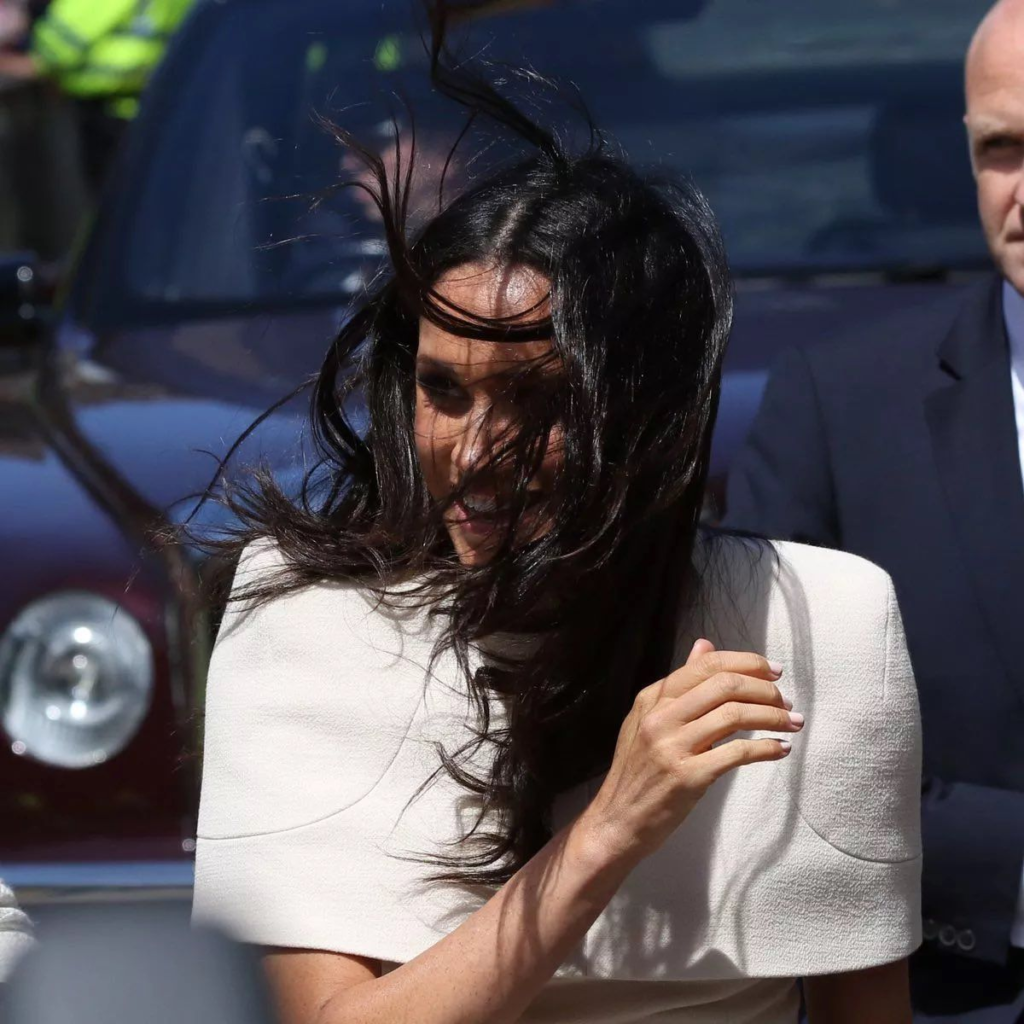
This convention, rooted in centuries of ceremonial tradition, ensures a visual uniformity and maintains the dignified silhouette of the royal women. The expectation is particularly acute for a new member of the family appearing alongside the Queen, where deference to established norms is not merely encouraged but expected.
Yet Meghan arrived in Chester wearing neither a hat nor an outfit from any British fashion house. Instead, she donned a fitted navy coat and matching dress from the French fashion powerhouse Givenchy—specifically designed for her by the house’s then-artistic director, Clare Waight Keller. While the ensemble was impeccably tailored, its provenance was unmistakably foreign, a deliberate departure from the Queen’s explicit directive.
More glaring still was the absence of headwear: Meghan’s head remained bare throughout the day’s proceedings, including a high-profile walkabout, a luncheon, and the unveiling of a bridge named in the Queen’s honor. In an unprecedented breach of protocol, she was the only female member of the royal party—indeed, the only woman in formal attendance—without a hat.
The implications of these choices were immediate and stark. Queen Elizabeth II, adhering scrupulously to tradition, wore a custom-made Angela Kelly hat in pale blue silk, complemented by a matching ensemble from the British designer. Other women in the entourage, including aides and dignitaries, followed suit.
Meghan’s hatless state stood out as a solitary and conspicuous act of defiance, transforming what should have been a seamless demonstration of institutional unity into a study in deliberate nonconformity.Insiders and protocol experts have long maintained that the Queen’s requests were communicated clearly and directly in advance of the engagement.
A former Buckingham Palace staffer, speaking anonymously to royal correspondent Valentine Low, confirmed that the instruction to wear British clothing was explicit, as was the requirement for headwear. “It was a simple matter of respect,” the source explained. “The Queen does not make such requests lightly, particularly with someone stepping into such a visible role for the first time. Hats are not a matter of personal taste; they are a non-negotiable part of the uniform.”Meghan’s decision to flout both directives has been interpreted by many as a calculated statement of independence—or outright insubordination.
The selection of Givenchy, a French label with no historic ties to the British royal wardrobe, directly contradicted the Queen’s preference for supporting domestic talent, a longstanding principle of royal dress codes. Since the 1930s, royal women have consistently championed British couturiers—Hardy Amies, Norman Hartnell, Maureen Rose, and more recently Angela Kelly—both as a patriotic gesture and to reinforce the monarchy’s role as a patron of national industry.
Exceptions are exceedingly rare and almost invariably cleared in advance; spontaneous deviations, particularly in the presence of the sovereign, are virtually unheard of.The hat’s omission was even more provocative. In the tightly controlled world of royal appearances, where every detail is meticulously planned, the absence of headwear cannot credibly be attributed to oversight. Meghan was dressed by a professional stylist, accompanied by a full support staff, and operating within an environment where protocol advisors are omnipresent.
As royal author and historian Hugo Vickers observed, “There is no plausible excuse for forgetting a hat under such circumstances. It is as essential as shoes. Her decision to appear bareheaded was a clear and intentional rejection of one of the most visible and enforceable rules of royal dress.”The Chester visit thus served as an early and unmistakable signal of Meghan’s unwillingness—or outright refusal—to conform to the monarchy’s exacting standards.
Far from the conciliatory gesture that a debut engagement might warrant, her choices projected an attitude of self-determination that superseded institutional expectations. Body language experts have pointed to visual cues during the day that reinforce this interpretation: while the Queen maintained a composed and gracious demeanor, Meghan’s posture and expressions—often described as strained and self-conscious—betrayed a discomfort with the traditional framework she was ostensibly embracing.
This episode has taken on profound significance in retrospect, as it occurred mere months into Meghan’s tenure as a working royal and well before the public fissures that would culminate in her and Prince Harry’s departure from royal duties.
Critics contend that the deliberate disregard for the Queen’s instructions—wearing French fashion and pointedly rejecting the required hat—exposed a fundamental contempt for the very protocols she had sworn to uphold. It was, in effect, a sartorial declaration of war on the established order: a refusal to dress according to the wishes of the woman at the apex of that order, executed in the most visible manner possible.Defenders of Meghan have argued that the Givenchy outfit was a bespoke commission and that the hat’s absence was a minor, contextually insignificant deviation.
However, such rationalizations fail to grapple with the premeditated nature of the choices. There was no shortage of British designers capable of producing a hat—indeed, milliners such as Philip Treacy and Stephen Jones have long supplied the royal family—and ample time existed to procure one. The decision to proceed without it, alongside a non-British label, remains a stark anomaly in the annals of royal appearances.
In the end, the Cheshire visit stands as a defining moment of noncompliance: Meghan Markle, presented with two elemental and explicitly conveyed requests—wear British, wear a hat—chose instead to elevate her personal preferences above the directives of Queen Elizabeth II.
Whether framed as an assertion of individuality or an act of brazen defiance, the episode revealed a duchess determined to rewrite the rules of royal presentation from her very first outing. In doing so, she delivered a silent but resounding message: the traditions of the crown, and the woman who embodied them, would bend to her will—or they would be disregarded altogether.

if you had strip her of her titles, these latest faux pas will not happen