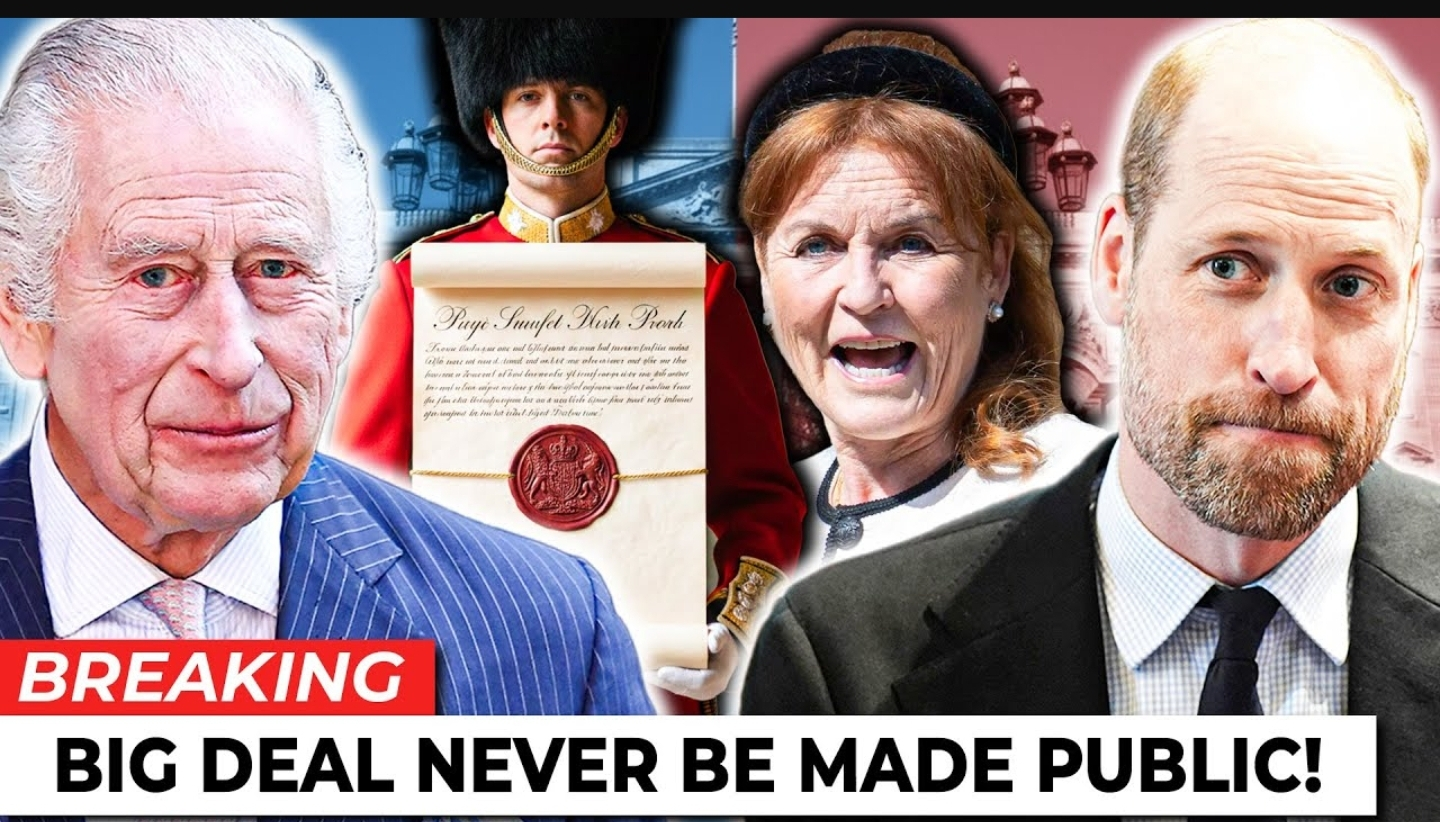
Buckingham Palace has confirmed the most severe disciplinary action taken against a senior royal in modern history. With a formal proclamation, King Charles III officially removed all royal titles, honors, and protections from Prince Andrew, ending his decades-long identity as “Prince of York” and ordering his eviction from Royal Lodge, the 30-room Windsor estate he has occupied for over twenty years.
The announcement — described by insiders as“firm, final, and heartbreaking” — sent shockwaves through the House of Windsor and left Sarah Ferguson, Duchess of York, in tears.
“My mistakes have been public. Other people’s mistakes haven’t. Good news doesn’t sell papers,”she reportedly said through sobs at Buckingham Palace.
But behind her emotion was something far more strategic.
⭐ A DECISION YEARS IN THE MAKING
Since ascending the throne in 2022,King Charles has pushed for a smaller, cleaner, more accountable monarchy. Prince Andrew, entangled in the fallout from his association with Jeffrey Epstein and stripped of public duties in 2019, represented the very opposite of this vision.
Despite losing titles and patronages, Andrew continued living in Royal Lodge under a rare 75-year lease signed under Queen Elizabeth II. For Charles — and the British public — this was unacceptable.
Yesterday, Charles acted.
The official statement read:
“His Majesty has today initiated a formal process to remove the style, titles, and honors of Prince Andrew. He will now be known as Andrew Mountbatten-Windsor.”
“Formal notice has been served to surrender the lease on Royal Lodge.”
The monarchy’s message was unmistakable:
Privilege without accountability is over.

⭐ WHY ROYAL LODGE MATTERS
Royal Lodge is not just a mansion — it’s a symbol.
Once renovated with £7.5 million of Andrew’s own money, the residence became a fortress of entitlement. Even after the Epstein disaster, Andrew refused all alternatives, including Frogmore Cottage and other scaled-down options.
For the King, the standoff was unacceptable.
Public anger grew. Politicians questioned royal spending. Media investigations reignited.
Royal Lodge had become the last battleground of Andrew’s failed legacy.
Last week, Charles ended the standoff for good.
⭐ THE CONFIDENTIAL NEGOTIATION: SARAH FERGUSON’S QUIET POWER
While Prince Andrew was emotionally spiraling, Sarah Ferguson stepped in — and surprised everyone.
Within 72 hours of the public announcement, Fergie’s legal team submitted a confidential counter-proposal to Buckingham Palace.
It demanded three non-negotiable conditions:
1. Separate private residences
Andrew and Sarah would be relocated — but not to Crown Estate properties where the palace could monitor their lives.
2. Lifetime financial support
Not luxury — but stability. Enough to avoid the optics of a disgraced royal being pushed into poverty.
3. A lifetime NDA (including after death)
No interviews.
No memoirs.
No documentaries.
No letters released posthumously.
The crown would own their silence forever.
Queen Camilla reportedly exploded when she learned of the terms:
“We are not paying them to behave!”
But Charles, pragmatic and calculating, saw the bigger picture.
A court battle over Royal Lodge would be catastrophic. A public meltdown from Fergie? Even worse.
The NDA ensured peace.
And silence.
On November 10, King Charles signed the agreement.

⭐ THE PRIVATE MEETING: BROTHER AGAINST BROTHER
Before the announcement, Charles summoned Andrew to Clarence House.
No aides.
No lawyers.
Just two brothers.
Sources say Andrew pleaded for mercy, reminding Charles the lease was signed with their mother’s blessing.
At one point, he snapped:
“You were forgiven. Why can’t I be?”
Charles’s reply — now leaked — was devastating:
“Because I learned from mine.”
Within days, Andrew withdrew into isolation.
⭐ THE FALL OF A PRINCE
On November 15, 2025, the palace quietly confirmed:
Prince Andrew will relocate to a smaller, isolated residence on the Sandringham Estate.
No farewell photos.
No ceremony.
No sympathy.
He leaves behind:
- his titles
- his honorific
- his home
- his relevance
- his public identity
Andrew Mountbatten-Windsor is now a private citizen.

⭐ SARAH FERGUSON: THE SURVIVOR
Royal watchers were stunned by one truth:
Fergie played her cards better than Andrew ever did.
She protected her daughters.
She secured long-term stability.
She avoided a media war.
She navigated Charles’s fury.
She kept her dignity.
One palace insider said:
“She didn’t beg. She didn’t threaten. She played chess.”
But the price was steep.
Her new NDA forbids any future memoirs, interviews, or posthumous revelations.
“It’s not the house I’ll miss,” she told a friend.
“It’s the stories I’ll never be allowed to tell.”
⭐ THE FUTURE OF THE MONARCHY — A NEW ERA OF ACCOUNTABILITY
Removing Andrew was not just disciplinary.
It was symbolic.
King Charles has publicly redrawn the line between privilege and responsibility.
Prince William supports the move wholeheartedly — and intends to go even further when his time comes.
Public reaction across the UK, Commonwealth, and global media has been overwhelmingly supportive.
The message is clear:
The age of inherited immunity is over.
The cost of disgrace is exile.
The crown will protect itself — even from its own.
As Andrew leaves Royal Lodge for the last time, a chapter closes on decades of unchecked entitlement.
And for the monarchy, a new chapter begins.