When the announcement came, it didn’t arrive with trumpets, televised statements, or palace balcony waves. It came quietly — almost too quietly for what it truly represented.
“Today I’ve sworn an oath to Princess Catherine to serve with fidelity, integrity, and diligence…”
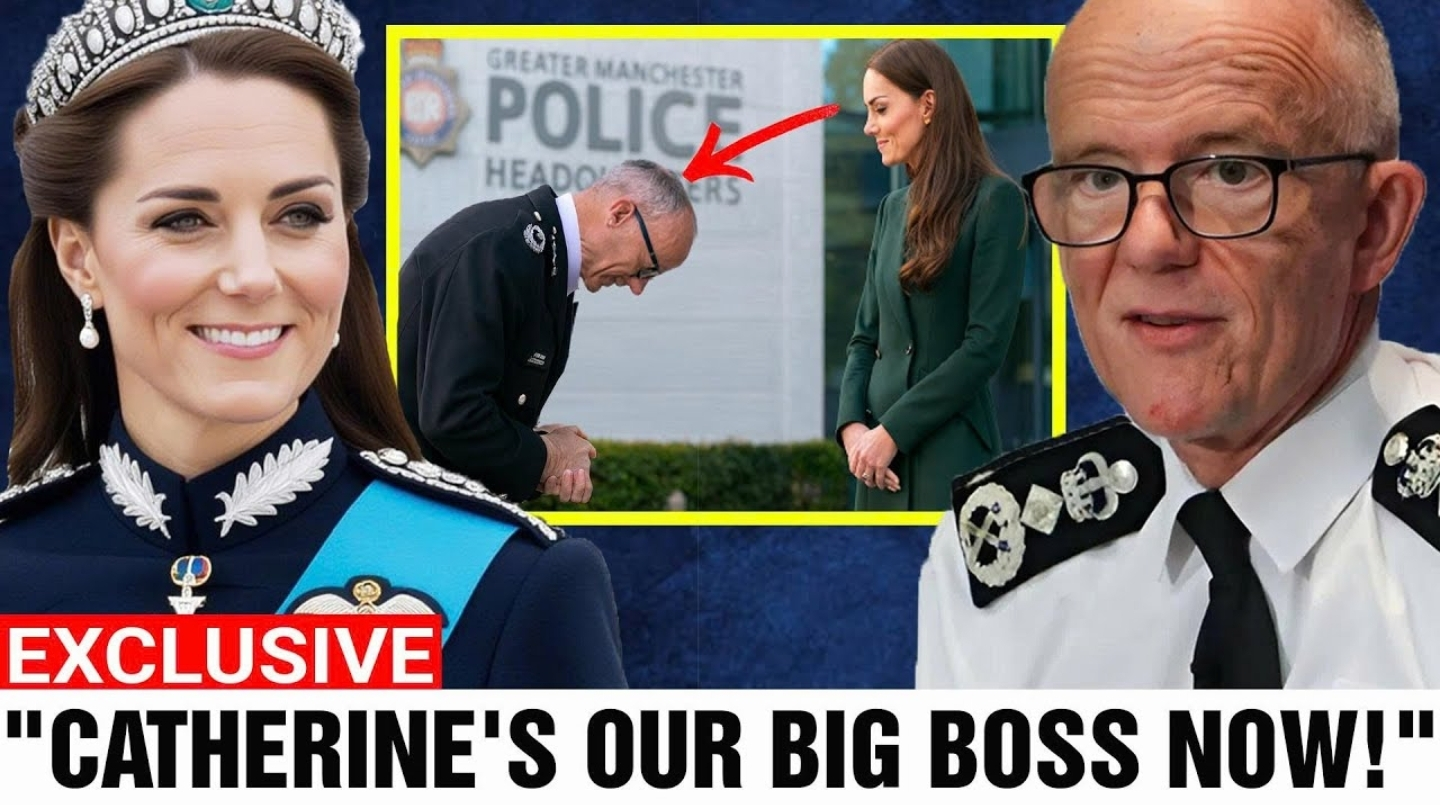
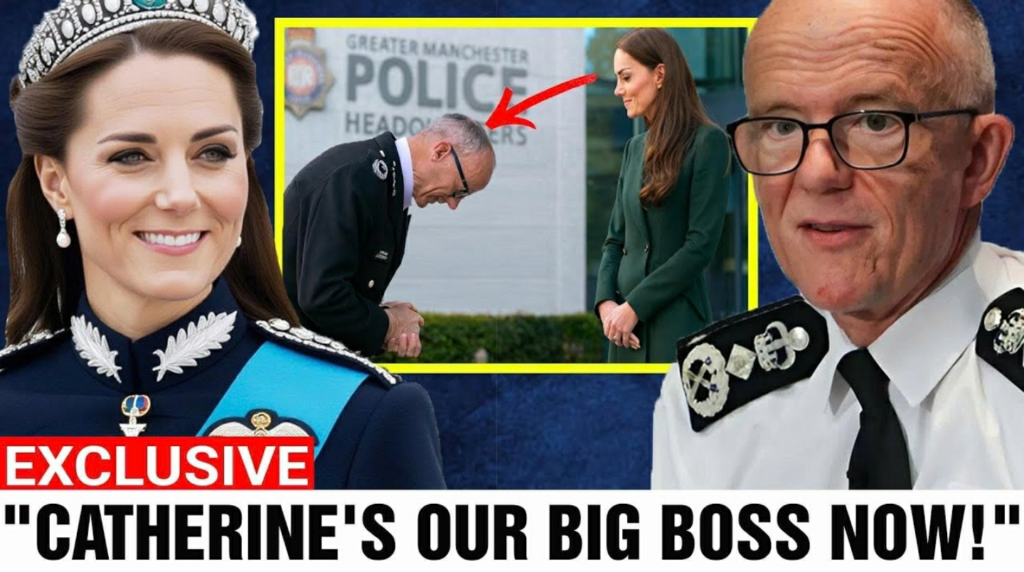
With those words, spoken inside a Greater Manchester Police (GMP) leadership forum, a seismic shift in British public life was sealed. Princess Catherine, the Princess of Wales — known to millions simply asKate — is now the Honorary Commissioner of Greater Manchester Police, an unprecedented role that blends centuries of royal symbolism with real influence in one of the UK’s largest and most overburdened police forces.
Inside GMP headquarters, the reaction was immediate.
One officer whispered to another, half amused, half awed:
“She’s our big boss now.”
It wasn’t a joke. Not really.
Because for the first time in modern history, a future Queen has been placedwithin the strategic core of British law enforcement — and the implications are enormous.
A TITLE THAT ISN’T CEREMONIAL
This isn’t ribbon-cutting.
This isn’t waving at cadets.
This isn’t merely lending a name to a charity dinner.
Catherine’s new role grants her:
- Input on operational strategy
- Influence on youth and community programs
- A voice in resource allocation
- Access to leadership briefings
- A direct advisory path to the Commissioner
In other words: She has a seat at the table. A real one.
This is the monarchy stepping not over, but into public service in a way not seen since Queen Elizabeth II oversaw the Royal Canadian Mounted Police.
And it’s happening now — at a moment when both the Crown and British policing are fighting to regain trust in an era of scrutiny, cynicism, and social strain.
WHY CATHERINE — AND WHY NOW?
To understand the appointment, you must understand the moment.
When Queen Elizabeth II died in 2022, the monarchy lost not just a sovereign, but its anchor — the steadying force who balanced tradition with duty for 70 years. King Charles’s slimmed-down monarchy has created a new reality: fewer royals, more responsibilities, and a desperate need for roles thatmatter, not simply roles that appear to matter.
That’s where Catherine steps in.
For years, she’s built a portfolio centered on three themes:
- Mental health
- Early childhood development
- Support for first responders
She has met wounded officers, grieving families, exhausted paramedics, and victims of tragedy. She’s listened to mothers who lost children to knife crime. She’s walked through communities that feel forgotten.
And she has done it with something rare in public life: sincerity that people believe.
So when GMP — a force dealing with rising youth crime, cyberthreats, budget strains, and deeply fractured public trust — sought a partner who could rebuild bridges, the choice made itself.
This was not just an appointment.
It was an answer.
THE POST-QUEEN ERA: A TORCH PASSED TO A NEW GENERATION
Catherine’s role is also a symbolic continuation of the late Queen’s legacy.
In her final decade, Elizabeth II strengthened ties with police services across the Commonwealth. She presided over the largest security operation in British history during her funeral — an event requiring over 5,000 officers.
After her passing, royal patronages needed new guardians. Catherine inherited many, but the police role stands apart. It signals a new royal philosophy:
The Crown will not simply watch society struggle.
It will stand inside the struggle.
For a monarchy fighting for relevance among younger generations, this is not just strategic — it is essential.
GREATER MANCHESTER POLICE: A FORCE IN NEED OF A BRIDGE
GMP’s challenges are not theoretical.
- Knife crime among teens
- Cybercrime expanding faster than budgets
- Frontline fatigue
- Public mistrust in certain boroughs
- Internal leadership pressures
Commissioner Stephen Watson has led reforms since 2021, but the force needs credibility as much as it needs resources.
That is where Catherine’s influence becomes transformative.
Her presence:
- Draws public attention
- Encourages national funding
- Boosts morale
- Strengthens community outreach
- Adds legitimacy to youth engagement initiatives
For officers who feel forgotten, a future Queen taking interest in their work is not a photo op — it is validation.
A ROYAL ROLE WITH REAL HUMAN WEIGHT
For Catherine, this is not an easy appointment.
She is a mother of three young children.
She is already the most photographed woman in Britain.
She is recovering from her own health battles.
And she now enters a profession where every issue — from gang violence to officer mental health — carries genuine stakes.
Her advisors know the risks.
Critics will question royal overreach.
Media commentators will debate her effectiveness.
Every misstep will be magnified.
But Catherine has built her public life on something more powerful than perfection: relatability.
When she sits with officers, listens to families, or stands at a crime memorial, the public does not see a distant aristocrat. They see a woman trying — sincerely — to make institutions more humane.
WHAT THIS MEANS FOR BRITAIN
This appointment raises profound questions:
- Should the monarchy hold real influence in public institutions?
- Will Catherine’s involvement rebuild trust in policing — or spark debate about royal power?
- Could this reshape what it means to be a modern royal?
- Is this the beginning of a more hands-on monarchy?
For now, what is certain is this:
Princess Catherine has stepped into a role no royal has taken before — one rooted not in tradition, but in service, strategy, and responsibility.
And as she quietly walks into GMP headquarters, shaking hands with officers who never imagined a princess would be part of their chain of command, a new kind of royal chapter begins.
One where duty isn’t ceremonial.
One where influence isn’t symbolic.
One where the Crown meets the street — and listens.