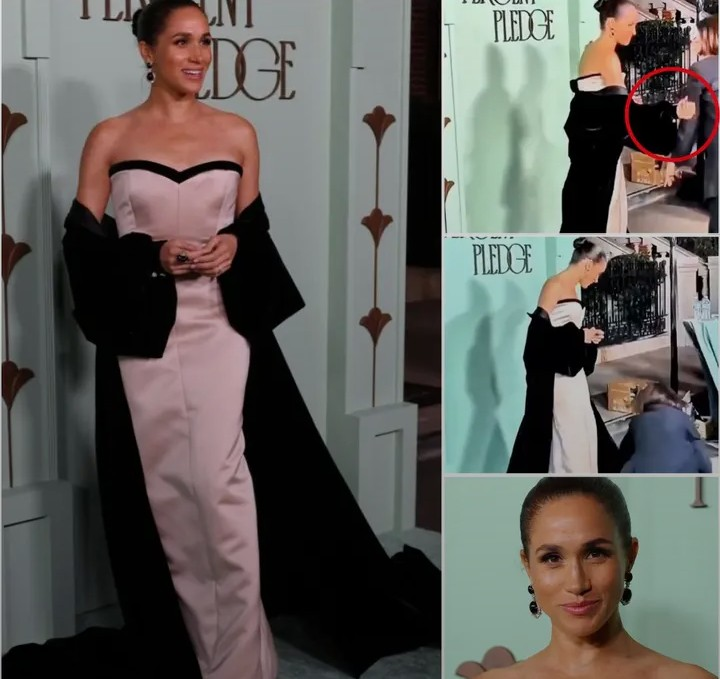
The clip spread rapidly across social media platforms, framed as a behind-the-scenes moment that audiences were “never meant to see.” In the footage, Meghan is seen at a public event where a woman believed to be a newly assigned assistant attempts to help move a comforter or garment from a guest room area into position. The interaction, however, quickly becomes the focal point of the video, not because of the logistics, but because of Meghan’s visible irritation and body language. Viewers claim she appears impatient, visibly annoyed, and dismissive, with gestures and expressions that many interpret as ordering the assistant out of the camera’s frame rather than calmly allowing her to do her job.
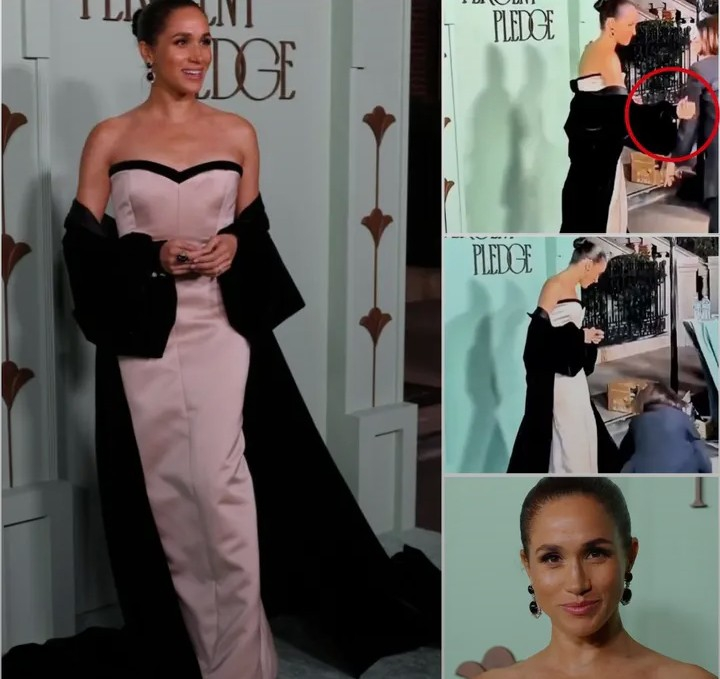
Meghan Markle Wore a Glamorous Strapless White Gown to the 15 Percent Gala
The person who originally shared the video slowed down the footage frame by frame, emphasizing Meghan’s facial expressions and micro-reactions, arguing that her discomfort was not subtle and not accidental. According to the commentary, this was not simply a stressed celebrity in a chaotic environment, but a pattern of behavior that reflects a deeper issue with control and image management. “It’s not the words alone,” one viewer wrote in the comments, “it’s the face, the eyes, the posture — everything screams irritation at being ‘interrupted.’” Another added, “You can tell she’s not angry about the situation, she’s angry about the shot.”
Meghan Markle attends Fifteen Percent Pledge Fundraising Gala wearing Harbison Studio
What escalated the backlash was not just the alleged mistreatment of the assistant, but what many described as Meghan’s fixation on camera positioning. In the same clip, viewers point to repeated micro-adjustments of posture, head turns toward lenses, and exaggerated expressions that appear designed to reclaim visual dominance of the scene. For critics, this reinforced a long-standing narrative that Meghan’s relationship with public space is not passive but highly strategic, where every environment becomes a stage and every interaction becomes secondary to visibility.
Online reactions quickly shifted from criticism to ridicule. “At some point, it stops being royal drama and starts looking like influencer behavior,” one commenter wrote. Another remarked, “This isn’t about titles anymore — it’s about attention economics.” These reactions reveal something deeper than gossip: a growing public fatigue with performative visibility, especially when it appears to override basic interpersonal decency. Even neutral observers expressed discomfort, with one user stating, “I don’t hate her, but watching that made me physically uncomfortable. No one deserves to be treated like a prop.”
Meghan Markle attends Fifteen Percent Pledge Fundraising Gala wearing Harbison Studio
Supporters of Meghan, however, pushed back, arguing that short, contextless clips can be misleading and that high-pressure public events often produce tense moments that cameras exaggerate. Some suggested the woman may not even be a personal assistant, but event staff, and that the narrative was being shaped by hostile framing rather than objective observation. Still, the sheer volume of negative response suggests the clip resonated with an existing public perception rather than creating a new one.
Behind the Scenes with Meghan, Duchess of Sussex | Harper’s BAZAAR
What makes this moment particularly damaging is its symbolic weight. For many viewers, the issue is not a single incident but a pattern narrative: repeated accusations of staff mistreatment, alleged control issues, and a relentless focus on image management. Whether fair or not, the video fits seamlessly into a broader storyline that critics already believe — that Meghan struggles with emotional regulation when situations deviate from her desired visual script.
One cultural commentator noted, “Public figures don’t fall from grace because of one scandal — they fall because small moments accumulate into a recognizable pattern.” Another observer wrote, “It’s not about hatred. It’s about trust. People no longer give her the benefit of the doubt.” This erosion of goodwill is arguably more damaging than any single controversy, because it reshapes how every new image, clip, or report is interpreted.
The phrase “secondhand embarrassment for the royal family” appeared repeatedly in online reactions, not because of protocol breaches, but because the behavior felt out of place within the symbolic restraint traditionally associated with royal representation. Even though Meghan is no longer a working royal, public perception still links her actions to the institution, creating a reputational echo effect that continues to affect the monarchy’s image abroad.
In the end, the video’s impact lies less in what is definitively proven and more in what it reinforces. It strengthens an existing narrative of control, visibility obsession, and emotional volatility under pressure. True or exaggerated, the clip has become another data point in a long-running public story — one where perception often matters more than verification. As one viewer summarized bluntly, “Even if this is overblown, the problem is that it feels believable — and that’s the real damage.”



Supporters of Nutmeg are fighting a losing battle..