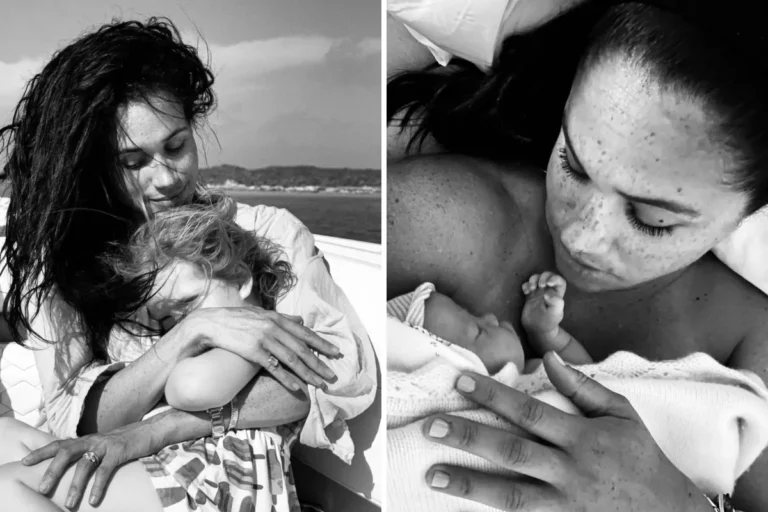
For years, the public narrative surrounding the Sussex family has moved between fascination, sympathy, and criticism. Recently, however, royal watchers have begun to notice a subtle but intriguing shift in how Prince Harry and Meghan Markle present their family life to the world. While both of their children have largely been shielded from public scrutiny, their daughter Princess Lilibet of Sussex has begun appearing more frequently in carefully timed photographs and references tied to specific public moments.
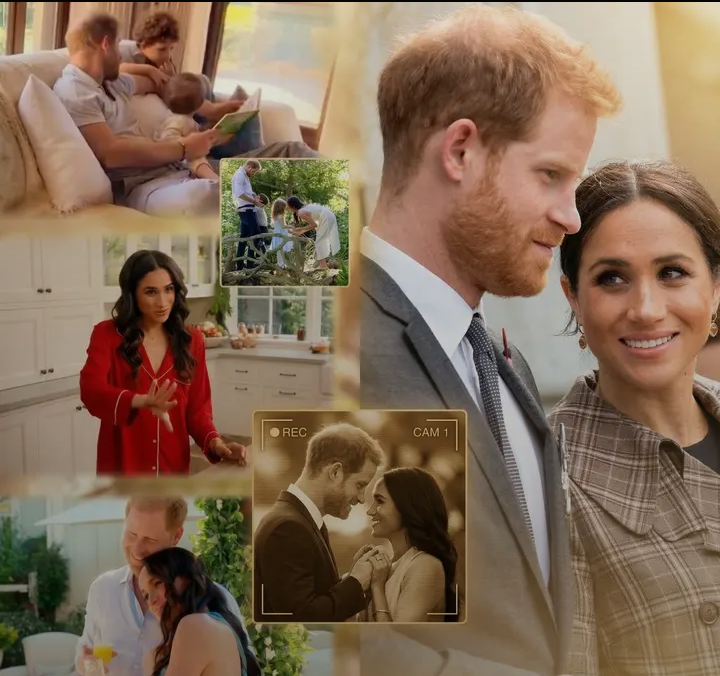
Meghan Markle, Prince Harry share new family photo featuring Archie, Lilibet – ABC News
At the same time, their son Prince Archie of Sussex has remained almost entirely absent from the spotlight in recent months. The contrast has not gone unnoticed. Some royal commentators believe this difference may reflect a new communications strategy emerging from the Sussex camp—one that places symbolic emphasis on themes of female empowerment and generational change.
Prince Harry’s return to the UK with Archie, Lilibet: ‘Will Meghan finally pull the trigger?’
The pattern became particularly visible during International Women’s Day, when an image connected to Lilibet circulated widely online. The message accompanying the image celebrated the idea of raising strong young women, a theme that has long been central to Meghan’s public identity. Supporters interpreted the moment as a heartfelt family tribute, while critics suggested it might have been carefully timed to reinforce Meghan’s broader narrative in the media.
Meghan Markle and Prince Harry Combat Racial Bigotry in the Media
A former media consultant who has worked with high-profile public figures explained that such moments rarely happen by accident. “In modern celebrity culture, every photograph and every caption can carry a strategic purpose,” the consultant noted. “When certain family members appear repeatedly in public messaging, it often signals how a public figure wants their story to be perceived.”
Within the context of the British monarchy, that perception inevitably connects to the institution’s future. Although Harry and Meghan stepped back from official royal duties several years ago, their children remain part of the extended royal family and continue to attract global attention. This attention sometimes fuels comparisons with the next generation of senior royals, particularly those connected to Prince William, Prince of Wales.
William’s eldest son, Prince George of Wales, is second in line to the throne, representing the monarchy’s long-term continuity. Because of that reality, discussions about the Sussex children are often framed by commentators as a parallel narrative—one that sits outside the official structure of royal duty but still intersects with public curiosity about the royal family’s evolving identity.
Adding another layer to the conversation is the reappearance of an older story that first surfaced several years ago during Harry and Meghan’s royal tour of Australia in 2018. Meghan later recalled a frightening moment when a heater in the room where Archie was meant to sleep reportedly malfunctioned. According to her description at the time, staff quickly removed the baby from the area before anything more serious occurred.
The story was originally shared as an example of the pressures she experienced while carrying out royal engagements shortly after becoming a mother. However, in later discussions among commentators, the incident became controversial. Some critics argued that the situation may have been exaggerated in public retellings, while others defended Meghan’s account as a legitimate expression of concern from a parent traveling abroad with an infant.
The renewed attention on this anecdote illustrates how easily past events can resurface in the ongoing narrative around the Sussexes. One British columnist recently observed that the couple’s public story now functions almost like an ongoing drama, where earlier moments are constantly revisited and reinterpreted through the lens of current developments.
Public reaction remains sharply divided. Some readers view the Sussexes’ evolving media presence as a natural attempt to build a life and identity beyond the rigid traditions of royal protocol. Others see the strategy as an effort to maintain influence in global conversations about the monarchy, even after stepping away from official roles.
A long-time royal observer summed up the situation with a mixture of curiosity and caution. “The monarchy thrives on symbolism,” he said. “So do modern media narratives. When the two collide, every photograph, every story, and every comment can take on meanings that go far beyond the original intention.”
For now, the Sussex family’s public story continues to unfold in small but intriguing chapters. Whether through the appearance of a carefully shared photograph, the revival of an old anecdote, or speculation about the next generation of royals, the conversation surrounding Harry, Meghan, and their children remains one of the most closely watched narratives in the modern royal era.