Six years after they slammed the door on royal duty, Meghan Markle and Prince Harry have slunk back into Britain the way they left it: loudly, expensively, and with a press pack that somehow knows the make of the jet, the sticker price of the cars, and the acreage of a house they still will not confirm they own.
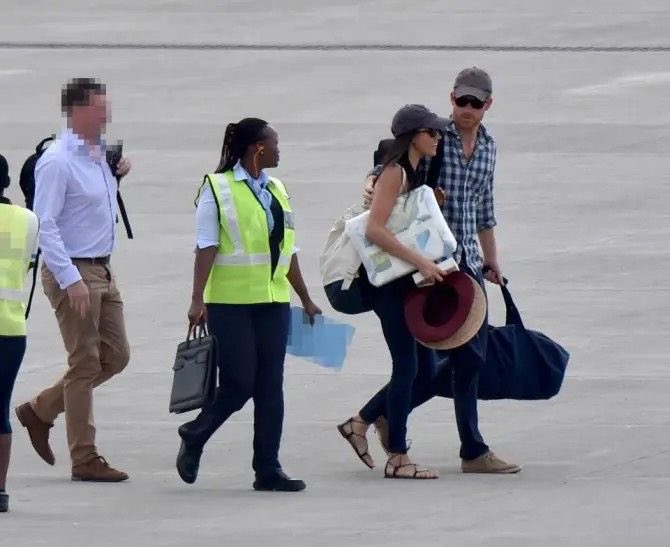
They landed at Birmingham Airport just before midday on Wednesday, 26 August, on a chartered Bombardier Global Express XRS — a long-range business jet with beds, two bathrooms and a hire rate reported at about $12,000 (£9,000) an hour. A ten-hour hop from Van Nuys, California, puts the flight in six-figure territory. They did not own the aircraft. They rented it from Planet Nine Private Air so the dogs could come too. The chickens, famously, stayed in Montecito.
That is the first tell. Real wealth does not issue a press kit for a taxi ride in the sky. The Sussexes’ entire return has been accompanied by a running inventory: the jet model, the hourly rate, the two black Range Rovers (in the ballpark of £90,000 apiece on the used-to-new market), and an £80,000 black Mercedes van that hauled the luggage while the family was “whisked away.” British papers photographed the convoy. There was no taxpayer-funded police escort. A private team — including a former Met officer now in the commercial trade — did the job instead.
Meghan has spent years branding herself the victim of intrusion. Then the arrival leaked like a product launch: plane, SUVs, van, price tags attached. That is not old-money discretion. It is influencer stagecraft — the same reflex that turns a grocery run into content and a rented driveway into a lifestyle ad.
The 83-acre daydream
Royal commentator Katie Nicholl has described the rumoured Cotswolds base as an 18th-century farmhouse with a pool, set in 83 acres of private farmland, with no public footpaths and Daylesford — the expensive farm shop of the Chipping Norton set — as the nearest “supermarket.” Some accounts float a figure north of £15 million. Estate agents talking to The Times put a comparable six-to-seven-bedroom house with staff quarters and enough land for privacy at £10 million in the north Cotswolds, or £7.5 million further south; rent would run £10,000 to £40,000 a month. Other reports say no purchase has closed and the family is parked, “indefinitely,” in a spare house on a wealthy friend’s land.
Either way, the brief is revealing. Meghan is said to want nine bedrooms and a home film studio so she can keep manufacturing “homemaking” content. Harry wants acreage and no ramblers. They already know the area: in 2018 they rented a £2.5 million Grade II farmhouse on the Great Tew Estate, then fled after aerial pictures appeared. They are circling the same celebrity paddock as the Beckhams, Ellen DeGeneres and Soho Farmhouse — not because they belong to it, but because they want to be photographed belonging to it.
Old money does not publish the price of the Range Rover. It does not need a studio in the barn to prove it lives in the country. The Waleses do not issue a spreadsheet every time they change cars. That contrast is the point Meghan never grasps. Privacy is a habit of people who are secure. Public price tags are a habit of people who are selling.
The lifestyle they advertise is not the lifestyle they fund
Look at the ledger they would rather you ignore.
They still hold the Montecito mansion, bought in 2020 for $14.65 million through a company, with a $9.52 million mortgage. Keeping that house mothballed while they “try” Britain has been estimated at up to $600,000 a year in mortgage, tax and upkeep. They also keep a reported £6.3 million holiday place in Portugal. Add private security — experts have put a serious UK detail at around £3 million a year — plus two children heading into Cotswolds prep-school fees that can top £50,000 a year per child at the top end, plus the next private-jet shuttle between three countries. The Times and others have sketched an “international lifestyle” that costs millions annually with no palace stipend attached. King Charles is not housing them and is not writing the security cheque.
How do they pay for it? Not with jobs in the ordinary sense. Spotify cut them loose after a thin return; an executive called them “grifters.” Netflix has been a mixed, shrinking bet. Meghan’s jam-and-lifestyle brand has been dogged by reports of unsold stock and a public that never quite converted from curiosity to customers. Page Six sources have described cash going out as fast as it comes in, staff cuts, and a household that needs several million dollars a year just to stand still in California. Then came the High Court: Harry and six co-claimants lost their privacy case against the Daily Mail publisher. Associated Newspapers’ costs were put at up to £34.5 million. Insurance covers £16.2 million. The shortfall is ugly. The judge ordered an interim £9.54 million payment. That is not a rounding error. That is a hole in the floor.
So the private jet and the blacked-out convoy are not proof of abundance. They are a rented costume. Chartering a Bombardier is not the same as owning one. Sitting in a Range Rover is not the same as holding the logbook. Parked on a friend’s estate is not the same as a title deed in your name. The only assets the Sussexes reliably advertise that actually sit on their side of the balance sheet are obligations: a California mortgage, a Portugal upkeep bill, commercial deals that under-delivered, and a legal tab they still have to service.
They want the palace perks without the palace rules
Harry spent years telling Britain he could not bring his children home without state-funded protection. He lost that fight. Seventy-one percent of the public, in a Times poll cited around the return, said the government should not pay for their security. They arrived anyway — and the first political argument of the homecoming was whether taxpayers should now pick up a bill the couple created by quitting the institution that used to protect them for free.
That is the vulgarity. Not the existence of money. The performance of money they do not fully control, paired with a hand still out toward the public purse. Meghan built a global brand on the claim that the institution failed her. Harry built a memoir on the claim that his family failed him. They then spent six years in California failing to replace the machine they smashed — and flew home on a hired jet to enrol the children in English schools, shop the Daylesford aisle, and test whether proximity to Highgrove might soften the King.
Britain is poorer in real terms than when they left. Food is sharply more expensive. The NHS waiting lists are longer. The couple’s answer is a photo-ready farmhouse, a film studio in the brief, and another round of “how will they pay for it?” coverage that they themselves feed by making sure every vehicle and every acre comes with a number attached.
You can take Meghan Markle out of the content mill. You cannot take the content mill out of Meghan Markle. Harry chose that mill over the institution that raised him. They are not returning as working royals. They are returning as a brand in need of a new set — and they have already started selling the set by the square foot and the sticker price.
True affluence does not need you to know what the jet cost. Desperation does.