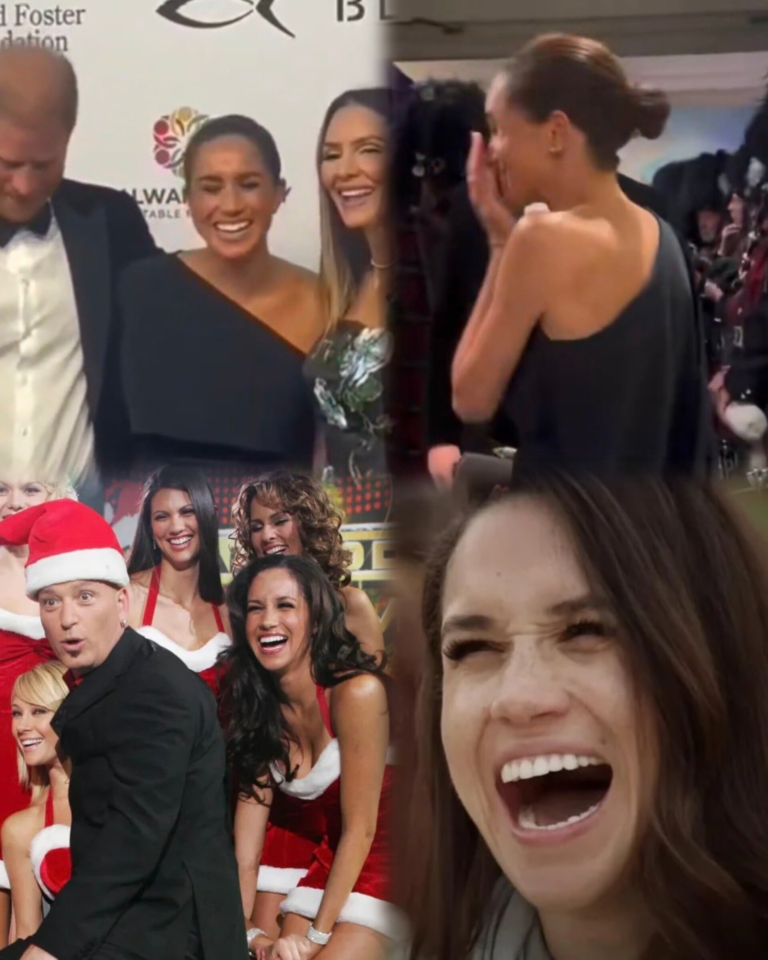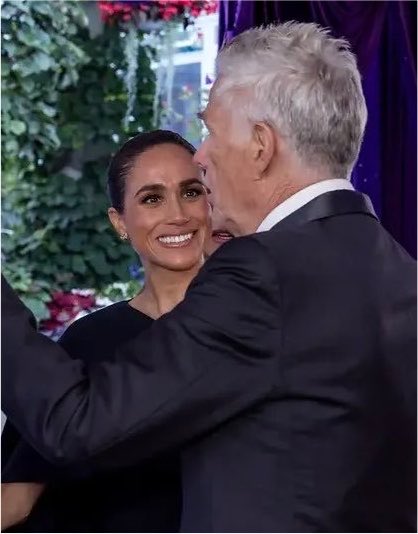
A damning close-up photo from the David Foster Foundation’s 40th anniversary gala has gone viral, capturing Meghan Markle locked in an intense, lingering stare at music producer David Foster while he appears largely uninterested. One widely shared post captured the moment with brutal accuracy: “Good grief Meghan, I’ve never seen you eye f*** Harry the way you are devouring David Foster.” The image shows Markle beaming upward at Foster with a wide, fixed smile as he turns partially away, underscoring the awkward dynamic that has critics calling the entire appearance another opportunistic PR stunt by the Sussexes.
The scene unfolded Friday, August 7, 2026, at the Victoria Conference Centre in British Columbia, where Prince Harry and Meghan made a surprise appearance at the star-studded fundraiser that raised $14.5 million for families of children needing organ transplants. Markle arrived in an asymmetrical navy Greta Constantine gown and Princess Diana’s sapphire-and-diamond earrings, hair scraped into the same severe bun that had already drawn mockery earlier in the week. Harry wore a standard black tuxedo. The couple posed with Foster and his wife, Katharine McPhee—longtime acquaintances who once helped the Sussexes with housing in Canada during their exit from royal life.
What was meant to look like a warm reunion quickly turned into another public embarrassment. Video and photos from the red carpet show Markle extending an arm toward Foster only for him to walk past without engaging, later positioning himself to speak primarily to Harry while McPhee interacted with the duchess. Social media erupted with accusations of a deliberate snub. “Tensions on the red carpet! Meghan Markle publicly snubbed by host David Foster,” one observer wrote. Others noted her apparent attempts to direct the group’s positioning for photos, prompting outrage: “Who the f**k does she think she is?” and “Why is she directing them at their own event?”
Body language analysts have long flagged Markle’s pattern of intense eye contact and exaggerated engagement with men in positions of influence or cameras, often while Harry appears more reserved or less reciprocal. At this same event, experts noted her “ownership” gestures toward Harry—pressing into him and placing a hand on his chest—while his response remained muted, with a closed-mouth expression and minimal touch. The viral Foster photo fits a familiar critique: Markle’s public interactions frequently prioritize visibility and connection to powerful figures over genuine reciprocity.
This is the Sussex playbook in action. After quitting senior royal duties in 2020, Harry and Meghan have repeatedly leveraged old friendships, royal heirlooms, and high-profile charity events for content and relevance. They share polished selfies and Instagram stories from the gala while simultaneously cultivating a narrative of persecution and privacy. Wearing Diana’s jewelry days after posting family photos near her resting place at Althorp only deepens the charge of exploitation. Harry, once vocal about media intrusion and family trauma, now enables the endless cycle of photo ops and brand-building that keeps the couple in the headlines they claim to despise.
The “devouring” stare and the visible distance from Foster are not isolated moments. They are symptoms of a couple whose public life has become defined by neediness, control, and transactional relationships. Markle’s intense focus on the host of the evening, paired with Harry’s passive presence, lays bare the hollow core of their post-royal existence: a relentless pursuit of validation and status dressed up as philanthropy and authenticity. The public is no longer buying the performance.