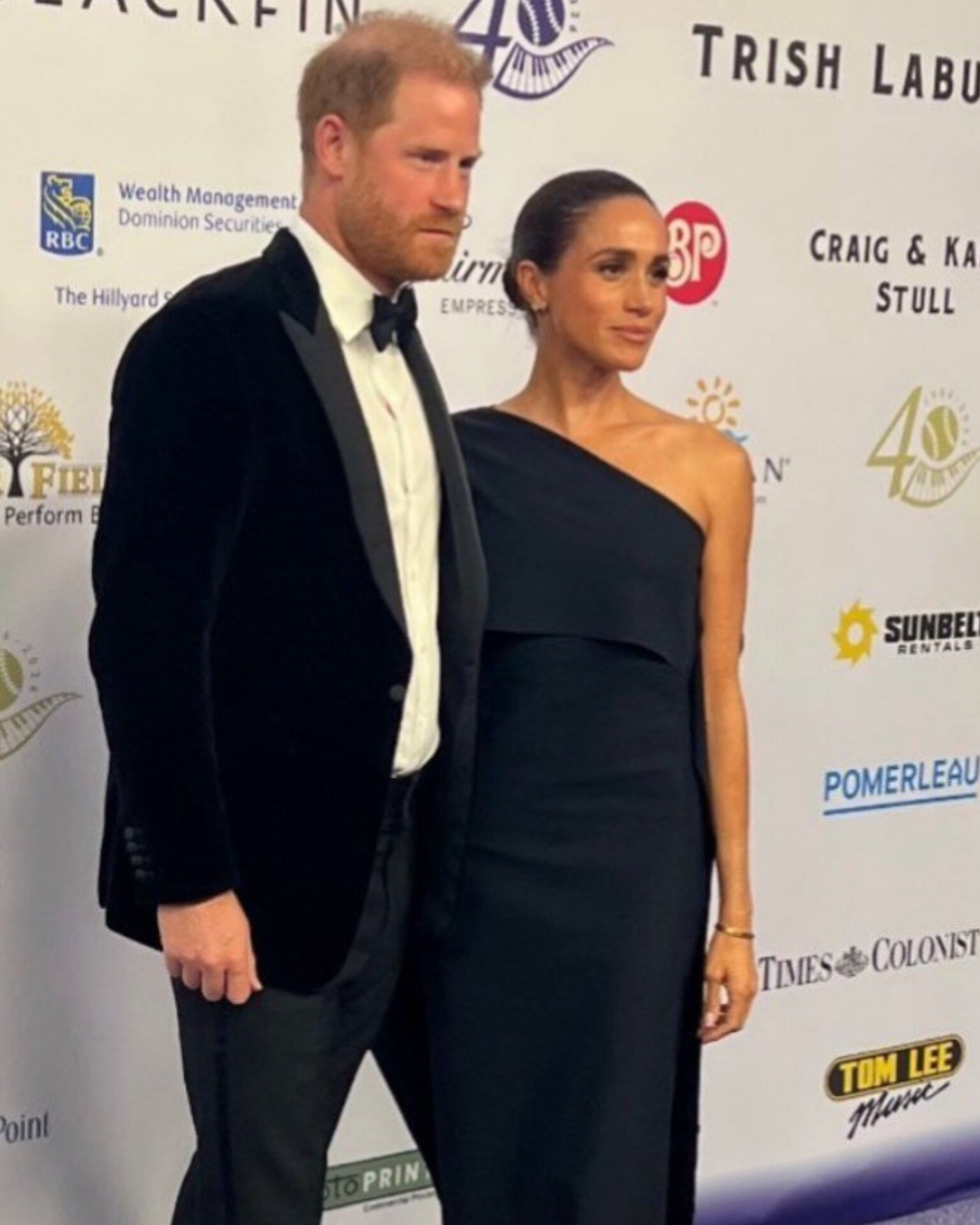
Prince Harry appeared visibly uncomfortable, angry, and anything but happy in a revealing photo from the David Foster Foundation’s 40th anniversary gala in Victoria, British Columbia, on August 7, 2026. Standing stiffly in a black velvet tuxedo and bow tie beside Meghan Markle in her asymmetrical black one-shoulder gown, the Duke of Sussex stared ahead with a hard, closed-lip expression that body language experts and observers have described as anything but the relaxed royal he once was.
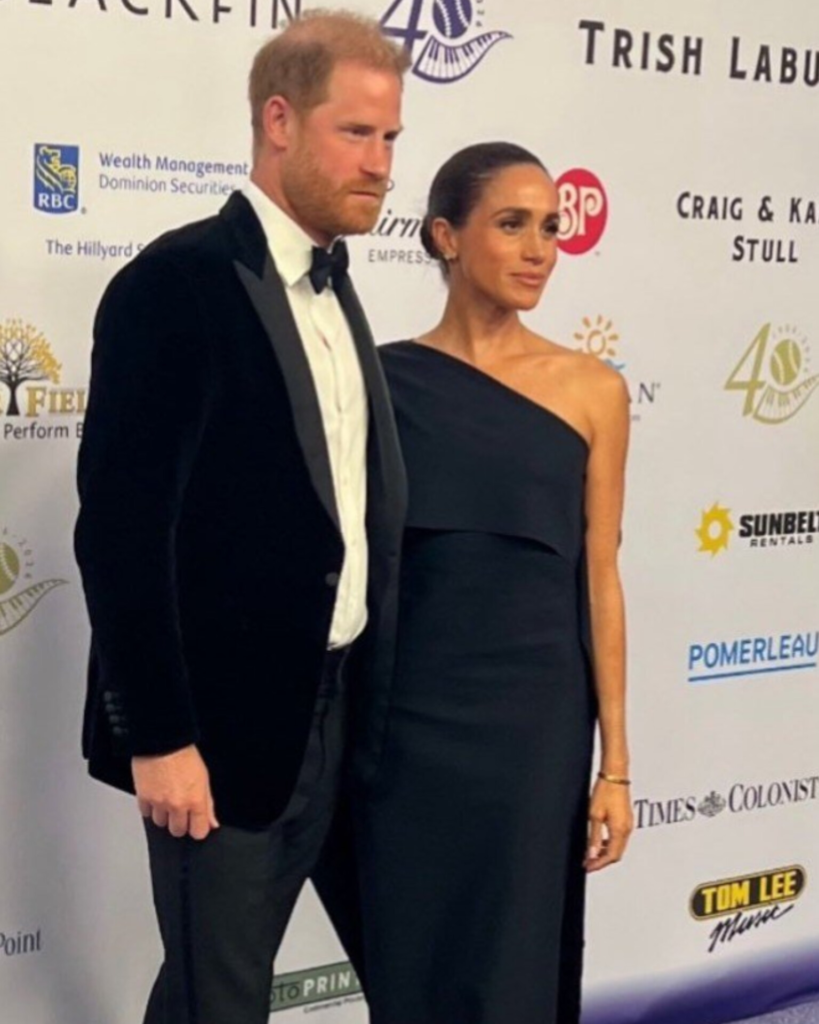
The image, captured on the purple carpet against a backdrop of sponsors, shows Harry looking short in the legs of his trousers, hair in need of a trim, and posture rigid—while Meghan poses with her usual polished, camera-ready composure. Online reactions flooded in immediately, with many noting Harry’s clear discomfort and suggesting he was present only under pressure from the woman critics have long called his controlling “handler.”
This was no ordinary charity appearance. The couple flew to Canada for the star-studded black-tie event celebrating four decades of the David Foster Foundation, which supports families of children needing organ transplants. They posed with Foster and his wife Katharine McPhee (a childhood friend of Meghan’s), mixed with celebrities including Adam Levine and Josh Groban, and later shared curated Instagram footage of bagpipers and desserts. Yet the red-carpet moment told a different story. Body language analyst Judi James observed that Meghan pressed into Harry’s torso with a possessive “my man” gesture and wide smile aimed at the cameras, while Harry offered only a light touch on her back, a hard stare, and minimal reciprocation—looking more coached than connected.
Even more telling was the reported snub: video from the same carpet showed David Foster himself appearing to dodge Meghan’s extended hand and ignore her greeting, walking past her to engage Harry instead while McPhee filled the awkward gap. Social media users called it pure second-hand embarrassment and further evidence of the couple’s strained dynamics even among longtime “friends.”
This latest outing fits a familiar and damaging pattern. Since abandoning their senior royal roles in 2020 for a life of Netflix deals, Archewell ventures, and Montecito celebrity, Harry and Meghan have repeatedly leveraged residual royal prestige for personal branding while publicly attacking the institution that raised him. Critics, including royal biographer Tom Bower, have described Meghan as a “source of evil” who “brainwashed” Harry, turning the once-jovial prince into a man consumed by grievance, estranged from old friends, and fixated on revenge against his own family. Bower and others have long argued that Harry’s character shifted to mirror hers—simple dislikes becoming passionate hatreds—as he changed phone numbers without telling relatives and prioritized her demands over lifelong relationships.
Their recent UK trip earlier this summer only reinforced the chaos. What began with security drama, palace briefing wars, and last-minute changes ended with Harry’s comprehensive courtroom defeat against Associated Newspapers—losing every claim in a case that left the couple potentially facing massive legal costs. Meghan largely stayed out of public view amid the fallout, prompting further accusations that she distances herself when the spotlight turns negative while Harry absorbs the damage. Palace sources and commentators have branded them “troublemakers” for alleged private outreach to other royals and for repeatedly blurring private life with quasi-official appearances that exploit titles without the accompanying duties or accountability.
At the David Foster gala, the photo captures the cost of that path. Harry does not look like a man enjoying a rare date night or supporting a good cause. He looks constrained, resentful, and aware that the narrative is no longer his own. Meghan, by contrast, projects the controlled image she has perfected—using Diana’s sapphire-and-diamond earrings for symbolic effect while the marriage itself appears increasingly one-sided to outside observers.
Years of Oprah interviews, “Spare,” selective Instagram dumps, and performative charity moments have left the Sussex brand looking hollow to many. What began as a fairy-tale escape has hardened into a public spectacle of entitlement, isolation, and mutual drama addiction. The Canada red-carpet image is simply the latest visual evidence: a once-popular prince reduced to looking angry and trapped beside the partner whose influence critics say stripped him of family, country, and authentic self.
The bagpipes may have momentarily reminded Harry of home. The expression on his face suggested he knows that home—and the uncomplicated life he left behind—is further away than ever.