Is it finally time to call Meghan Markle what she is: literally pitiful?
At 45, the Duchess of Sussex has spent the better part of a decade since walking away from the British royal family with little more than a string of half-baked projects, fading relevance, and an endless campaign to monetize the very institution she and Prince Harry claimed was so toxic they had to flee. What remains is a sad spectacle of a woman whose primary achievement appears to be basking in the reflected glory of a title and lineage she publicly rejected.
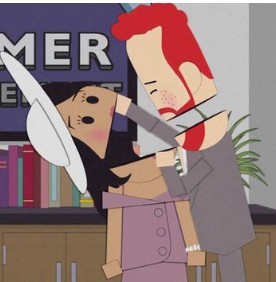
The cartoon circulating online captures the moment perfectly: a frustrated, South Park-style Harry yanking the hat from Meghan’s head in what looks like pure exasperation. It is not subtle. It is not kind. And it lands because it feels true.
Meghan Markle turned 45 on August 4, 2026. Instead of a triumphant mid-career peak, the milestone arrived amid another public failure. The couple’s theatrical documentary Cookie Queens — their first feature as executive producers under Archewell Productions — opened to a dismal $327,797 from 446 screens. That works out to roughly $735 per screen. It was beaten at the box office by CatVideoFest 2026, a compilation of internet cat videos.
Industry observers did not mince words. One source called the return “pretty pitiful.” Critics may have been kinder, but audiences simply did not care. The film’s late-summer release timing was called a major misstep, yet the deeper problem is more fundamental: the Sussex brand no longer moves the needle.
This is not an isolated flop. Netflix ended the exclusive multi-year deal that once underwrote the couple’s California lifestyle, shifting to a far less lucrative first-look arrangement. Meghan’s lifestyle series With Love, Meghan underperformed. Her podcast efforts stalled. The rebranded homewares line As Ever has struggled with limited inventory, supply-chain complaints, and an inability to convert fame into sustained consumer loyalty. Advisers have even suggested the pair “disappear professionally” for a while to salvage what remains of their reputation.
Harry, for his part, has spent years oscillating between grievance memoirs, security complaints, and half-hearted attempts at reconciliation with his father, King Charles, while remaining estranged from his brother William. Recent reports of marital tension, separate living arrangements, and Meghan deliberately appearing without her engagement ring only add to the sense of a partnership running on fumes. Sources describe Harry as increasingly focused on mending fences with the family he left, while Meghan prioritizes independence and Hollywood aspirations that keep falling flat.
What, exactly, has Meghan produced in 45 years that stands on its own merit without the royal halo? A solid supporting role on Suits, a short-lived lifestyle blog, and a series of media deals that converted temporary curiosity into short-term cash. The rest is complaint, curation, and the relentless packaging of personal narrative as product. The Oprah interview, the Netflix docuseries, the endless hints of palace cruelty — all of it leaned on the very institution she claimed to reject. Once the shock value faded, so did the audience.
The couple’s combined net worth is estimated around $60 million, a figure that looks impressive until one accounts for the massive security costs, legal bills, Montecito lifestyle, and the fact that the biggest paydays came from deals that have since been scaled back or ended. Their charitable vehicle, Archewell, has also seen declining revenue in recent reporting compared with the far more successful efforts of the Prince and Princess of Wales.
There is something uniquely hollow about watching two people who walked away from duty, privilege, and public service spend the subsequent years trying to sell the residual glamour of that same world back to the public. Meghan’s birthday posts — poolside balloons, kitchen dances, dogs in party hats — try hard to project joy and normalcy. They read instead as carefully staged evidence that the Montecito experiment is working. The public is no longer buying it.
Harry enabled this trajectory. He chose the exit, the memoir, the endless airing of family grievances, and the partnership that turned private unhappiness into a content brand. Both have treated the monarchy as both tormentor and product. The result is a pair who appear increasingly irrelevant, increasingly brittle, and increasingly defined by what they left behind rather than anything original they have built.
At 45, Meghan Markle has the fame, the title, the house, and the platform. What she does not have is a body of work, a loyal audience, or a reputation that stands independent of the royalty she spent years attacking. That is not empowerment. That is not reinvention. That is simply pitiful. And Harry, standing beside her through every misstep, looks no better.
The cartoon may be crude. The verdict it delivers is not.