In what may go down as one of the most spectacular own-goals in recent celebrity media history, a newly circulating trailer tied to an upcoming Netflix project has done what months of careful PR could not: it has captured, frame by frame, the complete migration pattern of Meghan Markle’s much-hyped “joy.”
Last year, the Duchess of Sussex positioned herself as a lifestyle guru of sorts, flooding timelines and interviews with calls to “find joy” in the everyday. Followers were told to embrace gratitude, slow down, and seek happiness in simple moments. The messaging was warm, aspirational, and perfectly timed with her various brand and foundation pushes.
Fast-forward to this week, and the same woman who urged the world to locate joy now finds herself at the center of a viral storm. The trailer in question — a montage of domestic, workshop, and candid-style moments — has been mercilessly dissected online. Instead of selling effortless bliss, it has documented something far more revealing: joy’s great escape.
The Clips That Broke the Internet
The footage stitches together several sequences that, taken individually, might have flown under the radar. Together, they form a damning highlight reel.
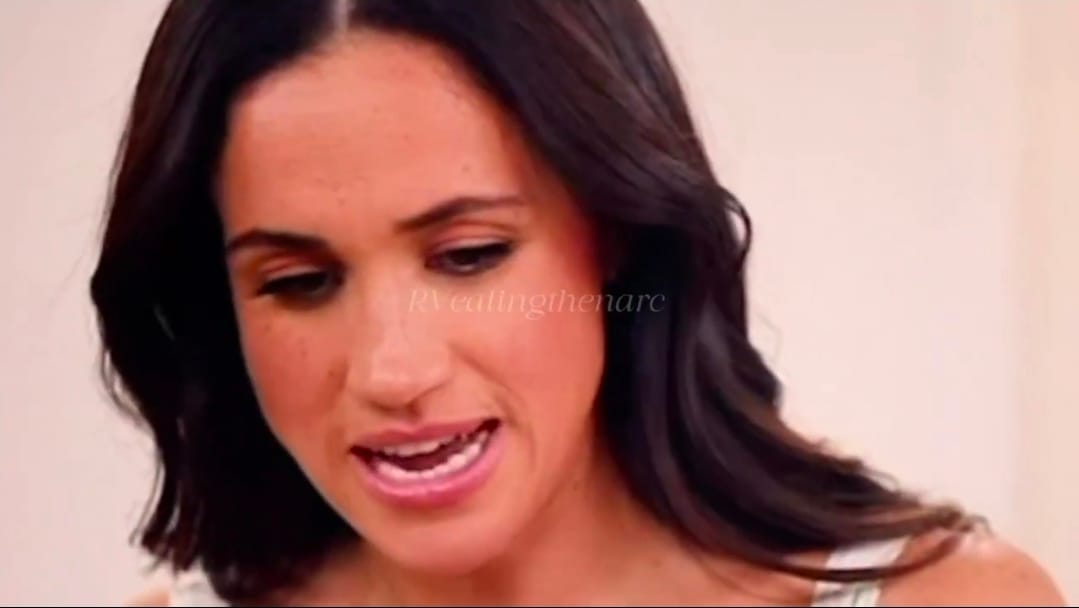
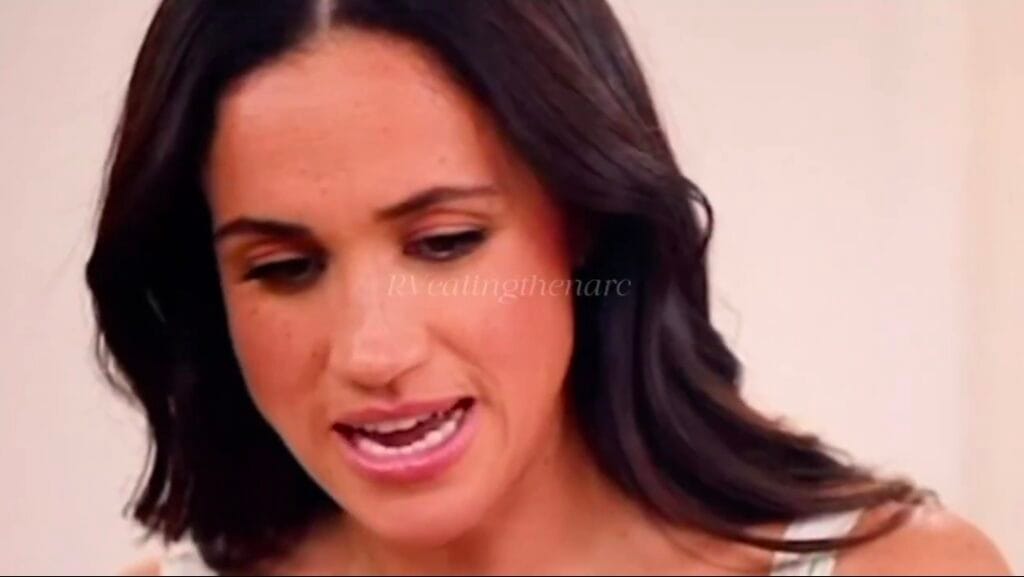
There is the now-infamous close-up of Markle in a purple knit, flashing a wide, toothy grin while clasping her hands near her face. The smile is technically perfect — dental work gleaming, cheeks lifted — yet something in the eyes refuses to fully participate. It is the smile of someone who has practiced this expression in the mirror.
Cut to a domestic scene: Markle in a striped top, seen from a side-rear angle in what appears to be a stylish kitchen. She claps and gestures with exaggerated enthusiasm as if reacting to an off-camera surprise. The energy is high, almost frantic. To critics, it reads less like spontaneous delight and more like a woman auditioning for her own life.
Another sequence places her in a more industrial or workshop-style environment, leaning forward in a dark top, laughing with her head angled downward. The laugh is hearty on the surface, but the context feels jarring — as though the joy is being performed on demand rather than emerging naturally.
Then comes the tasting moment: Markle brings food to her mouth, pauses, and delivers another camera-ready smile. The transition from tasting to performing is seamless and, to detractors, deeply telling.
The pièce de résistance is the full-throated, head-thrown-back cackle in the striped top. Eyes squeezed shut, mouth wide open — it is the kind of laugh that demands attention. For some viewers, it is the moment the mask slips entirely. For others, it is simply further proof that the performance has become the product.
“The Entire Migration Pattern”
The viral caption that accompanied the clip summed it up with brutal efficiency: Meghan spent last year encouraging everyone to find joy. The Netflix trailer appears to have documented its entire migration pattern.
The metaphor is savage in its precision. Joy is not merely absent — it has moved on. It has packed its bags, filed a change-of-address form, and left the Montecito zip code. What remains is the performance of joy: the muscle memory of smiling, the choreography of laughter, the muscle memory of a woman who once believed (or needed the world to believe) that happiness could be content-created on command.
The Hypocrisy Charge
The backlash has been swift and vicious in certain corners of social media. Critics argue this is not an isolated misstep but part of a larger pattern. The same woman who spoke of authenticity and vulnerability is accused of delivering the most inauthentic version of happiness possible — one that requires constant external validation and careful editing.
Body language commentators have been particularly brutal. Several have pointed out the lack of genuine Duchenne markers in the smiles — the eye crinkles that signal authentic amusement are frequently missing. What remains is “mouth work,” they say, the facial equivalent of acting class exercises.
Others have connected the dots to previous projects: the carefully managed Netflix docuseries, the podcast episodes heavy on narrative control, the public appearances that often felt more like photoshoots than moments. The trailer, they argue, simply removes the filter.
Public Reaction: From Eye-Rolls to Full Roast
Online, the response has ranged from the savage to the scholarly. One popular reply read simply: “She’s still looking for joy but joy doesn’t want to see her.” Another observed that the false laugh has become her signature — polished, empty, and instantly recognizable.
Supporters have pushed back, claiming the clips are edited out of context or that Markle is simply a naturally expressive person being unfairly scrutinized. Detractors counter that if the joy were real, it wouldn’t require this level of defense or this volume of performance.
Royal watchers have been quick to draw comparisons — some favorable to the Prince and Princess of Wales, whose family moments are often described as more understated and less curated. The contrast, whether fair or not, has only amplified the current conversation.
What This Means for the Brand
For a woman whose post-royal career has leaned heavily into lifestyle, wellness, and aspirational content, this is more than a bad clip day. It is a branding crisis in miniature.
When your central message is “find joy,” and your own footage becomes the primary evidence that the joy has migrated elsewhere, the commercial implications are obvious. Future projects — whether lifestyle series, brand partnerships, or public appearances — now carry the burden of proving authenticity rather than assuming it.
The timing could not be worse. With multiple high-profile ventures already under the microscope for viewership and cultural impact, another round of “is any of this real?” discourse is the last thing the Sussex brand needed.
The Performance of a Lifetime
Ultimately, the trailer has achieved something its producers likely never intended. It has turned Meghan Markle’s own face into the most compelling argument against her current narrative.
The laughter is loud. The smiles are bright. The gestures are enthusiastic. But somewhere between the kitchen clapping and the workshop cackle, something essential appears to have slipped away — or perhaps was never truly there to begin with.
Joy, it seems, has completed its migration. And the cameras, cruelly, kept rolling.
Whether this latest storm passes like so many before it or marks a genuine turning point in public perception remains to be seen. One thing, however, is already clear: the woman who told the world to find joy may have accidentally shown us exactly where it went.