A resurfaced video from the couple’s 2018 royal tour of Australia is once again sending shockwaves across social media, with critics branding Meghan Markle’s signature two-handed hold on Prince Harry as her infamous “double claw” — an unusually tight, almost desperate grip that many are calling controlling, possessive, and deeply revealing.
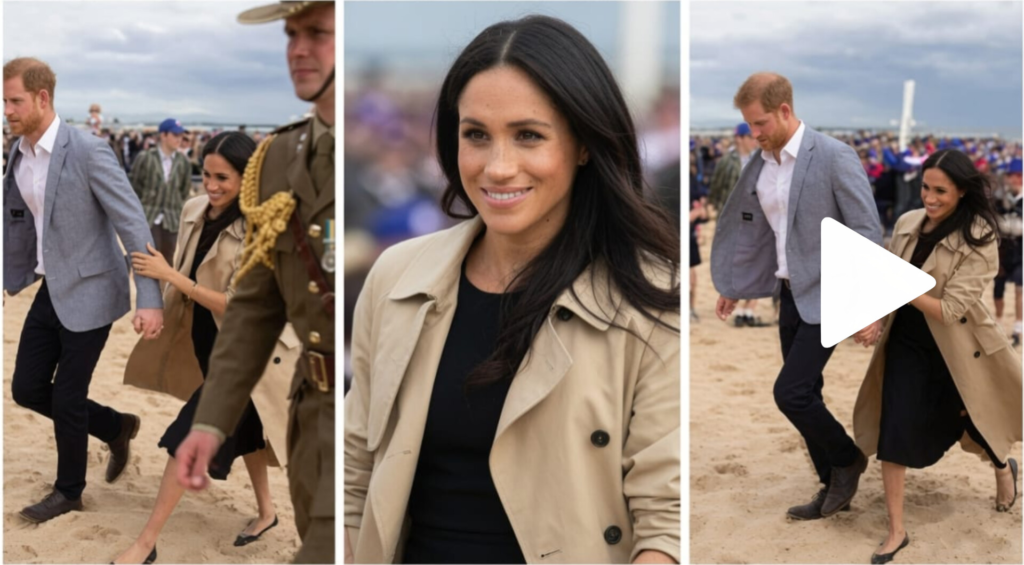
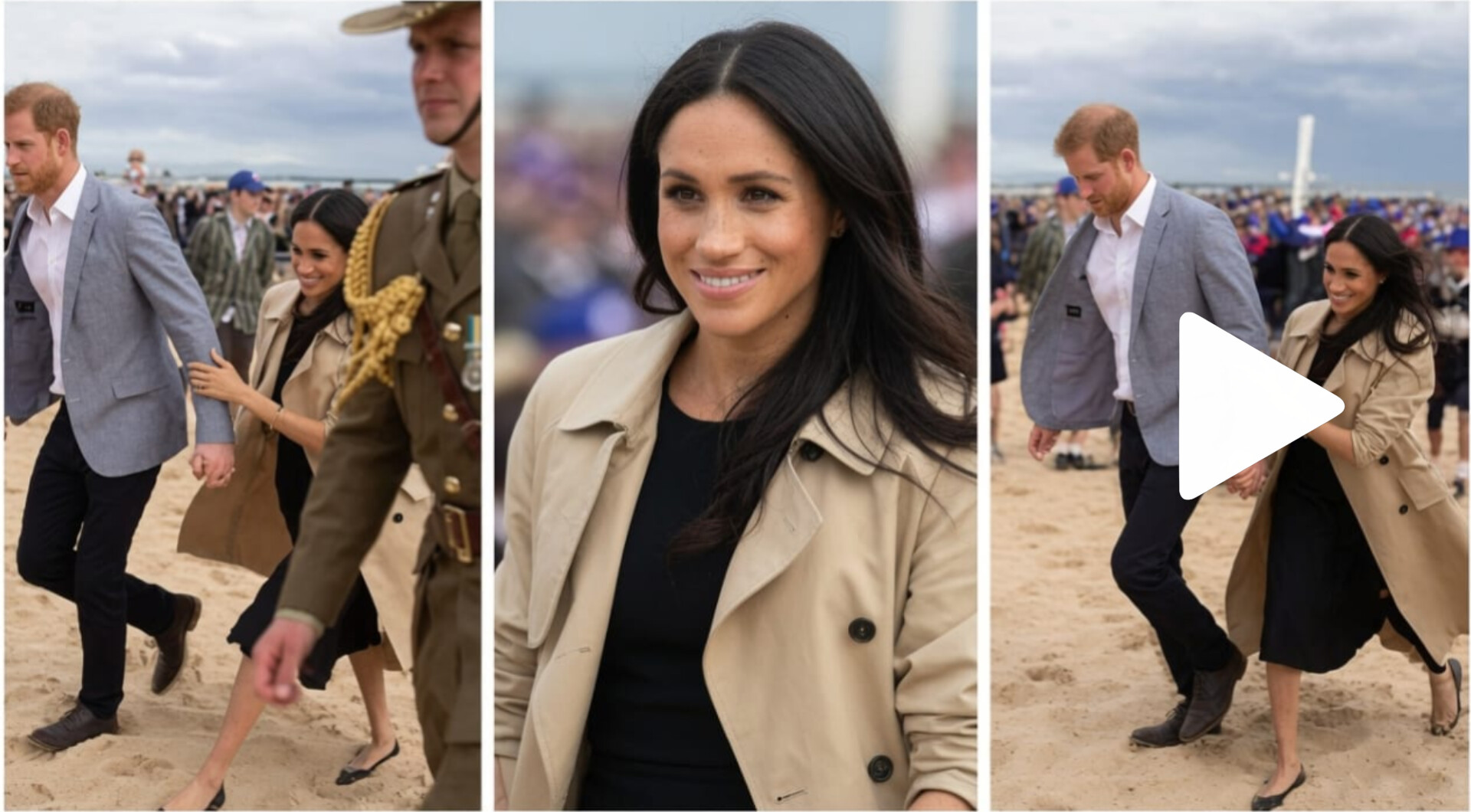
The roughly 12-second clip, captured during a public beachside engagement Down Under, shows the then newlyweds navigating a sandy stretch lined with cheering crowds, military personnel, and photographers. Harry, dressed in a grey suit, strides forward with purpose. Meghan, in a beige trench coat over a black dress, keeps pace — but not without latching onto his left arm with both hands in a firm, claw-like grip that appears to dig into his sleeve.
What has viewers and body language watchers transfixed is the sheer intensity. Her fingers splay and tighten visibly, at times pulling or redirecting his movement as they walk. Harry keeps his gaze forward or slightly down, his body language suggesting forward momentum, while Meghan’s hold looks less like affectionate hand-holding and more like a deliberate anchor.
The “Double Claw” That Broke the Internet
Social media users who have dissected the footage are not holding back. One widely shared reaction summed it up bluntly: “The double claw is just so intense!” Others described it as a “vice grip,” “creepy,” and “extraordinarily strange and controlling.” Several noted that Harry appears to be trying to move ahead while Meghan’s hands act like physical restraints, keeping him tethered.
“She acts like she thinks he’s gonna bolt if she lets go,” one commenter observed. Another added: “He looks as if he’s trying to outrun her.” Multiple viewers pointed out the contrast with typical royal couples, where hand-holding is usually relaxed and mutual. Here, the dynamic looks one-sided and almost frantic.
Body language analysts who have studied similar clips from the Sussexes’ public appearances say this particular grip goes beyond simple affection or nervousness. The use of both hands, the spread fingers, and the sustained pressure suggest a need to maintain physical control of the narrative — and of Harry himself — especially in front of cameras. In a crowded, high-stakes setting like the 2018 Australia tour, every frame mattered. Critics argue Meghan’s “double claw” ensured she remained central in every shot, literally attached to her husband.
Not an Isolated Moment
This 2018 footage is far from the only example critics have flagged over the years. Observers have long commented on a recurring pattern: Meghan frequently reaching for Harry’s arm or hand with notable firmness during walkabouts, arrivals, and public events. Some describe it as “steering” or “directing” him through crowds. Others see it as a visible manifestation of insecurity or a desire to project unity at all costs.
During the Australia-New Zealand-Fiji-Tonga tour — their first major overseas outing as a married couple — the pressure was enormous. The world was watching the new Duchess closely. According to those who study these interactions, the tight physical connection may have served multiple purposes: reassurance for her, visual proof of togetherness for the cameras, and perhaps a subtle way of guiding Harry’s pace and positioning.
Harry’s own posture in the clip — leaning slightly forward, eyes ahead — has been interpreted by some as a man trying to keep moving while being physically held back. Whether he welcomed the constant contact or simply endured it remains a matter of speculation, but the visual contrast between his forward drive and her anchoring grip is striking.
Public Reaction: “She Can’t Walk on Her Own?”
The resurfaced video has ignited a fresh wave of commentary, much of it highly critical. “I’ve never seen ANYONE do this unless they were having massive trouble walking and needed support. She’s a loon,” one user wrote. Another asked pointedly: “Can she not walk about on her own? She’s pathetic.”
Others took a more psychological angle: “She pretends she is relying on him, that she is vulnerable, and it is all BS — she is doing it to control and dominate the stage.” Several noted the irony of a self-proclaimed feminist appearing to physically drag or anchor her husband in public.
The clip has also prompted comparisons to other high-profile moments where similar behavior was observed, reinforcing for critics a consistent pattern rather than a one-off nervous reaction on a windy beach.
What Does It Really Reveal?
Supporters of the couple have long dismissed such observations as over-analysis or outright misogyny. They argue that any hand-holding in public can look awkward on camera and that the intense scrutiny itself creates the perception of strangeness.
But for a growing number of online commentators and royal watchers, the “double claw” has become shorthand for something deeper — a visual representation of a relationship dynamic they believe is fundamentally imbalanced. The grip, they say, is not about love or support. It is about possession, visibility, and control.
Whether Harry ever felt smothered by the constant physical tethering is something only he knows. What the footage undeniably shows is a moment frozen in time: a husband walking forward while his wife’s hands remain locked on his arm like a vice.
The Video Keeps Circulating — And the Questions Remain
More than seven years after it was filmed, the clip continues to resonate because it captures something raw and unscripted. In an era of carefully curated images and polished PR, these unfiltered seconds of body language speak louder than any carefully worded statement.
As the video racks up views and reactions once again, one question keeps surfacing: Was this simply an affectionate — if unusually firm — hold between newlyweds under pressure? Or was it, as so many now claim, the “double claw” of a woman determined to never let go — literally or figuratively?
The footage doesn’t lie. Harry kept walking. Meghan kept holding on. And the world is still watching.