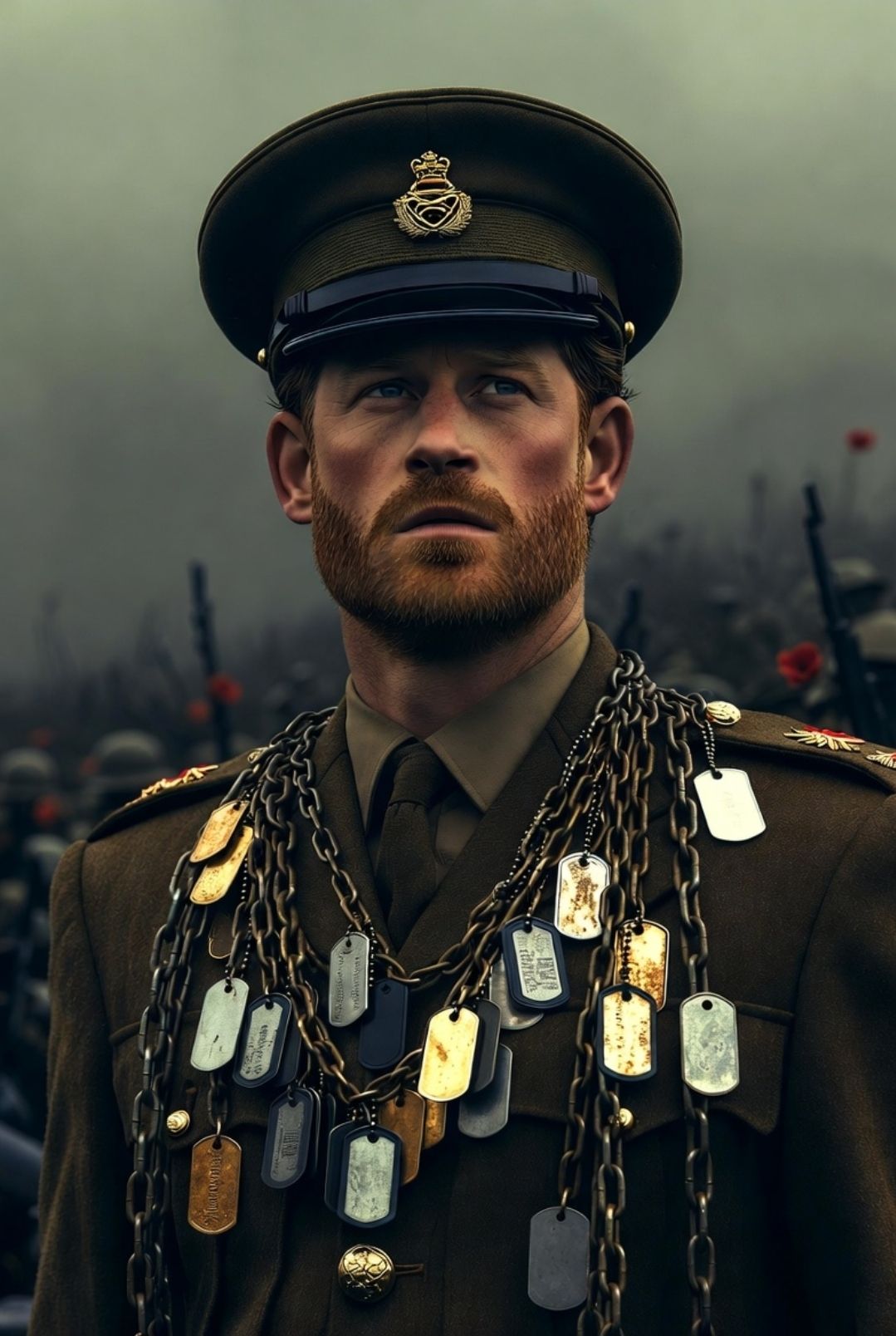
By Royal Insider Desk
In a moment that was meant to honor the ultimate price paid by Ukraine’s fallen defenders, Prince Harry, the self-styled “soldier prince,” has ignited a firestorm with a single, jaw-dropping phrase that has left military veterans, royal watchers, and grieving families reeling. What was billed as a solemn tribute at Kyiv’s National Military Memorial Cemetery has instead become the latest chapter in Harry’s seemingly endless saga of tone-deaf missteps – one that critics say reveals a man utterly detached from the brutal finality of war.
The handwritten note, left atop a grave during his unannounced visit yesterday alongside Ukraine’s Minister for Veterans’ Affairs Nataliya Kalmykova, read in full: “Thank you for your service and your sacrifice. We are all so grateful to you for your commitment to this great nation. Best wishes, Harry.”
Best wishes.
To the dead.
As one viral open letter now blasting across social media puts it with devastating precision: “To send ‘best wishes’ to fallen soldiers is not a small slip of phrasing. It is a failure to understand the finality of their sacrifice.” Penned by royal commentator Queen Esther and rapidly amassing thousands of engagements, the letter doesn’t pull punches – and neither should the world when confronting this glaring disconnect.
The full missive, which has dominated X (formerly Twitter) timelines since its posting this morning, continues: “These men and women are gone. They cannot receive wishes, cards, or gestures. What they left behind is memory, honour and the heavy responsibility of the living to speak of them with gravity and reverence.”
It’s not just semantics. In the sacred silence of a war cemetery – where fresh graves mark the irreversible cost of Russia’s brutal invasion – language matters. It reveals whether a public figure truly grasps the weight of what they’re invoking… or if it’s all performative optics in a desperate bid to reclaim relevance.
Harry, who served two tours in Afghanistan as an Apache helicopter pilot and has long leveraged his military credentials through the Invictus Games for wounded veterans, positioned himself as a kindred spirit to Ukraine’s fighters. He laid flowers, posed for carefully framed photos, and scrawled that note for the cameras. But in addressing the deceased as if they were pen pals awaiting a cheerful update from Montecito, California, he crossed a line that even casual observers find unforgivable.
“This is why such moments demand care,” the open letter thunders. “Language is not trivial here; it reveals whether we truly comprehend the cost of war or are merely performing respect. A thoughtful message would have honoured their service, acknowledged their sacrifice, and recognised that they are remembered, not addressed.”
Contrast this with the time-honoured rituals of remembrance that have defined British monarchy for centuries. “Lest we forget” isn’t just a slogan – it’s a solemn vow etched into the national psyche, from the poppy fields of the Somme to the cenotaphs of Whitehall. It doesn’t chat up the fallen; it bows before them. Even Prince William and Princess Kate, during recent ANZAC Day commemorations in London, struck the perfect chord of reverence without a single misfired pleasantry. No “best wishes.” No casual sign-off. Just the quiet dignity the dead demand.
Public reaction has been swift, brutal, and overwhelmingly supportive of the open letter’s takedown. “Best wishes? What? Just goes to show you what a nonce he is,” one veteran descendant fired back. Another replied: “He’s the village idiot.” Scores more piled on, calling the note “inauthentic,” “dim,” and proof that Harry “has never been a soldier” in spirit. One sharp observer noted the irony of Harry invoking “commitment to this great nation” while having walked away from every duty tied to Britain. “At some point it stops being irony and just becomes pure detachment from reality.”
Military insiders, speaking anonymously, echoed the outrage. “You don’t ‘wish’ the fallen anything,” a former British Army officer told us. “They gave everything. The living owe them silence, not salutations. This feels like signing a birthday card to a ghost.”
Harry’s defenders – the dwindling Sussex Squad – have tried to spin it as heartfelt gratitude amid his “humanitarian” trip. But the optics scream otherwise. Fresh from fresh rounds of tabloid scrutiny, family rifts, and the slow fade of his Hollywood-adjacent lifestyle, this Ukraine visit reeks of calculated PR. Laying flowers for the press? Check. Handwritten note leaked instantly? Check. Yet the execution? A catastrophic own-goal that has royals experts whispering: Has the spare finally run out of second chances?
Let’s rewind the tape on Harry’s military mythos. He once spoke rawly about the horrors of Afghanistan – the chess-piece analogy for enemies, the friends lost, the PTSD he later detailed in his bombshell memoir Spare. He founded Invictus to champion the wounded, not the dead. But war’s true gravity isn’t in the glory of service; it’s in the graves left behind. Those who “never came home,” as the open letter hauntingly reminds us, deserve language that doesn’t soften the blow. No Hallmark endings. No casual closers.
This isn’t about perfection. As the letter wisely notes: “This is not about demanding perfect words. It is about basic responsibility.” When you invoke the memory of those who died in service – especially on foreign soil, in a conflict still claiming lives daily – you carry an obligation. Harry, who lost comrades in Helmand Province, should know this better than most. Instead, the note feels like the work of a man who’s traded barracks discipline for California casual.
The fallout is already rippling. Ukrainian officials have stayed diplomatically silent, but back home in Britain, the royal family’s carefully guarded image of solemn duty is once again under fire. King Charles, battling health issues, has maintained stoic silence on his son’s latest escapades. Prince William, ever the steady heir, continues to embody the quiet reverence Harry seems to have misplaced.
And the families? The mothers, fathers, widows, and children of Ukraine’s fallen – or Britain’s own 457 Afghanistan dead, whom Harry once passionately defended against Donald Trump’s barbs – deserve better than this. They don’t want postcards from a prince. They want the world to remember their loved ones not as recipients of “best wishes,” but as eternal heroes whose sacrifice demands unvarnished truth.
The open letter closes with a gut-punch: “In matters of sacrifice and loss, there is no space for language that softens or diminishes what was given. The fallen deserve better.”
Indeed they do. As Harry jets back to his Montecito mansion, perhaps it’s time for the Duke of Sussex to reflect – not on optics or Invictus branding, but on the irreversible reality he claims to honor. War isn’t a photo op. The dead aren’t audience members awaiting your sign-off.
They are gone. And the living? We owe them gravity. We owe them reverence. We owe them words that don’t make their ultimate sacrifice sound like a polite exchange of pleasantries.
Prince Harry, the soldier who never quite left the spotlight, has been called out – loudly, publicly, and with the full weight of tradition behind it. Will he listen? Or will this be yet another “best wishes” moment forgotten in the next PR cycle?
The graves in Kyiv – and countless others across history’s battlefields – await an answer that actually means something.
Lest we forget.