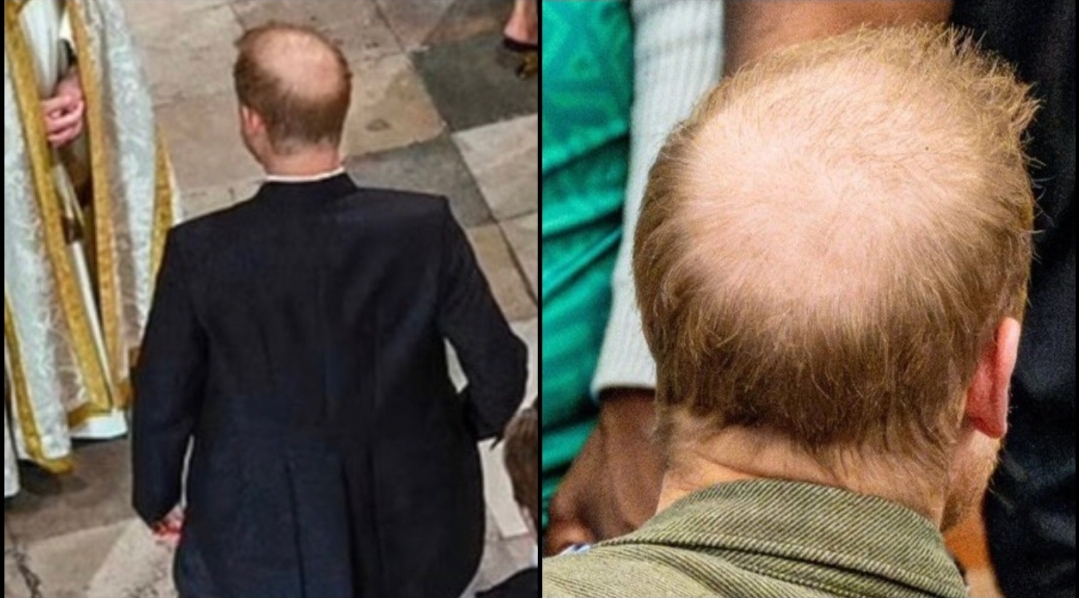
The side-by-side image above — and the one attached to this report — tells a story no amount of PR spin or Montecito mansion insulation can hide. On the left, Prince William at the 2023 Coronation, the weight of duty and family legacy visible even from behind as his crown thins in the most public of settings. On the right, a more recent photograph of his younger brother, Prince Harry, the Duke of Sussex, revealing an even more advanced recession of hair that has left a prominent, shiny expanse of scalp on full display.
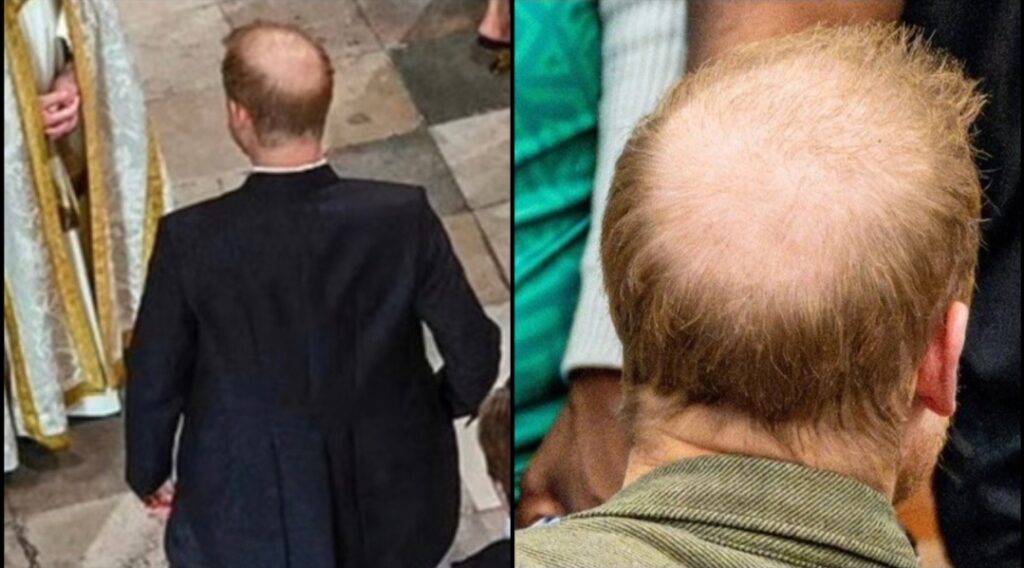
This is not merely a grooming observation. It is the visual manifestation of breathtaking hypocrisy from a man who, in his 2023 memoir Spare, chose to weaponize his brother’s appearance in one of the most personal and cutting passages of the entire book.
Harry wrote of looking at William after their grandfather Prince Philip’s funeral: “I took it all in: his familiar scowl, which had always been his default in dealings with me, his alarming baldness, more advanced than my own…”
At the time, Harry positioned himself as the one with the superior hairline. He framed William’s thinning as further evidence of his brother’s supposed emotional coldness and fading resemblance to their late mother. The comment was petty, unnecessary, and deliberately designed to sting — part of a broader pattern of settling scores with the family that raised him, protected him, and gave him every privilege.
Fast-forward to 2025 and 2026, and the mirror has turned. High-resolution photographs from public appearances, including trips to Australia and court proceedings in London, show Harry’s own hairline in dramatic retreat. The “alarming baldness” he once diagnosed in his brother now sits squarely atop his own head, complete with the thin, wispy strands and visible pink scalp that online observers have not hesitated to highlight.
The Bald Truth Is Only the Beginning
Hair loss is hereditary and common — millions of men experience it without turning it into a weapon against their own sibling. What makes this moment so damning for Harry and his wife, Meghan Markle, is how perfectly it symbolizes everything that has gone wrong since they stepped back from royal duties in 2020.
They sold the world a narrative of escape from toxicity, privacy invasion, and institutional racism. In reality, they have spent the years since monetizing their royal connections at every turn while simultaneously attacking the very institution that gave them global fame.
Harry’s book deal, the Netflix series, the Spotify podcast that was quietly shelved, the paid speaking engagements, and the high-ticket events where attendees are charged thousands of dollars to hear them speak — all of it trades on the titles and status they claim to have rejected. Critics, including royal biographer Tom Bower, have called out the hypocrisy of “monetising her royalty” after promising the late Queen they would not do so.
Recent developments have only sharpened the contradictions. In 2026, Harry suffered a significant legal defeat in his long-running privacy case against British newspapers. The man who has spent years decrying media intrusion and demanding “privacy” for his family built much of his post-royal income on the most intimate disclosures imaginable — about his brother, his father, his stepmother, and even his own mother’s memory. The court loss laid bare the selective outrage: privacy is sacred when it protects the Sussex brand, but apparently optional when there are book advances and streaming deals on the table.
Their approach to security reveals the same double standard. Having voluntarily left the working royal fold, Harry continues to push for taxpayer-funded protection in the UK while jetting between luxury homes and charging premium prices for appearances. Petitions in Australia protested the use of public resources for what critics called a private, profit-driven visit.
Meghan’s own social media activity and the couple’s creation of what has been described as their own “royal court” of staffers while publicly scorning palace courtiers adds another layer of inconsistency. They attack the system, then replicate its trappings for their own benefit.
The Wales Contrast: Duty Over Drama
While Harry and Meghan have chosen the path of perpetual grievance and public score-settling, Prince William and Princess Catherine have modeled a different way. They have absorbed personal attacks, health scares, and relentless media scrutiny with quiet resilience. They continue to undertake hundreds of official engagements, support countless charities, and raise their three children with evident stability and warmth.
William’s own hairline has been a topic of public discussion for years. He has handled it with dignity — at times opting for a close-cropped, practical style that suits a man with far more important responsibilities than vanity. He has never used it as ammunition against his brother. The contrast in character could not be starker.
A Pattern of Betrayal, Not Baldness
The baldness irony is memorable because it is visual and undeniable. But it sits within a much larger pattern:
- Publicly accusing the royal family of racism while offering little concrete evidence that withstood scrutiny.
- Claiming to want a private life while signing multimillion-dollar deals to air family laundry.
- Positioning themselves as victims of the press while waging legal and PR campaigns against it.
- Demanding respect for their titles and status while refusing the corresponding duties and accountability.
The result has been a slow but steady erosion of public sympathy, even among those initially inclined to give them the benefit of the doubt. Polls and commentary in 2026 continue to show the couple struggling for relevance outside their most committed online defenders.
The Final Reckoning
Prince Harry once looked at his brother and saw “alarming baldness.” Today, the world looks at Harry and sees something far more concerning: a man who traded his birthright, his family, and his reputation for a life of curated victimhood and commercial exploitation — and who is now watching the consequences catch up with him in the most literal, visible way.
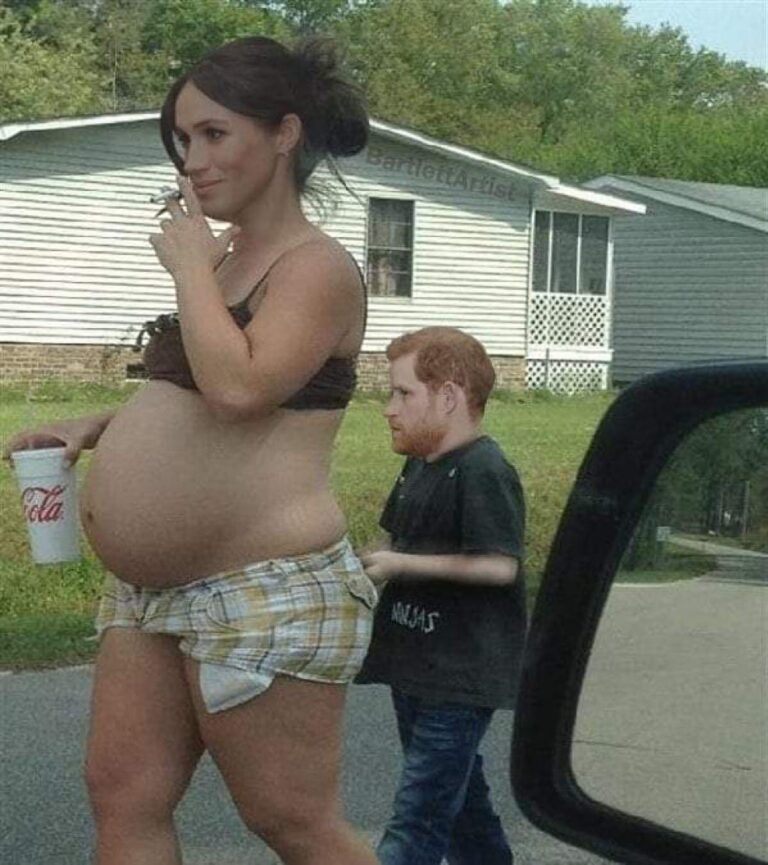
The attached and generated images above are not cruel. They are simply evidence. The hair tells a story the Sussexes’ carefully managed narrative cannot.
Harry and Meghan wanted the world to see them as modern, independent, and unfairly maligned. What the world increasingly sees instead is a couple defined by hypocrisy, selective outrage, and an apparent inability to accept that actions — including cruel words written in a bestselling memoir — have consequences.
The bald spot is just the part you can see from behind. The deeper emptiness is what lies beneath.