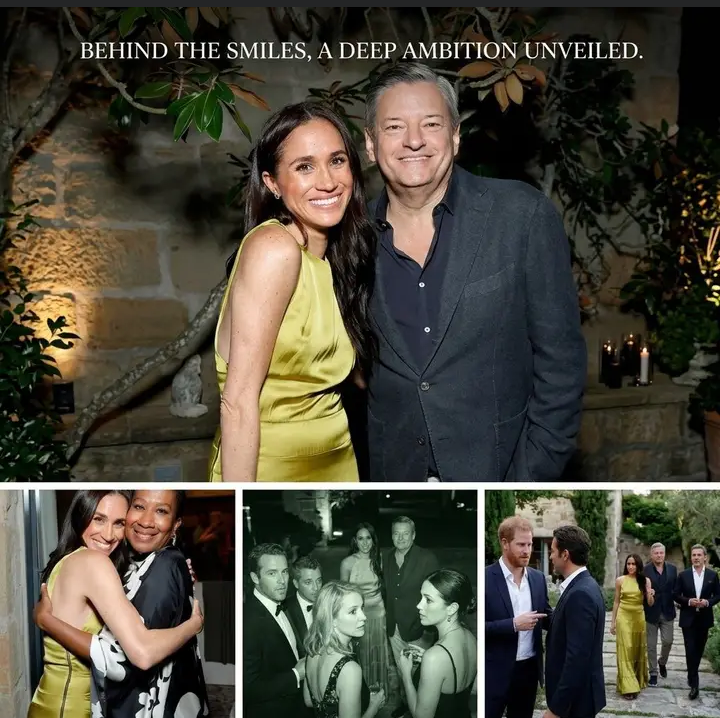
Meghan Markle’s appearance at the Beef Season 2 Netflix event has quickly become one of the most talked-about moments in recent celebrity news, not because of the show itself, but because of what unfolded the moment she arrived. What was supposed to be a polished, star-studded celebration reportedly turned into an evening filled with tension, whispers, and visible discomfort among attendees.
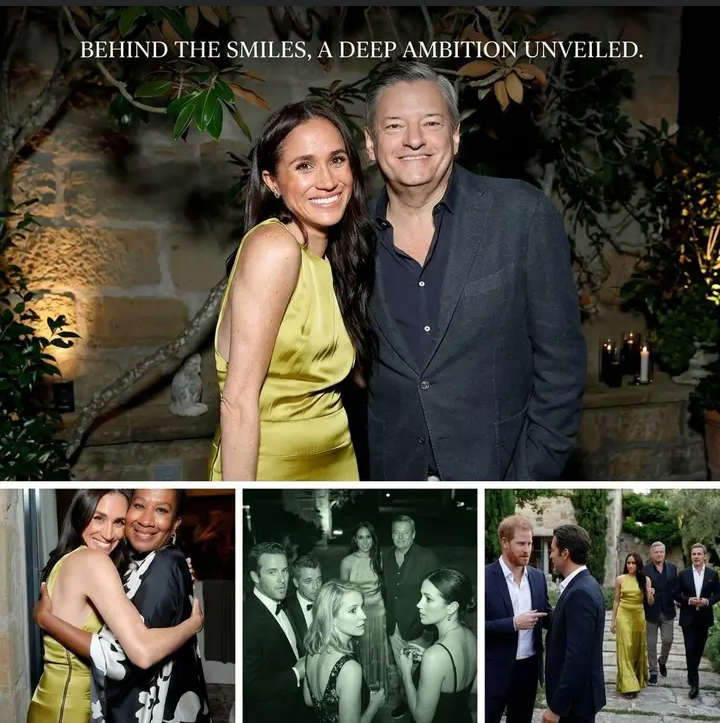
The Duke and Duchess of Sussex pose for a photo with Netflix boss Ted Sarandos and his wife Nicole Avant in Montecito on Friday night
According to accounts circulating after the event, Meghan’s entrance immediately drew attention—not unusual for a figure of her global recognition, but this time, the focus seemed to shift in a way that many present did not expect. The dress she chose, a bold and highly noticeable color, allegedly overlapped with the styling planned for the event’s leading actress, Carrie Mulligan. In Hollywood, where premieres are often carefully curated to ensure the spotlight remains on key stars, such a clash is rarely overlooked.
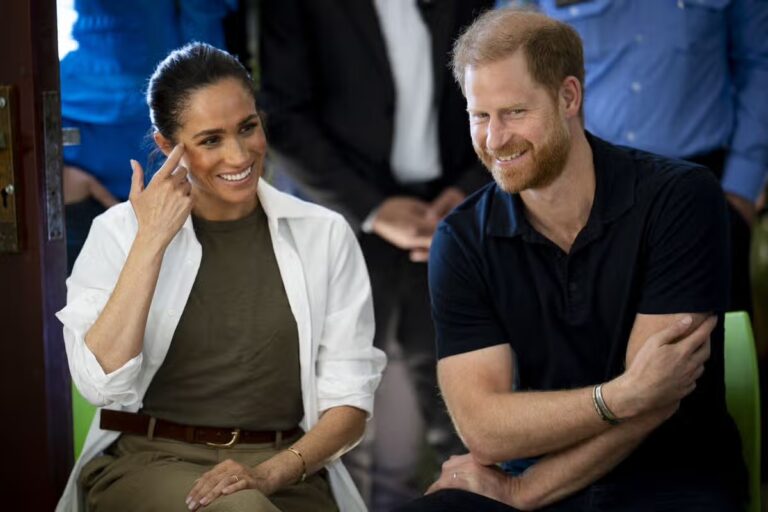
Meghan donned an olive green dress in a satin material while Nicole, 58, wore a black and white floral gown
Guests reportedly began exchanging glances almost instantly. Some were said to have quietly questioned whether the choice had been accidental, while others felt it was too precise to be a coincidence. One attendee, speaking informally, described the moment as “awkward in a way that’s hard to explain—like everyone suddenly realized something wasn’t quite right, but no one wanted to say it out loud.”
Riverdale star Charles Melton (right), Oscar Isaac (left) and British actress Carey Mulligan (centre) at the event
Meghan and Nicole embrace each other as they pose for a picture at the star-studded party
The situation quickly evolved into a broader conversation about Meghan’s public persona. For critics, the incident reinforced an existing narrative—that she often positions herself at the center of attention, even in settings where the focus is meant to be elsewhere. This perception, whether fair or not, has followed her since her transition from royal life to the entertainment industry, shaping how her actions are interpreted in high-profile environments.
Meghan, wearing an olive green dress and sandals, smiles for a photo with Netflix boss Ted Sarandos
What made the moment particularly sensitive was the context. This was not an event celebrating Meghan’s work, but rather a showcase for a successful Netflix production and its cast. In such settings, there is an unspoken understanding that guests align themselves with the tone and hierarchy of the evening. Deviating from that expectation, even subtly, can be perceived as disruptive. “There’s a code,” one entertainment journalist noted. “You don’t outshine the person the night is meant for—it’s just part of the culture.”
Orlando Bloom poses for a picture with Sarandos and his wife Nicole at the party
At the same time, not everyone agrees with the criticism. Supporters argue that Meghan’s style choices have always been bold and distinctive, and that expecting her to blend into the background contradicts the very nature of celebrity culture. They point out that attention is an inevitable part of attending such events, and that any high-profile figure would attract similar scrutiny under the same circumstances.
Sex and the City star John Corbett with Nicole Avant at the party on Friday night
Still, the incident comes at a time when Meghan and Prince Harry’s relationship with Hollywood appears increasingly fragile. Their initial deals with major platforms like Netflix generated enormous anticipation, but recent developments—including scaled-back projects and mixed audience reception—have led to questions about their long-term position in the industry. In this environment, even seemingly minor controversies can carry amplified consequences.
Observers have also highlighted how moments like this contribute to a cumulative effect. It is not necessarily one event, one outfit, or one interaction, but rather a pattern that shapes perception over time. Each appearance adds another layer to the public narrative, influencing how both industry insiders and audiences interpret future actions. As one media analyst explained, “In Hollywood, reputation isn’t built overnight—but it can be chipped away piece by piece.”
There is also a broader cultural dimension to the reaction. In an era where authenticity is highly valued, audiences are quick to question actions that appear overly calculated or out of sync with context. Whether Meghan’s choice was intentional or simply misjudged, the response reflects a growing sensitivity to how public figures navigate visibility and influence.
Interestingly, some voices within the industry have expressed a more measured perspective. They acknowledge that while the situation may have been awkward, it is far from unprecedented. Fashion missteps, overlapping styles, and unintended clashes happen regularly at major events. The difference, they suggest, lies in the level of attention Meghan attracts, which magnifies every detail beyond its usual significance.
Ultimately, the Beef Season 2 event has become less about the show itself and more about what it reveals regarding Meghan’s place in the entertainment world. For some, it confirms a narrative of overexposure and miscalculation. For others, it highlights the intense scrutiny she continues to face, regardless of intent.
As the dust settles, one thing remains clear: in Hollywood, perception can be as powerful as reality. And for Meghan Markle, every appearance—down to the color of a dress—has the potential to shape the story that follows.