Prince Harry and Meghan Markle touched down in Birmingham today after six years of “independence.” Hours later, her lifestyle brand pushed a new autumn spread on a country that still can’t even order it. Critics say the timing is not a homecoming. It’s a fire sale.
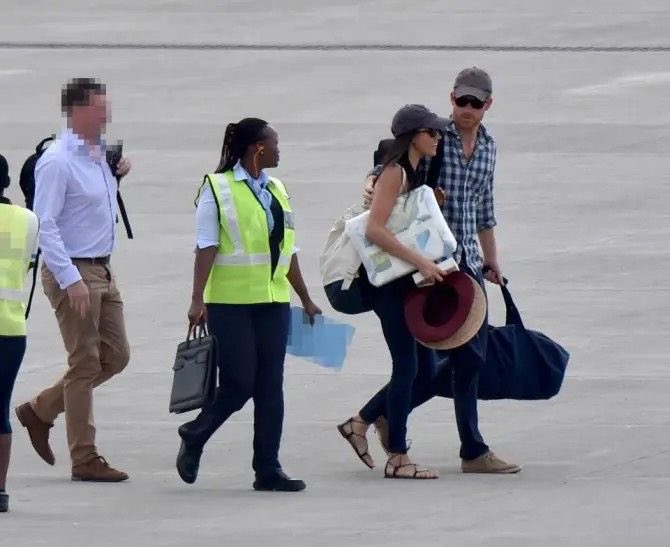
Prince Harry and Meghan Markle slipped back onto British soil on Wednesday, 26 August 2026, on a private jet into Birmingham Airport — no publicly funded police convoy, no palace welcome, and no working-royal role waiting for them.
They left in 2020 promising a new life of purpose and financial freedom. They have returned as non-working members of the family, children in tow, with a California mansion still on the books and a lifestyle label that has spent the last year drowning in unsold jam, collapsing web traffic, and a humiliating split from Netflix.
Hours after the wheels hit the tarmac, As Ever — Meghan’s food-and-homeware brand — announced a new seasonal product: Spiced Apple Butter, sold alone or in a trio. The caption invited shoppers to “Shop now at AsEver.com.”
That is the “grand entrance.” Not a speech. Not an apology. A pot of apple butter.
The product drop that looks like a panic button
The Sussexes’ UK return was only confirmed last week. Archie, 7, and Lilibet, 5, are due to start British schools next week. The family is expected to live in a private house outside London, widely tipped as the Cotswolds, while keeping the Montecito estate and a Portugal holiday home. They will not resume official royal duties.
Meghan’s brand did not wait for the school run. It treated the landing like a launch window.
For days beforehand, As Ever teased orchard footage of Meghan picking apples with the caption “A little hint of what’s coming.” Today the hint became a SKU.
The problem is not that a business owner launched a seasonal flavour. The problem is the context she hoped Britain would forget.
As Ever still built its catalogue around US shipping. Brand experts have said the UK was never the priority because Meghan no longer has the “star power” here to move flower sprinkles and celebrity rosé against shelves already packed with better-known names. One analysis put it bluntly: British shoppers do not need another influencer preserve.
So the Duchess lands in the country she spent years attacking through interviews, a Netflix series and her husband’s memoir — then asks that same country to celebrate a product many of them cannot buy from the official site.
That is not a homecoming. It is brand management.
Netflix did not “grow with her.” It cut the cord
In March 2026, Netflix ended its partnership with As Ever, barely eleven months after launch. Official statements were syrupy. Insiders were not.
A Netflix source told Page Six the cooking show “did not go on,” so the brand deal “did not make sense.” Other sources said the streamer put millions behind the venture and “never saw a return,” then “just cut a loss.” Unsold tea, baking mixes and spreads were reportedly handed back to Meghan after Netflix had already been giving product away to staff to clear space.
With Love, Meghan was supposed to turn her into the next Martha Stewart. Season two collapsed in the data. The brand that was meant to ride the show’s halo was left holding perishable stock.
The couple’s original 2020 Netflix pact was sold to the world as a $100 million proof that Megxit had paid off. That exclusive deal was later downgraded to a first-look arrangement. The consumer-products tie-up lasted seven months after the formal “extension.” Hollywood did not dump a winner. It walked away from a cost centre.
Meghan’s team called the split a planned graduation: the brand was “ready to stand on its own.” Independent businesses that are thriving do not usually inherit truckloads of leftover jam from their only major backer.
The inventory crisis they keep calling “speculation”
As Ever has never published audited sales, profit or sell-through. What has leaked is ugly.
Variety reported more than $10 million in unsold As Ever stock. A January website leak was even worse: hundreds of thousands of remaining units with a retail value put at around $21.8 million. Daily Mail analysis of jar counts found fruit-spread trios barely moving — tens of boxes a day against a warehouse that would still be stuffed when expiry dates hit next summer. Potential losses on the jams alone were put above $5 million, with flower sprinkles adding another chunk.
Website traffic told the same story. Newsweek, using Similarweb data, tracked a 33 percent drop in visits between January and April 2026, then a 46 percent fall across the first half of the year — from 268,000 visits in January to 145,000 in June.
That is not “rapid growth.” That is a brand cooling in public.
A spokesperson for As Ever has called bankruptcy rumours “entirely false and based on speculation.” Fair enough: excess stock is not the same as a court filing. But the denial does not erase the dates on the lids. Perishable goods do not wait for a duchess to finish her rebrand. If the jars expire unsold, the loss sits with her, not with Netflix.
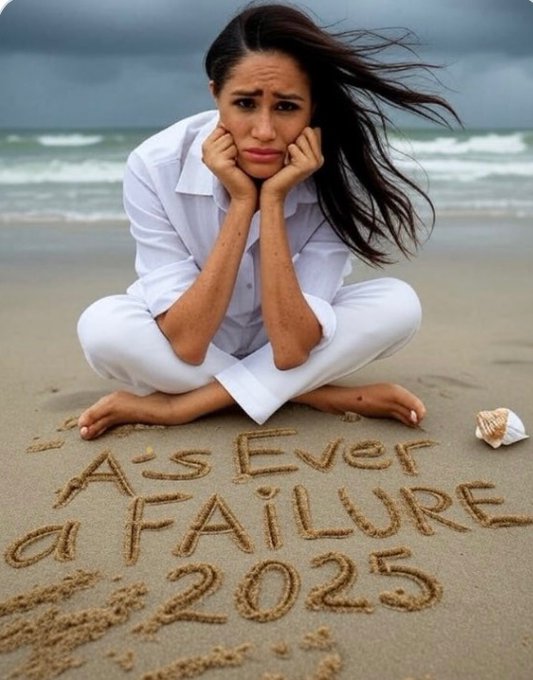
The viral image circulating today — Meghan on a grey beach, “As Ever a FAILURE 2025” scraped into the sand — is cruel. It is also the sentence her own numbers have been writing for months.
The tweet that set off today’s pile-on claimed she has “lost over $15 million so far” and that the company is “bankrupt.” Those specific figures have not been proven in filings. What has been reported, repeatedly, is eight-figure leftover inventory, a partner that wrote the project off, and a website audience in freefall. That is enough to make a new apple-butter drop look less like confidence and more like a clearance tactic dressed as autumn hygge.
Harry’s part in the mess
This is not only Meghan’s commercial problem. It is the bill for the story the couple sold in 2020.
They stepped back from royal duty, left Britain, and spent years monetising the rupture: a tell-all documentary, Spare, the Archewell brand, and a lifestyle series that treated Montecito as a moral high ground. Private security, staff and a sprawling California house do not come cheap. Reports have put annual running costs in the multimillion-dollar range, with security alone near $3 million a year. Staff was later cut. Archewell faced its own money headaches. Insiders have described the household as tight.
Harry wanted out of “the Firm.” He got a different firm: publicists, streamers, and a wife whose side hustle is now the family’s most visible commercial engine. The man who lectured the world about trauma and the press is now hitching his children’s first British school term to a jam launch.
If this return were about the children, the product email could have waited a week. It did not. That tells you which audience they still care about.
King Charles was only informed shortly before the move became public. There is no working-royal rehabilitation on offer. There is a private house, a school gate, and a brand that still speaks in California captions. Britain is being used as a backdrop. Again.
Britain already knows this routine
Meghan’s UK problem was never “the tabloids.” It was the pattern.
Leave the institution, then keep the titles. Denounce the monarchy, then fly home when Hollywood cools. Accuse the country of cruelty, then ask it to buy the merch. Launch a “values” brand that cannot, or will not, ship to the island she has just landed on.
Brand expert Nick Ede has argued the UK could theoretically be lucrative if the products felt connected to British growers and communities rather than Montecito mood boards. As Ever has not done that work. It has done another teaser video and another pot.
The couple will say the children need stability. Fine. Stability does not require a same-day SKU. Stability does not require treating Birmingham Airport like a pop-up shop. Stability does not require Harry standing silently beside a commercial project that Netflix already decided was not worth the warehouse space.
They wanted to be global celebrities, not working royals. Global celebrities live and die on whether anyone still wants what they are selling. Today’s evidence: a private arrival, a muted official line (“this is not something we would comment on”), and a jar of spiced apple butter aimed at a market that has heard this pitch before.
If As Ever were the roaring success the launch-day headlines claimed in 2025, Meghan would not need to bolt a product announcement to the one day Britain is forced to look at her again.
That is the story of this landing. Not a grand entrance. A soft landing on a hard balance sheet — and another attempt to make the public pay for it.