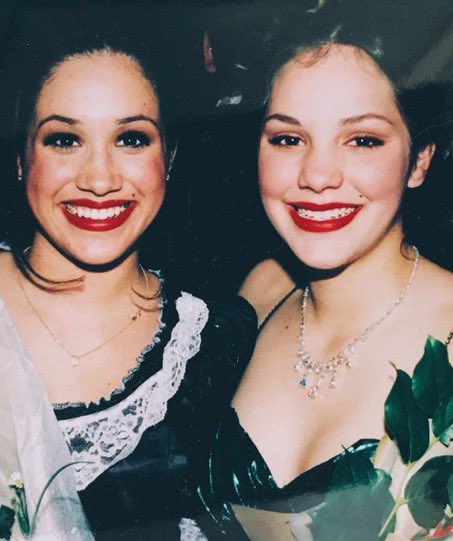
In a stunning revelation that lays bare the selective outrage and social-climbing tactics of Meghan Markle and Prince Harry, it has emerged that the Duchess of Sussex prioritized Hollywood A-listers over a real connection from her past when compiling the guest list for her 2018 royal wedding to Prince Harry.
Meghan Markle, who has repeatedly accused the British royal family and media of racism and bias related to her mixed-race heritage, invited Oprah Winfrey — a woman she had scarcely met, if at all — to a prime seat at St. George’s Chapel in Windsor Castle. Yet she failed to extend the same invitation to Katharine McPhee, the American Idol alum and actress with whom she performed in school musicals as theater kids in Los Angeles.
The throwback photo of young Meghan and Katharine, shared years ago by McPhee herself on Instagram, shows the two beaming in stage makeup and costumes after a school production. McPhee captioned it: “Meghan and I did musicals together as kids. She grew up to be the Duchess of Sussex and I grew up to star on the West End, so same life if you ask me.” They attended the same Catholic school, Immaculate Heart High School in Los Angeles (Meghan in high school while McPhee was in middle school; McPhee’s sister was in Meghan’s class). They were not exceptionally close as teenagers, according to McPhee’s own later comments, but the connection was real and longstanding.
Fast-forward to May 19, 2018. The guest list for Harry and Meghan’s wedding was packed with high-wattage celebrities: Oprah Winfrey (seated in prime real estate opposite the Queen), George and Amal Clooney (who reportedly told another guest they didn’t actually know the couple), Serena Williams, the Beckhams, Elton John, the Suits cast, and more. Royal author Tina Brown, in her book The Palace Papers, described these celebrity guests as “a portrait not of Meghan’s intimate circle but of the friends she most wanted to recruit.”
Oprah had barely crossed paths with Meghan beforehand — her primary link was hosting Meghan’s mother Doria Ragland for lunch. The Clooneys’ awkward admission that they didn’t know Harry or Meghan only underscored how transactional the invitations were.
Katharine McPhee? Nowhere on the lists. No mention in official accounts or detailed guest roundups. She and her husband, music producer David Foster, only reconnected meaningfully with the Sussexes after the couple left royal life. Foster later helped arrange temporary housing for Harry and Meghan in Canada, and McPhee has spoken warmly of the “father and son” bond between her husband and Harry. They have dined together and appeared at events in recent years, including a 2026 foundation gala. But when it counted most — the biggest day of Meghan’s life — the childhood theater pal was left off the gold-embossed invitation list.
The irony is glaring and damning. Meghan and Harry have built an entire public brand around claims of racism, isolation, and being mistreated because of skin color. Their 2021 Oprah interview was filled with vague, unsubstantiated allegations of “concerns” about their future child’s skin tone. Yet when it came to her own wedding, Meghan elevated a powerful Black media mogul she barely knew while freezing out a white childhood acquaintance from the same Los Angeles school stages.
Was the omission because of Katharine’s “skin tone”? The sarcastic suggestion circulating online highlights the selective nature of the Sussexes’ narrative. Meghan has shown a consistent pattern of prioritizing status, access, and useful connections over genuine long-term relationships. Childhood friends and even family members have been sidelined when they no longer fit the brand. Harry, for his part, has enabled and amplified every grievance, turning private family matters into global soap operas while benefiting financially from the fallout.
This is not about defending every royal tradition or denying that mixed-race individuals can face prejudice. It is about the sheer hypocrisy of a couple who lecture the world on authenticity, racism, and “doing the work” while their own actions — from the wedding guest list onward — reveal a calculated focus on celebrity recruitment and victimhood branding. Inviting Oprah helped cement alliances that later produced a high-profile interview and ongoing Hollywood proximity. Leaving out Katharine McPhee cost them nothing in terms of star power.
Years later, the Sussexes continue to cultivate select Hollywood relationships while complaining about the institution they voluntarily left. The school musical photo remains a quiet reminder: once upon a time, Meghan shared a stage with a girl who simply went on to build a successful career without demanding the world rearrange itself around her narrative. When the royal wedding invitations went out, that real (if casual) history was discarded in favor of A-list optics.
The public is right to call it out. Meghan Markle and Prince Harry’s pattern of selective memory, social climbing, and opportunistic claims of victimhood has worn thin. Preferring the powerful stranger over the old school friend speaks louder than any carefully staged interview about skin tone ever could.