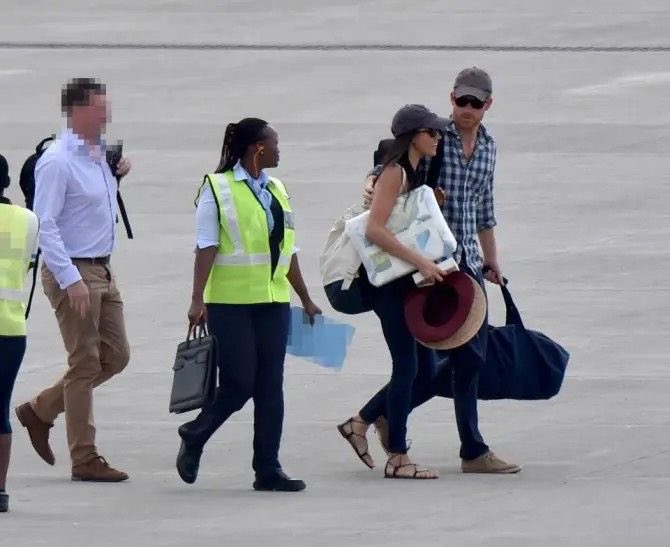
Prince Harry and Meghan Markle did not slip back into Britain quietly. They arrived on Wednesday, 26 August, at Birmingham Airport after an overnight transatlantic hop on a chartered Bombardier Global Express XRS — a refurbished long-range jet with two bathrooms, five beds and room for more than a dozen passengers — at an estimated $12,000 an hour. Ten hours in the air puts the bill in the region of $120,000.
That is not the behaviour of a family living on the edge. It is the behaviour of a wealthy couple who chose private luxury, brought the dogs, kept the California mansion, kept the Portugal holiday house — and then resumed a years-long campaign to make the British public pay for armed protection they forfeited when they walked away from royal duty.
They should pay for their own security. Full stop.
The arrival they want you to treat as a homecoming
The family landed around lunchtime on 26 August. Archie, 7, and Lilibet, 5, are expected to start school in Britain in September. Harry and Meghan will remain private, non-working members of the royal family. There is no return to official duties, no Sovereign Grant salary, and no restoration of the automatic police package that comes with working for the Crown.
They were not met by a taxpayer-funded police convoy. Private security collected them. That is the arrangement they accepted when they left in 2020. It is the arrangement they have spent years trying to overturn through the courts, through RAVEC, and through a relentless public-relations campaign that treats every refusal as proof of persecution.
The Prime Minister has called the funding question a “private matter.” The British public has been rather less polite. A YouGov poll found 71 per cent of respondents said the taxpayer should not pay a penny for Sussex security; only 2 per cent supported full public funding. A Daily Express reader poll was even blunter: 96 per cent said no.
Those numbers are not “hate.” They are a verdict on six years of entitlement.
Millionaires do not get to play paupers
The Sussexes bought their Montecito estate through a company for $14.65 million in June 2020. They still own it. Property taxes alone ran to about $149,668 in 2025. Add the mortgage and running costs and the California house is widely reported as a mid-six-figure annual burden — before staff, insurance and upkeep. They also keep a vacation property in Portugal. They are looking for a private base outside London, with speculation pointing to the Cotswolds.
That is three countries’ worth of property, elite private education, a lifestyle brand, leftover Hollywood deals, and a six-figure charter flight so the dogs could travel in comfort. A couple who can drop the price of a family home in much of Britain on a single overnight flight is not “scraping by.” They are choosing not to spend their own money on the one thing they keep demanding from everyone else: protection.
If you can afford the jet, the estate, the second home and the PR machine, you can afford private security. Other wealthy celebrities do it every day. Harry and Meghan already employ private teams. What they want is the state version — armed officers, intelligence access, the old IPP automatic status — because that bill lands on the public, here and, they hope, abroad.
Working royals such as Princess Anne and Prince Edward receive state protection when they are on official duty for the monarch and the country. Harry and Meghan do not perform that duty. They stepped away. They monetised the exit. They do not get to keep the perks of the job they quit.
The tax contrast they never mention
King Charles has published his tax figures. He paid £12.9 million in 2024–25 and more than £30 million since becoming king, placing him among the country’s highest taxpayers. Prince William paid £7.76 million in the same year. Both sit inside the working institution Harry left.
Harry and Meghan have not been contributing to the UK tax system as working royals for more than half a decade. They built a commercial life in California. That was their choice. It does not entitle them to reopen the public purse because life as private multimillionaires turned out to have invoices attached.
This week the invoices got larger. On 21 August a High Court judge ordered Harry and his fellow claimants to make an interim payment of £9.54 million by 28 August toward the Daily Mail publisher’s costs after their unlawful-information-gathering case was thrown out. Associated Newspapers’ total costs were put at about £34.5 million. The judge had already dismissed every claim. That is not a family being squeezed by the state. That is a litigant who lost, facing the bill.
Spending six figures to fly in while a multimillion-pound costs order falls due is not evidence of hardship. It is evidence of priorities.
The gaslight is the point
The Sussex narrative has always been the same: they are victims; the institution is cruel; the public is being misled; only automatic state security will keep the children safe. The facts sit awkwardly beside that story.
They left official life, then spent years briefing the press, sitting for Oprah, publishing Spare, and cutting Netflix deals that required the spotlight they claim to fear. They announce movements, then complain that movements create risk. They demand the privileges of senior royalty without the work, the tax contribution, or the discipline of working royals who only receive protection when they are on duty.
Private security in the United States can be armed. In Britain it generally cannot. That is a real operational difference. It is not a moral argument that the bus driver in Birmingham, the nurse in Leeds or the pensioner in Glasgow should cover the gap. If the King wants to see his son privately, he can pay for additional protection from his own considerable private means. That is a family question. It is not a taxpayer obligation.
Estimates that a full state package could run into the millions per year are precisely why the public has drawn a line. Armed protection is scarce. Britain already covers a record number of former prime ministers. Resources are not infinite. A couple who chose celebrity over service do not jump the queue because their publicists are good at framing refusal as cruelty.
They created the circus. They can pay for the ring fence.
Harry and Meghan are not being “forced out” of Britain. They flew here, enrolled the children, kept the American mansion, and immediately restarted the security argument. That is not caution. That is leverage. Brief the papers, land in luxury, then dare ministers to look heartless.
The honest position is simple. They are private citizens with royal titles, vast assets and a documented habit of turning every institutional boundary into a media campaign. They already have high-level private security. They refuse to treat that as the cost of the life they chose.
British taxpayers have paid enough. They should not fund a millionaire couple whose sense of entitlement has become everyone else’s problem. If Harry and Meghan want armed protection on these shores, they can write the cheque — or live more quietly, without the constant press choreography that they themselves generate.
No more gaslighting. No more half-in, half-out. They walked away from the job. They do not get to keep the bodyguards on the public tab.