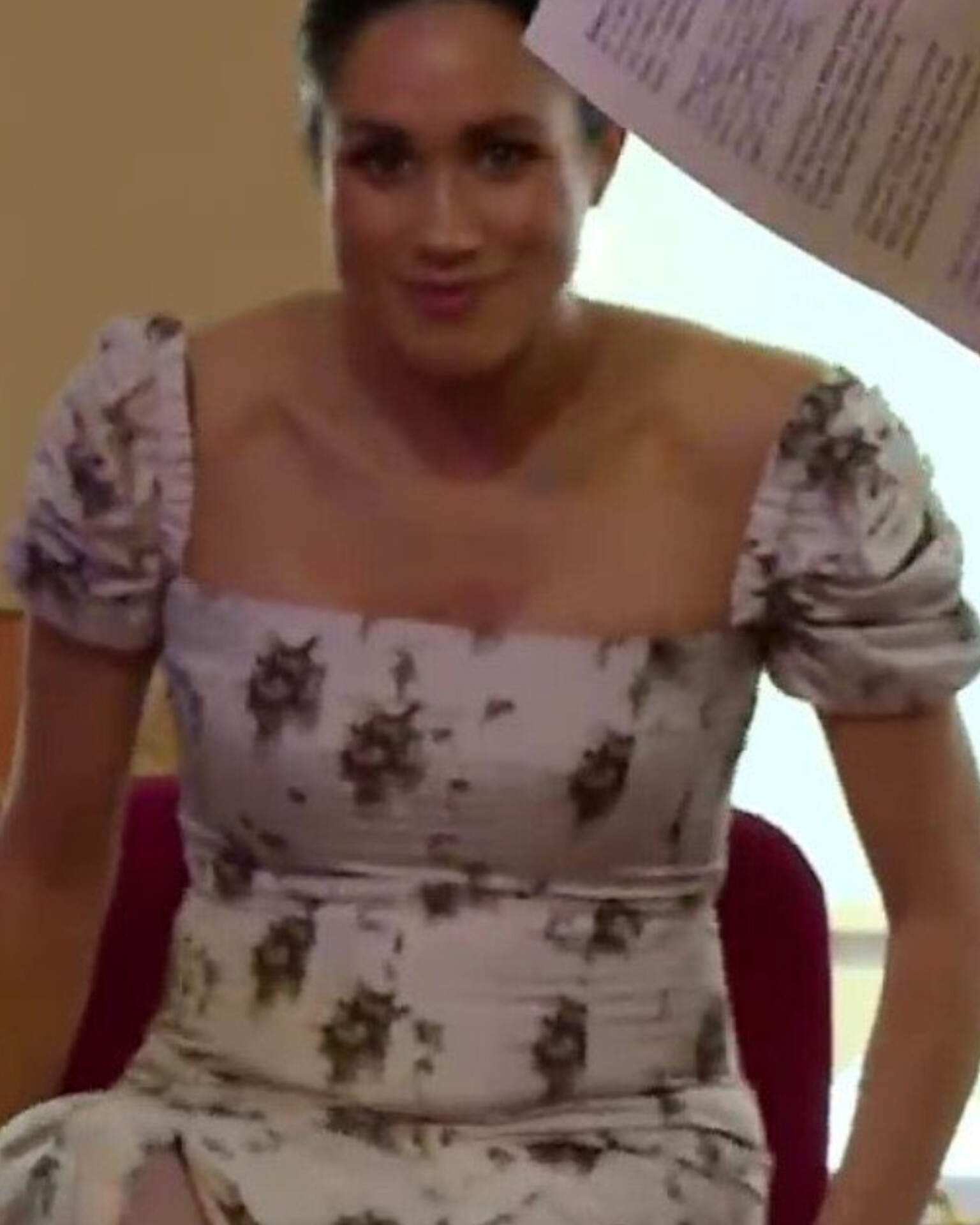
A still from Meghan Markle’s 18 December 2018 visit to Brinsworth House in Twickenham is back in circulation again: the Duchess of Sussex in a square-neck Brock Collection floral dress, seated, a sheet of paper drifting into the frame, a caption insisting the bump is “obviously fake” and that King Charles should treat it as fraud on the British taxpayer.
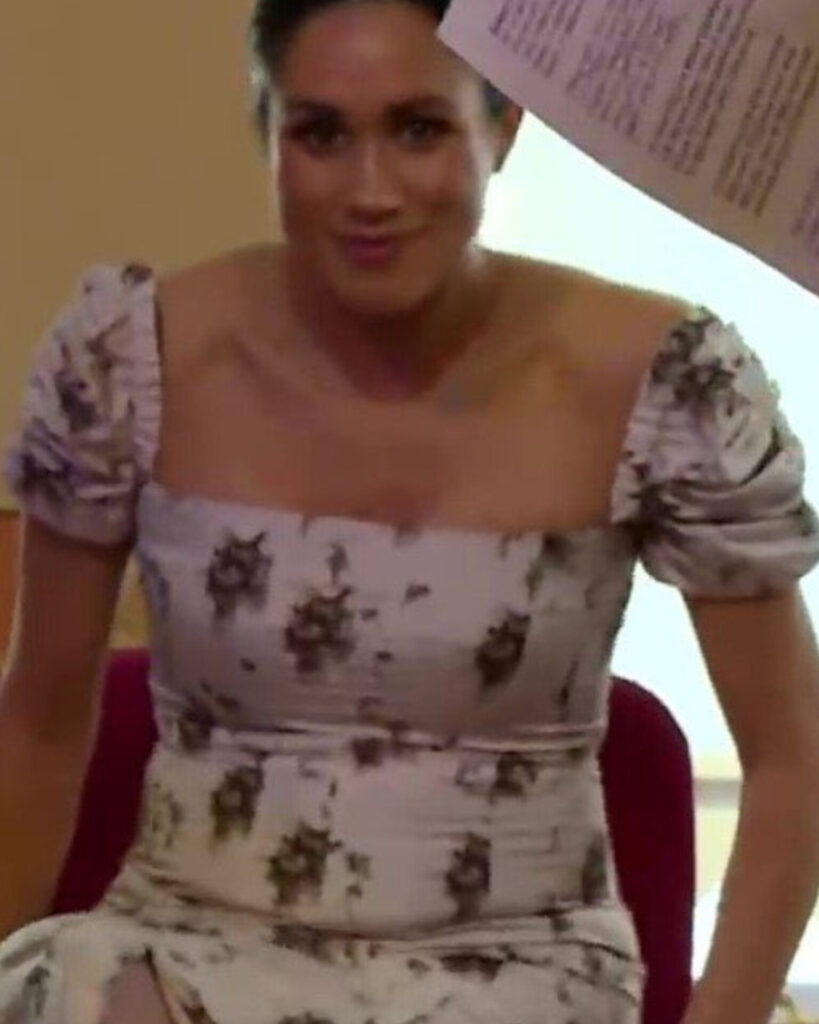
The visit itself is not in dispute. It was her last announced official engagement before Christmas. She met retired entertainers at the Royal Variety Charity home, made decorations, signed a bauble, and told a resident she was feeling “very good” and “very pregnant today,” putting her hands on her stomach. Contemporary coverage treated the dress as maternity-adjacent and the bump as real. The pregnancy had been announced on 15 October 2018. Archie Harrison Mountbatten-Windsor was born on 6 May 2019 at Portland Hospital. A birth certificate followed.
That is the official record. It has not stopped the theory. The reason is not a smoking-gun photo from a care-home crafts table. It is a pile-up of choices the Sussexes made around the birth, the money, and the exit — choices that left gaps the internet filled in.
A mid-pregnancy dress became a crime scene
By mid-December 2018 Meghan was months into a pregnancy due in spring. Mid-pregnancy does not look like late pregnancy. A fitted, paneled day dress on a seated woman will crease. Fabric will sit high or flatten depending on posture. That is ordinary physics. Online, it became “evidence.”
The same pattern repeated for years: a dress that moved while she walked, a bump that looked different from one angle to the next, later a hospital-room dance clip while pregnant with Lilibet. Critics called it a “moonbump.” Other mothers posted their own late-pregnancy photos and said the shape was unremarkable. Fact-checkers, including Reuters in 2021, rated the claim that she faked Archie’s pregnancy false. There is a live birth, a hospital, a certificate, and no documented prosthetic.
The theory did not need a prosthetic to survive. It needed distrust. Harry and Meghan supplied that themselves.
The birth they would not stage
Royal births in the modern era come with a ritual the public treats as proof of life: the mother, hours after delivery, on the hospital steps. Princess Anne started it at the Lindo Wing. Diana did it. Kate Middleton did it three times, once only hours after Louis was born.
Harry and Meghan refused the ritual. They did not disclose the hospital in real time. They did not appear on any steps. They went home to Frogmore Cottage and produced the baby two days later, inside St George’s Hall at Windsor Castle, Harry holding the child. Meghan later said on the Netflix series that she wanted her own doctor at Portland Hospital, that palace staff told her a Lindo-style photocall there was impossible because of the emergency entrance, and that the Windsor session was the agreed substitute.
Fair enough as a personal preference. As public communication it was a vacuum. A seventh-in-line baby is not a future king, but the family had spent a year selling the pregnancy as a national event. Then they treated the delivery like a private celebrity birth. People who already disliked Meghan read concealment. People who already liked her read autonomy. The middle ground — a couple who wanted control and underestimated how control looks like a cover-up — is less exciting, so it lost.
The announcement that arrived after the baby
The communications failure on the day itself was worse.
Archie was born at 05:26 on 6 May 2019. That afternoon, Kensington Palace put out word that the Duchess had gone into labour in the early hours — wording that landed more than eight hours after the birth. A second statement then confirmed a son. There were grammatical errors. Broadcasters were left scrambling. The palace blamed “technical difficulties.” Harry spoke outside Frogmore calling it “the most amazing experience.” The easel went up at Buckingham Palace. None of that repaired the sequence: the public was told she was in labour when, on the palace’s own later timeline, she was already a mother.
That is not proof of a surrogate. It is proof of a household that could not execute a birth announcement. Conspiracy culture does not require a perfect lie. It requires an official story that looks sloppy. Sloppy is what they delivered.
Then came the invoice
Six weeks after the birth, the royal accounts landed. Frogmore Cottage — five tired units knocked back into one official residence — had cost £2.4 million from the Sovereign Grant. The couple paid for most fixtures and fittings. The structural work, wiring, heating, and conversion sat on the public books. Officials said the building had already been due a renovation. That did not change the political picture: a newly minted duchess, a prince who had just broken with birth-week tradition, and a seven-figure refurb completed in time for the baby.
They later repaid the £2.4 million after stepping back from working-royal duties in 2020, and paid rent for a time. Repayment does not rewind the year in which the bill was public and the couple was still inside the firm. “Taxpayer” and “Sussex” fused in the same news cycle as the bump memes. The Brinsworth caption — Charles better address this FRAUD pulled on the UK taxpayer — is not an accounting argument. It is that fusion, years later, with a care-home still taped on top.
Megxit locked it in. They left official duties, took the Netflix and Spotify route, and then spent years in court over UK security. Harry argued the family could not safely return without police-level protection; he said he had offered to pay so as not to burden the taxpayer; the Home Office and the courts said stepping away from working-royal status changed the deal. Legal costs on the government side were reported in the hundreds of thousands. Polling has repeatedly shown little appetite for putting the family back on the public protection bill. Every new security headline restarts the same sentence: they wanted the privacy of private citizens and the armour of working royals.
That sentence is about status and money. Online it gets rewritten as: if they hide the birth and bill the state, what else did they hide?
What the theory actually feeds on
The fake-bump claim is a parasite. Its host is not obstetrics. It is a communications style that treated ordinary royal transparency as an insult.
A mid-pregnancy floral dress in December 2018 does not prove a costume department. A missing hospital-steps photo does not prove a rented infant. A late labour tweet does not prove a secret delivery weeks earlier. A Sovereign Grant line for Frogmore does not prove the child was a prop.
What those things did prove, to a hostile audience, was that Harry and Meghan would not play the old game and were not good at explaining the new one. They wanted the tour, the bump photos, the “very pregnant today” line in a nursing home — and then a locked-down birth, a delayed name, a castle photocall, and a refurbished grace-and-favour house. When they left the institution that had paid for the house, the same audience filed the whole era under one word: extraction.
That is why the Brinsworth still still travels. It is a convenient frame. The dress is doing what dresses do. The caption is doing what captions do when a couple has spent seven years teaching people not to take their official story at face value.
The documented story remains smaller and less cinematic: a real pregnancy, a real birth at Portland Hospital, a couple who broke the photocall tradition, bungled the timing of the announcement, spent public money on a cottage they soon vacated, repaid it after the row, and then fought the state over security they no longer automatically had. That record is messy enough. It does not require a fake bump to explain why so many people still want one.